Key takeaways
- Find the best travel projector for hotel rooms and movie nights on the go. Compare five portable mini projectors for brightness, battery life, and size.
A good travel projector turns a plain hotel wall into a cinema screen, a blank office wall into a presentation display, and a campsite tent into a movie night venue. The best models pack a bright picture, a built-in battery, and simple setup into a body small enough to slip into a carry-on bag.
Choosing the right one means balancing brightness, resolution, battery life, and weight. A dim projector looks washed out in a lit room, while a heavy one stays in the suitcase. The five portable projectors below cover the main trade-offs travelers face, from a pocket-sized pico model to a sharp 4K cube.
As an Amazon Associate, we earn from qualifying purchases.
Quick Answer
For most travelers, the Nebula Capsule 3 Laser is the best travel projector because it combines a sharp 1080p laser picture, a built-in battery, and a soda-can shape that fits easily in a bag. If you want the sharpest image, choose the LG CineBeam Q. For the smallest budget pick, the Kodak Luma 150 is hard to beat.
1. Nebula Capsule 3 Laser
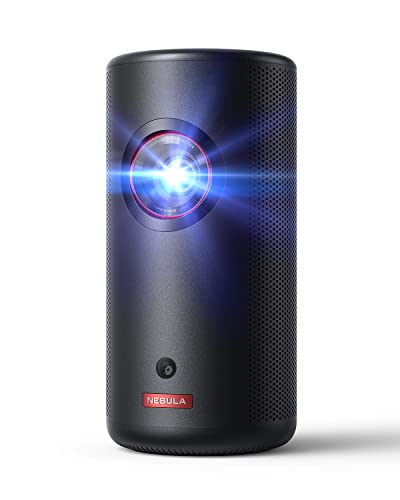
The Nebula Capsule 3 Laser is the most travel-friendly projector in this roundup. Its soda-can shape weighs about two pounds and slides into a bag beside a water bottle, yet it projects a 1080p picture up to 120 inches across. The laser light source delivers 300 ANSI lumens, which suits a darkened hotel room and evening viewing outdoors. Autofocus and auto keystone correction handle setup in seconds, so you can point the projector at a wall and start watching without fiddling with dials.
Android TV is built in, with Google Assistant and Chromecast support, so streaming apps and screen mirroring work without a separate stick. The 8W Dolby Digital speaker is surprisingly full for a unit this small, and Bluetooth lets you pair headphones or a portable speaker when you want quieter sound. A 52Wh battery runs for up to 2.5 hours in standard mode, which covers most films, and USB-C charging means a compatible power bank can top it up on the move.
Specs
- Resolution: 1920 x 1080
- Brightness: 300 ANSI lumens
- Light source: Laser
- Maximum screen size: 120 inches
- Battery life: Up to 2.5 hours in standard mode
- Weight: About 2 pounds
- Speaker: 8W Dolby Digital
- System: Android TV 11.0 with Google Assistant and Chromecast
- Connectivity: HDMI, USB-C, Bluetooth, Wi-Fi
- Tier: Premium
2. Samsung The Freestyle

Samsung The Freestyle takes a different approach to travel. Instead of a built-in battery, it uses a compact cylindrical body that can point at a wall, a ceiling, or even a tabletop, thanks to a cradle that tilts through a wide range of angles. That flexibility is handy in hotel rooms where the only clear surface might be above the bed. Auto focus, auto keystone, and auto leveling adjust the picture as you move the projector, so setup stays simple in an unfamiliar room.
The picture is Full HD at 1920 x 1080, with a maximum screen size of 100 inches and brightness rated at 550 lumens on the product page. Smart TV features are built in, so streaming apps run directly on the projector, and 360-degree sound fills a small room without an external speaker. The Freestyle weighs 1.8 pounds and measures about 4 inches wide by 7 inches tall. It runs from a USB-C power source rated at 50W or above, so plan on a wall outlet or a compatible external battery.
Specs
- Resolution: 1920 x 1080
- Brightness: 550 lumens
- Maximum screen size: 100 inches
- Weight: 1.8 pounds
- Dimensions: About 4 x 4 x 7 inches
- Sound: 360-degree sound
- System: Smart TV with built-in streaming apps
- Setup: Auto focus, auto keystone, and auto leveling
- Connectivity: Bluetooth, HDMI, USB-C
- Power: USB-C power source rated at 50W or above
- Tier: Mid-range
3. LG CineBeam Q HU710PB

The LG CineBeam Q HU710PB is the sharpest projector in this guide. It delivers true 4K resolution at 3840 x 2160 from a compact cube with a rotating handle, and its three-channel RGB laser produces vivid color across a wide gamut. Auto screen adjustment and auto focus correct distortion and sharpen the image when the projector is placed on a surface. The maximum screen size is 120 inches, so a hotel wall becomes a genuine home theater screen.
WebOS is built in, giving access to major streaming services, free channels, and screen sharing from a phone or laptop. Built-in speakers handle sound for casual viewing, while Bluetooth and HDMI cover headphones, soundbars, and laptops. One point to plan around is power: this model has no built-in battery and needs an external power source, so it works best in rooms with a handy outlet rather than in the middle of a field.
Specs
- Resolution: 3840 x 2160
- Brightness: 500 ANSI lumens
- Light source: Three-channel RGB laser
- Maximum screen size: 120 inches
- Color: Up to 154 percent of the DCI-P3 color gamut
- System: webOS with built-in streaming apps
- Setup: Auto screen adjustment and auto focus
- Connectivity: Bluetooth, HDMI, USB
- Power: External power source required, no built-in battery
- Tier: Premium
4. ViewSonic M1 Mini Plus

The ViewSonic M1 Mini Plus is a true pocket projector. It measures about 4 inches square and weighs well under a pound, so it fits in a jacket pocket, a purse, or a small daypack. The built-in smart stand doubles as a lens cover and props the projector at a useful angle, which helps when you are setting up on a nightstand or a tray table. Swappable color panels let you change the look of the unit, and a wrist strap keeps it secure while you carry it.
Picture quality is modest, with a native resolution of 854 x 480 and brightness of 120 LED lumens, so this model is best in a dark room and at smaller screen sizes, up to 100 inches at most. The built-in battery runs for up to 1.5 hours, and the projector can also run from a power bank. A JBL speaker with Bluetooth handles audio, and integrated Wi-Fi supports streaming. HDMI and USB-C connect laptops, phones, and media sticks.
Specs
- Native resolution: 854 x 480
- Brightness: 120 LED lumens
- Maximum screen size: 100 inches
- Battery life: Up to 1.5 hours
- Weight: About 0.66 pounds
- Dimensions: About 4.1 x 1.1 x 4.1 inches
- Speaker: Built-in JBL speaker with Bluetooth
- Connectivity: HDMI, USB-C, USB-A, Wi-Fi
- Built-in storage: 8GB
- Tier: Budget
5. Kodak Luma 150
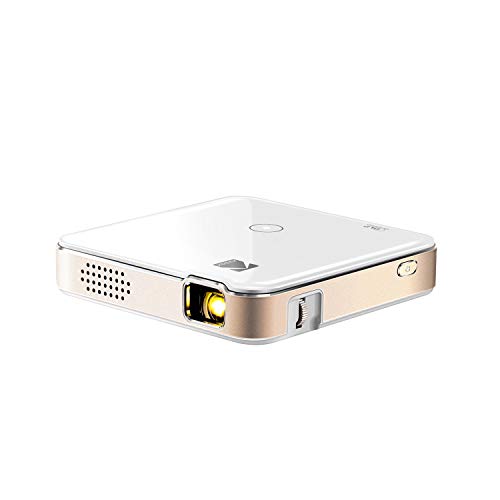
The Kodak Luma 150 is the smallest and simplest projector here. It is a pocket-sized DLP pico projector with a rechargeable battery, a built-in speaker, and a travel case in the box. The native resolution is 854 x 480 with support for 1080p input, and brightness is rated at 60 ANSI lumens, so it needs a dark room to look its best.
Battery life runs up to 2.5 hours, which is generous for a unit this small, and the projector connects through HDMI, USB, and a microSD card slot. AirPlay and Miracast screen casting work with phones for downloaded content, and the focus is manual, so you turn a small dial to sharpen the image. At under an inch thick and about 3.9 inches square, it takes up almost no space in a bag.
Specs
- Native resolution: 854 x 480 with 1080p input support
- Brightness: 60 ANSI lumens
- Maximum screen size: 150 inches
- Battery life: Up to 2.5 hours
- Speaker: Built-in 1.5W speaker
- Dimensions: About 3.9 x 3.9 x 0.89 inches
- Connectivity: HDMI, USB, microSD, AirPlay, Miracast
- Focus: Manual
- In the box: Travel case and HDMI cable
- Tier: Budget
How to Choose
Start with brightness and room light. In a dark hotel room, 60 to 120 lumens can work, but in a room with lamps on or curtains open, look for 300 lumens or more. Next, check the battery. A built-in battery frees you from hunting for outlets, and 2.5 hours covers most films. Resolution matters for text and fine detail: 1080p looks noticeably sharper than 480p, and 4K is the best choice when picture quality is the priority.
Weight and shape decide whether the projector actually travels with you. A soda-can or pocket model disappears into a bag, while a larger cube needs a dedicated pocket. HDMI covers laptops and media sticks, USB-C charging works with common travel chargers and power banks, and built-in streaming apps reduce the number of devices you must carry.
Who Should Skip
Skip a travel projector if you mostly watch in bright daylight, because even the brightest portable models struggle against sunlight and need a darkened room to shine. Skip one if you need a large, bright image for a group presentation in a lit conference room, where a full-size office projector is a better tool.
If you never watch films away from home and only need a screen for occasional slides, a portable monitor or a larger tablet may be simpler and lighter. A travel projector earns its place in a bag when you regularly want a big screen in hotels, rentals, or outdoor evenings and you are willing to dim the lights to get it.
Frequently Asked Questions
Do travel projectors need a dark room?
Most travel projectors look best in a dark or dim room. Brighter models with 300 lumens or more cope better with some ambient light, while dimmer pocket models need the lights off and the curtains drawn.
How long does the battery last on a travel projector?
Battery life varies by model and brightness setting. The projectors in this guide run from up to 1.5 hours to up to 2.5 hours on a charge, and models with USB-C charging can often run from a compatible power bank.
Can I use a travel projector with my phone?
Yes, in most cases. Many travel projectors support screen mirroring, casting, or a direct wired connection through HDMI or USB-C. Some models also run streaming apps directly, so you can watch without connecting a phone at all.
What should I pack with a travel projector?
Pack the charging cable, a small tripod or stand if the projector has a tripod mount, and a short HDMI cable for laptops and media sticks. A soft pouch protects the lens in a bag, and a compact Bluetooth speaker improves sound in larger rooms.
Final Verdict
The best travel projector depends on how you travel, but the Nebula Capsule 3 Laser is the strongest all-round choice, pairing a bright 1080p laser picture with a built-in battery and a genuinely pocketable shape. The LG CineBeam Q wins on picture quality for hotel stays with an outlet nearby, while Samsung The Freestyle wins on flexible placement. For the lightest possible kit, the ViewSonic M1 Mini Plus and the Kodak Luma 150 both slip into a pocket and still deliver a big screen in a dark room.