Key takeaways
- Compare five verified wine openers for home use: a double-hinged waiter's corkscrew, a wing model, a vertical lever, and two cordless electric openers.
Opening a bottle of wine should take a few seconds, not turn into a wrestling match at the table. The difference usually comes down to the mechanism: a folding waiter’s corkscrew rewards a little technique, a wing corkscrew trades that technique for leverage, a lever model does the pulling in one stroke, and an electric opener replaces the whole motion with a button. Picking the right style matters more than picking a particular brand.
This guide compares five verified wine openers sold on Amazon, one or two for each main style home hosts actually use. Every pick below lists only specifications confirmed from its listing or manufacturer record, and every model is different from the openers covered in our sister site’s guide. Note: these are ordinary kitchen tools with sharp worms and small blades, not safety devices, so keep fingers clear of the point and blade and follow each maker’s instructions.
As an Amazon Associate, we earn from qualifying purchases.
Quick answer
For most home hosts, a double-hinged waiter’s corkscrew like the Barvivo is the best default: compact, fully manual, and easy to control once the two-step pull clicks. Beginners who want leverage without technique should look at the Beneno wing corkscrew, while the OXO vertical lever and the Oster and Cuisinart electrics suit anyone who would rather let a mechanism or a motor do the pulling.
How to choose
Start with the mechanism, because it decides how an opener feels in use. A waiter’s corkscrew is the folding pocket-style tool servers carry: you trim the foil with a small blade, twist the worm into the cork by hand, and lever the cork out against the bottle lip in two stages. It is the smallest option and gives you the most control, but it asks for a steady hand and a little practice. A wing corkscrew centers itself over the neck; turning the top knob drives the worm down while two arms rise, and pressing those arms down lifts the cork with leverage instead of wrist strength.
Lever corkscrews move the effort into one stroke. You clamp or hold the unit on the bottle neck, push a lever to drive the worm in, and pull it back to extract the cork. They are quick and consistent, but larger, so they tend to live on a counter or in a bar drawer. Electric openers remove the effort almost entirely: set the unit over the neck, hold the bottle steady, and press a button while a motor drives the worm in and draws the cork up. They suit frequent hosts and anyone with limited hand strength, at the cost of charging and counter space.
Whatever the style, look at the worm next. An open helix with a sharp, centered tip grips the cork’s core, and a non-stick or grooved surface helps the worm travel in and release the cork afterward. Foil cutting matters too: an integrated serrated blade or a separate cutter both beat peeling foil by hand. Finally, weigh materials and extras. Stainless steel resists bending, die-cast zinc adds leverage, rosewood handles add grip comfort, and extras such as a spare spiral or a charging base matter if you open bottles every week.
Barvivo Professional Waiter’s Corkscrew

The Barvivo follows the classic sommelier pattern with a natural rosewood handle and a stainless steel frame. Its fulcrum is double-hinged, so the boot lever braces on the bottle lip at one notch and then at the second, lifting the cork in two controlled stages rather than one hard pull. Per Barvivo, the steel is 430 grade stainless, and the worm uses a grooved double-helix design intended to track through the center of the cork.
The rest of the tool kit folds into the same slim frame. A long, rounded serrated blade trims foil capsules, and a cap remover at the end handles crown-capped bottles, so one tool covers both wine and beer at a home bar. At about 4.7 inches long closed, it stores in a drawer or apron pocket, and the rosewood gives it a warmer look and a rounded grip compared with all-metal wine keys.
Specs
- Type: Waiter’s corkscrew (manual, double-hinged)
- Material: Stainless steel with natural rosewood handle, per Barvivo
- Mechanism: Double-hinged fulcrum, two-step cork extraction
- Worm: Grooved double-helix design, per Barvivo
- Foil cutter: Integrated serrated blade
- Extras: Built-in cap remover
- Dimensions: About 4.7 inches long closed
Beneno Zinc Alloy Premium Wing Corkscrew
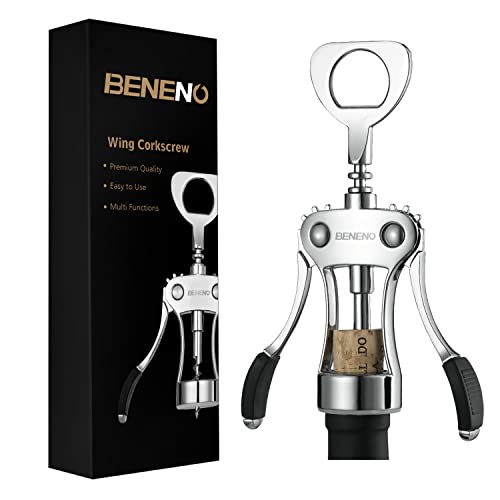
The Beneno is the beginner-friendly pick in this group. A wing corkscrew needs no technique beyond alignment: set the bell over the bottle neck, twist the top handle so the worm drives into the cork while the two wings rise, then press both wings down and the leverage of the arms lifts the cork out. Because the force comes from the arms rather than your wrist, the motion is easy to learn on the first bottle.
Per Beneno, the body is zinc alloy rather than thin stamped metal, which gives this model more heft than basic wing openers, and the wing handles carry a non-slip grip surface. The top handle doubles as a bottle opener for crown caps. There is no separate foil cutter in the box, so plan on trimming capsules with a kitchen knife or a standalone cutter. It is a countertop or drawer tool, not a pocket one, and the listed weight is 8.8 ounces.
Specs
- Type: Wing corkscrew (manual)
- Material: Zinc alloy body with alloy steel parts, per Beneno
- Mechanism: Twist knob drives worm; twin wings lever the cork out
- Extras: Bottle opener built into the top handle; non-slip wing grips
- Weight: 8.8 ounces, per the listing
- Model: 1O3SR
- Finish: Silver
OXO Steel Vertical Lever Corkscrew
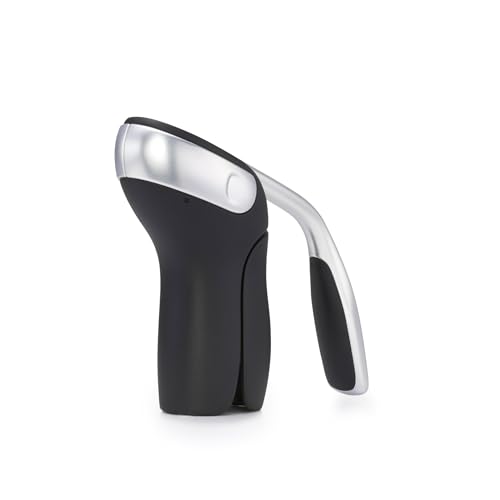
OXO’s vertical lever design shrinks the lever corkscrew idea into a compact countertop tool. Per OXO, you place the opener on the bottle, squeeze the handles to grip the neck, then pull the lever down and up: two motions drive the worm in and extract the cork, with no twisting at all. The die-cast zinc handle has a soft non-slip grip, and OXO lists the opener for both natural and synthetic corks.
The details are tidy. The non-stick screw releases the cork with a further push of the lever, a spare screw is included in the box for when the first one eventually wears, and the removable foil cutter stores on the opener itself so it does not wander off in a drawer. At roughly 7.6 inches tall it needs counter or deep-drawer space, and it is the heaviest manual tool here, but for hosts who open bottles weekly it is the fastest manual routine in this guide.
Specs
- Type: Vertical lever corkscrew (manual)
- Material: Die-cast zinc handle with non-slip grip, per OXO
- Mechanism: Squeeze handles on neck; lever down and up to extract
- Worm: Non-stick coated; spare screw included
- Foil cutter: Removable, stores on the opener
- Dimensions: 2.5 x 7.6 x 7.2 inches, per the listing
- Model: 11147600
Oster Cordless Electric Wine Opener (FPSTBW8207)

The Oster is the long-running budget-friendly electric design. You set it over the bottle neck, hold the bottle steady, and press the button: per Oster, the motor drives the worm into the cork and draws the cork up into the unit, and pressing the reverse direction releases the cork from the worm. There is no twisting, pulling, or leverage to learn, which makes it a sensible pick for anyone whose hands tire quickly.
The opener is cordless and sits on a recharging base between uses, so it stays ready on the counter rather than in a drawer. A foil cutter is included in the box. The trade-offs are the usual electric ones: it is the tallest style of tool in this guide, it needs its base and an outlet, and like any rechargeable device it should be returned to the base after a party rather than left uncharged for months.
Specs
- Type: Electric corkscrew (cordless)
- Power: Built-in rechargeable battery; charging base included, per Oster
- Operation: Push-button cork removal and release
- Foil cutter: Included
- Finish: Silver
- Model: FPSTBW8207-S-AMZ
Cuisinart CWO-25 Electric Wine Opener

The Cuisinart CWO-25 takes the same push-button idea and wraps it in a stainless steel body with a more appliance-like feel. Operation uses separate buttons for removing the cork and ejecting it from the worm, and per Cuisinart the internal NiMH battery pack is rated to open up to 50 bottles on a single charge, which suits households that entertain often. The unit recharges on its base, and a foil cutter is included.
Cuisinart lists the opener for both natural and synthetic corks. It is a countertop appliance in size, at about 10 inches tall, so it needs a home next to the outlet like the Oster. Between the two electrics here, the Oster is the simpler, lighter design, while the Cuisinart adds the longer maker-rated run time per charge and the stainless finish. As with any rechargeable tool, following the maker’s charging guidance keeps the battery in good shape.
Specs
- Type: Electric corkscrew (cordless)
- Material: Stainless steel body, per Cuisinart
- Power: NiMH rechargeable battery pack; up to 50 bottles per charge, per Cuisinart
- Operation: Separate remove and eject buttons
- Foil cutter: Included
- Dimensions: About 3.5 x 4.75 x 10 inches, per the listing
- Model: CWO-25
Who it’s for / who should skip
These five openers suit home hosts who open cork-sealed bottles regularly and want a tool matched to their hand strength and habits. Choose the Barvivo if you want one compact tool for wine and bottled beer, the Beneno if you are new to corkscrews and want leverage to do the work, the OXO lever if you open bottles weekly and value speed, and either electric if grip strength or convenience is the priority.
Skip this whole category if your wine mostly comes in screw caps or boxes, since none of these tools adds anything there. Collectors opening very old, fragile corks should also look elsewhere: delicate vintage corks are usually handled with two-prong pullers or specialty tools rather than the worms in this guide. And if you almost never open wine, a basic opener borrowed from a kitchen drawer will do; there is no need to give counter space to a charging base.
Comparison
The five picks split by how much work they ask from you. The Barvivo is the smallest and most portable, with a two-stage pull and a rosewood handle. The Beneno wing model is the easiest manual motion to learn, though it lacks a foil cutter. The OXO vertical lever is the fastest manual option, with a spare non-stick screw and a foil cutter that stores on the tool, at the cost of size and weight. The two electrics ask the least of your hands: the Oster keeps things simple with one-button operation and a charging base, while the Cuisinart adds a stainless body and a maker-rated 50 bottles per charge. Manual tools never need charging and store anywhere; electrics trade that freedom for push-button ease.
FAQ
Which wine opener is easiest for beginners?
The Beneno wing corkscrew and the two electric openers are the most forgiving starting points. The wing model only asks you to twist a knob and press two arms down, while the Oster and Cuisinart replace both motions with button presses. A waiter’s corkscrew like the Barvivo is simple too, but its two-stage pull takes a bottle or two of practice.
Do these openers work on synthetic corks?
Yes, with the right expectations. OXO lists its vertical lever for natural and synthetic corks, Cuisinart lists the CWO-25 for both types, and Barvivo describes its grooved worm as suitable for natural and synthetic closures. With any style, keep the worm centered and vertical so it grips the cork’s core rather than skating off the side.
How do I keep a cork from breaking?
Makers generally give the same guidance: cut the foil cleanly first, start the worm at the exact center of the cork, and keep it vertical as it goes in. On a waiter’s corkscrew, use both hinge steps so the cork leaves in stages, and on older bottles pull slowly near the end, when the cork is most fragile. No opener can guarantee an intact cork, especially on aged bottles.
Do the electric openers need special batteries?
No. Both the Oster and the Cuisinart use built-in rechargeable battery packs and recharge on their included bases, so there are no disposable cells to buy. Cuisinart rates the CWO-25 at up to 50 bottles per charge. Leaving either unit on its base between uses keeps it ready for the next bottle.
Final verdict
For most home bars, the Barvivo waiter’s corkscrew is the best default: it is compact, fully manual, and covers foil, corks, and crown caps in one folding tool. If you would rather skip the technique, the Beneno wing corkscrew offers the gentlest learning curve among the manual picks, and the OXO vertical lever is the fastest manual routine for frequent hosts. If effort is the deciding factor, the Oster keeps electric opening simple, while the Cuisinart CWO-25 adds a stainless body and the longest maker-rated run time per charge in this group.
Product and ASIN Reference
| Product | ASIN |
|---|---|
| Barvivo Professional Waiter’s Corkscrew | B00YGZ7P7G |
| Beneno Zinc Alloy Premium Wing Corkscrew | B07YBVR46Y |
| OXO Steel Vertical Lever Corkscrew | B01DP8Q5BG |
| Oster Cordless Electric Wine Opener (FPSTBW8207) | B003YFI0O6 |
| Cuisinart CWO-25 Electric Wine Opener | B01IA3H6ZA |