Key takeaways
- Looking for the best bike for under 3000? We compare five electric bikes on motor power, battery, range, brakes and certification to help you choose well.
Introduction
Finding the best bike for under 3000 is less about chasing the highest number on a specification sheet and more about matching a bike to the riding you will actually do. This budget tier sits in a useful place: it is high enough to buy a well-equipped electric bike with a proper battery, hydraulic brakes and a certified electrical system, yet it still rewards careful shopping, because the difference between a good e-bike and a disappointing one at this level comes down to components, not branding.


The quick answer is that a folding commuter such as the Lectric XP 3.0 Step-Thru is the strongest all-round choice for most riders, thanks to its step-thru frame, hydraulic brakes and flexible battery options. If you want the simplest full-size commuter, the Jasion EB5 and the ANCHEER 26-inch commuter cover everyday riding with far less bulk. Riders who face sand, snow or rough tracks should look at the fat-tire Engwe EP-2 Pro, while the Gotrax R2 suits anyone who needs a compact folder for a mixed commute. Every pick below is an electric bike, because that is where this budget tier buys the most capability.
This guide explains what to check before you buy, compares the five picks side by side, and flags the specification traps that catch first-time buyers.
Quick Picks
Our Short List of 3
- Motor: 500W brushless motor
- Battery: 48V 10.4Ah removable
- Claimed range: Up to 55 miles pedal-assisted, around 22 miles throttle only
- Top speed: 20 mph
- Motor: 500W peak brushless motor
- Battery: 360Wh removable
- Claimed range: Up to 40 miles
- Top speed: 20 mph

- Motor: 350W brushless motor
- Battery: 48V 10.4Ah removable, 500Wh
- Claimed range: Up to 60 miles in pedal-assist mode
- Certification: UL 2849
All 3 Picks at a Glance
| Product | Specs | Action |
|---|---|---|
| 2. Gotrax R2 (B0C99GY4MS) |
| Check price on Amazon |
| 3. Jasion EB5 (B09L63HGDP) |
| Check price on Amazon |
| 5. ANCHEER 26-Inch Commuter (B0C8HYXBSG) |
| Check price on Amazon |
How to Choose
Motor Power and the 750W Line
Motor power shapes how a bike climbs and how it pulls away from a stop. A 350W motor handles flat streets and gentle slopes with pedalling help, while a 500W motor copes better with hills, heavier riders and loaded panniers. A 750W motor adds still more pulling power, which matters on steep ground and soft surfaces such as sand or snow. In the United States, 750W is also a familiar legal line: many state rules treat bikes at or below that figure as bicycles rather than motor vehicles. Read the listing carefully, because sellers sometimes advertise a peak figure in the title and a lower continuous figure in the specification table. The number that matters for everyday riding is the continuous rating, and a peak figure on its own tells you little about how the bike behaves on a long climb.
Battery Size and Honest Range
Battery size decides how far you can ride, and it is measured in watt-hours, a figure that combines voltage and capacity into one comparable number. A 360Wh battery suits short commutes of a few miles each way, while a 500Wh battery covers longer daily rides with more margin. Larger packs add weight and bulk, so there is a real trade-off between range and portability. Claimed range figures are optimistic by design: they assume a light rider, flat ground, low assist and mild weather. A useful rule is to expect roughly half to two-thirds of the claimed figure in ordinary riding, less again in cold weather or on hilly ground. A removable battery is worth seeking out, because it lets you charge indoors and take the most expensive part of the bike inside at night.
Frame Style: Step-Thru, Folding, or Full-Size
Frame style decides how easy the bike is to mount, store and carry. A step-thru frame has a low top tube, so you can step through rather than swing a leg over the saddle, which helps riders with stiff knees and anyone who mounts and dismounts often. A folding frame collapses for a car boot, a closet or a train, which suits commuters with limited storage and riders who mix cycling with public transport. The trade-off is weight and complexity: folding bikes are heavy to carry, and the hinge adds a part that needs occasional attention. A full-size frame with 26-inch wheels rides more steadily than a folder and rolls over rough roads with less fuss. Think about where the bike will live overnight, because a bike that is hard to store is a bike that gets ridden less.
Brakes and Gears
Brakes matter more on an e-bike than on an ordinary bicycle, because the bike is heavier and travels faster, so the stopping system has to handle more momentum. Hydraulic disc brakes give stronger stopping power with less hand effort and a smoother feel at the lever. Mechanical disc brakes use a cable, are simpler to adjust with basic tools, and still outperform rim brakes in rain, mud and dust, because the braking surface sits at the hub rather than on the rim. Either type works for flat commuting, but hydraulic brakes are worth prioritising if your route includes long descents or heavy loads. Gears matter too: a 7-speed or 8-speed drivetrain covers gentle hills and lets you pedal comfortably when the battery runs low.
Safety Certification and Battery Care
Battery safety deserves real attention, because a lithium-ion battery holds a large amount of energy in a small package. Look for a UL 2849 certification, which covers the electrical system of the bike as a whole, or a UL 2271 certification for the battery pack itself. A certified system has been checked against recognised safety standards. Beyond certification, daily habits matter: charge the battery in a dry place away from flammable material, use only the charger supplied with the bike, and avoid leaving the battery fully drained for weeks. If a battery is damaged, swollen or smells unusual, stop using it and seek advice from the seller or a bike shop.
Warranty, Parts, and Local Service
An e-bike is a machine with a motor, a battery, a controller and a display, and any of those parts can fail. Before buying, check how long the warranty lasts, what it covers, and who handles claims. A brand that sells through bike shops gives you a local place to take the bike for assembly and repairs, which matters for a machine that still needs its brakes, gears and bolts checked. A direct-to-consumer brand can give you more bike for the same outlay, but you may be the one doing the assembly and the fault-finding. Check whether common wear parts such as brake pads, chains and tires are standard sizes that any shop can supply.
The Best best bike for under 3000 Reviewed
1. Lectric XP 3.0 Step-Thru (B0CVZG2BM5)
Lectric is the best-known direct-to-consumer e-bike brand in the United States, and the XP 3.0 Step-Thru is its most versatile folding model. The low step-thru frame makes mounting easy, and the frame folds in half for a car boot or a closet. A 500W hub motor with 1000W peak output and 55Nm of torque gives strong starts and confident hill climbing, while the 48V battery gives up to 45 miles of range in standard form and up to 65 miles with the long-range battery option. Hydraulic disc brakes with 180mm rotors give confident stopping power in wet weather, a genuine advantage at this level, where many rivals still use cable brakes. The bike is heavy at around 64 lb, so carrying it upstairs is hard work. One flag belongs with this pick: the XP 3.0 reaches 28 mph with pedal assist in Class 3 mode, which exceeds the 20 mph limit that applies to e-bikes in many US states, while the throttle alone is limited to 20 mph.
- Motor: 500W hub motor, 1000W peak, 55Nm torque
- Battery: 48V lithium-ion, standard or long-range options
- Claimed range: Up to 45 miles standard, up to 65 miles long-range
- Brakes: Hydraulic disc brakes with 180mm rotors
- Check on Amazon
2. Gotrax R2 (B0C99GY4MS)
- Motor: 500W brushless motor
- Battery: 48V 10.4Ah removable
- Claimed range: Up to 55 miles pedal-assisted, around 22 miles throttle only
- Top speed: 20 mph
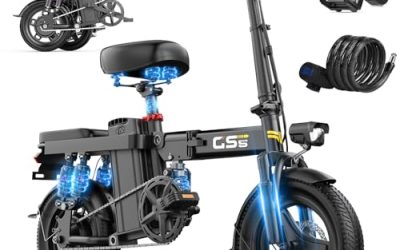
Gotrax began with scooters and has become a familiar name for affordable electric rides, and the R2 is its folding e-bike for commuters who want a compact bike without a premium badge. A 500W brushless motor and a 48V 10.4Ah battery give a claimed 55 miles of pedal-assisted range or around 22 miles on throttle alone, with a top speed of 20 mph that sits inside the usual e-bike limits. The 20-inch folding frame, Shimano 7-speed drivetrain, front suspension, and LCD display with five assist levels cover the essentials for a daily ride, and the removable battery charges on or off the bike. The R2 is a step up from the cheapest folders, but 20-inch wheels are less steady than 26-inch wheels on rough paths, so it suits smooth streets and paved trails better than broken ground. One caution: Gotrax sells some Amazon-only versions with small specification differences, so compare the specification sheet on the exact listing itself before ordering.
3. Jasion EB5 (B09L63HGDP)
- Motor: 500W peak brushless motor
- Battery: 360Wh removable
- Claimed range: Up to 40 miles
- Top speed: 20 mph
Jasion is a budget-first brand, and the EB5 is its full-size commuter for riders who want a 26-inch e-bike rather than a folder. The listing linked below is the 500W peak version, with a 360Wh removable battery, a claimed range of up to 40 miles, a top speed of 20 mph, a 7-speed drivetrain, and front suspension. That covers flat commutes and gentle hills, and the full-size wheels give a steadier ride on rough roads than a small-wheel folder. The compromises are clear: a 360Wh battery is modest, so range falls quickly at higher assist levels, and the bike uses a basic cadence sensor rather than a torque sensor, so the assistance feels less natural. Read the listing title carefully, because Jasion sells the EB5 under several Amazon listings with different peak motor figures, including versions advertised with 750W and 1000W peak output, and a newer EB5 listing also circulates under a different ASIN that is not used here. The ASIN below is the 500W peak listing.
4. Engwe EP-2 Pro (B0C337XQPX)
Engwe is a folding fat-tire specialist, and the EP-2 Pro is the model that made the brand familiar to Amazon shoppers. It pairs a 750W motor with a 48V 13Ah battery, 20-inch by 4-inch fat tires, a folding frame, and a 7-speed drivetrain, with a claimed range that stretches well beyond a daily commute. Fat tires and front suspension suit beach paths, gravel, snow, and rough tracks, where a narrow tire would sink or slip. The drawback is bulk: the bike is heavy to lift folded, and the fat tires add drag on smooth tarmac, so it is slower and thirstier than a narrow-tire commuter on a flat road. Two flags belong with this pick. First, the EP-2 Pro is advertised with a top speed of up to 28 mph, which exceeds the 20 mph limit that applies to e-bikes in many US states. Second, more than one ASIN circulates for this model name, so confirm the motor, battery, and wheel size on the exact listing before ordering; this is the weakest verification in the guide.
- Motor: 750W
- Battery: 48V 13Ah removable lithium-ion
- Top speed: Up to 28 mph as advertised
- Check on Amazon
5. ANCHEER 26-Inch Commuter (B0C8HYXBSG)
- Motor: 350W brushless motor
- Battery: 48V 10.4Ah removable, 500Wh
- Claimed range: Up to 60 miles in pedal-assist mode
- Certification: UL 2849
ANCHEER is a long-standing budget brand, and its 26-inch commuter is the pick for riders who want a simple full-size e-bike with certified electrics and no folding mechanism to maintain. A 350W brushless motor and a 48V 10.4Ah battery give a claimed range of up to 60 miles in pedal-assist mode, with a top speed of 19.8 mph that sits inside the usual e-bike limits. The step-thru aluminum frame makes mounting easy and the 7-speed Shimano drivetrain covers gentle hills. The 350W motor is modest, so steep hills will ask for real pedalling effort. In return you get a UL 2849 certified electrical system and a removable battery with fast charging. One caution: ANCHEER also sells small 14-inch folding models under similar names, so check the wheel size on the listing before ordering.
What to Check Before You Buy
Start with the listing itself, not the headline. Confirm the motor rating, the battery capacity in watt-hours, the wheel size, and the frame style on the exact listing you are about to order, because similar model names often hide different specifications. Check the size chart against your height and inseam, and confirm the weight limit for the bike, since e-bikes carry a motor and battery before you even sit on them. Read the assembly notes: most e-bikes arrive mostly assembled, but the handlebars, pedals, front wheel and brakes still need fitting and checking, and a bike shop can do this if you would rather not. Confirm the warranty length and who handles claims, and check whether the seller is the brand itself or a third party. Finally, check your state and local e-bike rules, including the class limits and where each class may ride.
FAQ
What kind of bike can you get in this budget tier?
This guide focuses on electric bikes, because that is where this budget tier buys the most capability. At this level you can expect a hub motor, a removable battery, disc brakes, a 7-speed or 8-speed drivetrain and a display with several assist levels. The motor, battery and certification vary widely between models, so careful comparison matters most here.
How far will an e-bike really go on one charge?
Expect roughly half to two-thirds of the claimed range in ordinary riding, and less in cold weather or on hilly ground. A claimed 40-mile range usually means 20 to 28 real miles. If your commute is close to the claimed range, choose a bigger battery or plan to charge at work.
Do I need a licence to ride an e-bike?
In most US states, no licence, registration or insurance is needed for a Class 1 or Class 2 e-bike within the usual power and speed limits. Rules vary by state and city, and some places restrict where Class 3 bikes may ride, so check your local rules before buying.
What do Class 1, Class 2, and Class 3 mean?
Class 1 bikes give pedal assistance up to 20 mph with no throttle. Class 2 bikes add a throttle and also stop assisting at 20 mph. Class 3 bikes give pedal assistance up to 28 mph. The class affects where you may ride, so a bike that reaches 28 mph is not legal everywhere a 20 mph bike is.
Should I buy a folding e-bike or a full-size one?
Choose a folder if storage space is tight, you carry the bike on public transport, or you need to fit it in a car boot. Choose a full-size bike for longer distances, rough roads, or the steadiest handling. Folders trade ride comfort for portability, while full-size bikes trade portability for comfort.
Bottom Line
The best bike for under 3000 depends on how you will ride. Most riders will be happiest with the Lectric XP 3.0 Step-Thru, which combines a folding step-thru frame, hydraulic brakes and flexible battery options. Commuters who want a simple full-size ride should choose between the Jasion EB5 and the ANCHEER 26-inch commuter: the ANCHEER wins on certification and claimed range, the Jasion on simplicity. The Gotrax R2 suits compact storage and mixed commutes, while the Engwe EP-2 Pro is the pick for sand, snow and rough tracks. Whichever you choose, confirm the exact specification on the listing, check your local e-bike rules, and have the brakes and bolts checked before your first ride.
Disclosure: As an Amazon Associate, we may earn from qualifying purchases.