Key takeaways
- DJI Osmo Pocket 4 review 2026: a 1-inch sensor, 4K 240fps slow motion, 3-axis gimbal, ActiveTrack 7.0 and 107GB storage, compared with the Pocket 3 today.
This dji osmo pocket 4 review 2026 looks at DJI’s newest pocket gimbal camera and whether it is the right upgrade for vloggers, travelers, and solo creators. The Osmo Pocket 4 arrived on April 16, 2026, and it keeps the pocket-sized, three-axis gimbal formula that made the Pocket 3 a favorite while adding a faster sensor readout, far stronger slow motion, and built-in storage. If you film while walking, talking to camera, or traveling light, this is a camera built around exactly that kind of shooting.
The quick answer is that the Pocket 4 is a meaningful step up from the Pocket 3 for image quality and slow motion, and it is the most capable pocket gimbal camera DJI has made. The 1-inch CMOS sensor, 4K recording at up to 240 frames per second, 14 stops of dynamic range, and 10-bit D-Log give creators more room to shape footage in editing, while 107GB of built-in storage and a battery rated for up to 240 minutes of recording make it easier to shoot all day. Buyers in the United States face one real complication: DJI did not give the Pocket 4 an official US release, so Amazon listings in the US come from third-party sellers rather than DJI itself. That does not change what the camera can do, but it changes how you should buy it, and the Pocket 3 remains the straightforward, officially sold option for US buyers who want full manufacturer support.
Quick Picks
| Pick | Best For | Standout Feature |
|---|---|---|
| DJI Osmo Pocket 4 Standard Combo | Vloggers and travelers who want the newest pocket gimbal camera | 1-inch sensor with 4K 240fps slow motion and 107GB built-in storage |
| DJI Osmo Pocket 3 Creator Combo | US buyers who want the officially sold model with creator accessories | Proven 1-inch sensor camera with a wireless mic, battery handle, and mini tripod included |
How to Choose
Sensor Size and Image Quality
The sensor is the first thing to check on any pocket camera, because it shapes low-light performance and how much detail survives in bright and dark areas of the same frame. The Osmo Pocket 4 uses a 1-inch CMOS sensor with an f/2.0 aperture and a 20mm equivalent lens, the same sensor size and lens specification as the Pocket 3. What changes is the signal: the Pocket 4’s 14 stops of dynamic range and 10-bit D-Log color profile deliver more tonal range and more flexibility when grading, which matters most at dusk, indoors, and in high-contrast scenes. If you mostly film in daylight and publish with light editing, the gap between the two generations is smaller.
Stabilization That Holds While You Walk
A pocket camera lives or dies on stabilization, and both the Pocket 4 and the Pocket 3 use a three-axis mechanical gimbal rather than relying on software cropping. Mechanical stabilization keeps the horizon level and smooths out footsteps while preserving the full frame, which is why gimbal cameras still look better than phone footage when you are moving. The Pocket 4 keeps this approach with a controllable pan range of -235 to 58 degrees and tilt range of -120 to 70 degrees, and adds a 5D joystick for moving the camera, recentering the gimbal, and flipping it, which makes manual control quicker than the button-only layout of earlier models.
Slow Motion and Frame Rates
Slow motion is the headline upgrade on the Pocket 4. It records 4K video at up to 240 frames per second, double the 120fps ceiling of the Pocket 3, which means full-resolution footage can be slowed to a tenth of normal speed and still look smooth. That is useful for action, sports, water, pets, and any moment where motion is the subject. The Pocket 4 also supports 3K vertical video and 1080p recording with slow-motion options, and its maximum video bitrate is 180 Mbps. When comparing cameras, check the resolution at the highest frame rate, not just the frame rate number. If slow motion is central to your style, the Pocket 4 is clearly ahead. If you rarely slow footage down, this upgrade alone may not justify switching.
Battery Life and Built-In Storage
Battery life and storage decide whether a pocket camera is genuinely grab-and-go. The Pocket 4 has a 1545 mAh battery rated for up to 240 minutes of recording at 1080p and 24fps, against 166 on the Pocket 3, and it charges to 80% in 18 minutes with a full charge in about 32 minutes. Storage is the bigger change: the Pocket 4 includes 107GB of built-in storage with transfer speeds of up to 800MB/s, so you can shoot without a memory card at all, and it still accepts microSD cards up to 1TB for longer trips. Still photos reach approximately 37 megapixels, with a maximum image size of 7680 by 4320 in 16:9. When choosing, match storage to your habits: built-in storage suits day trips and short vlogs, while a large microSD card remains the right call for multi-day travel.
Tracking and Autofocus
Solo creators need a camera that can hold focus and framing without an operator, and tracking is where the Pocket 4 makes its most practical gains. ActiveTrack 7.0 can follow a subject even at up to 4x zoom, and the camera adds Subject Lock Tracking, Registered Subject Priority, Spotlight Follow, and Dynamic Framing modes. Intelligent autofocus keeps the subject sharp as it moves, and gesture controls add hands-free options: palm detection can toggle tracking, and a peace sign can capture a photo or start recording. The three built-in microphones support OsmoAudio four-channel recording, and the camera connects directly to DJI Mic 2, DJI Mic 3, and DJI Mic Mini transmitters.
Screen, Controls, and Everyday Handling
The Pocket 4 keeps the familiar pocket form at 144.2 by 44.4 by 33.5 millimeters and 190.5 grams, with a 2.0-inch rotatable touchscreen at 556 by 314 resolution and 1000 nits of brightness. Rotating the screen starts recording, which makes the camera faster to use in the moment. Below the screen sit two new buttons: a dedicated zoom button that switches between 1x and 2x lossless zoom with one tap and reaches 4x digital zoom, and a customizable preset button for your preferred settings. Handling matters because the gimbal head is the most delicate part of the camera, so a protective cover, a wrist strap, and a carrying pouch all earn their place.
Buying in the US and What the Listing Means
This is the least glamorous part of choosing the Pocket 4, and the most important for US buyers. DJI launched the Pocket 4 globally in April 2026, but the camera has no official US release, because new DJI equipment authorizations were frozen after the FCC added DJI to its Covered List in December 2025. On Amazon US, the Pocket 4 is sold by third-party marketplace sellers importing stock, not by DJI, and the listing carries no DJI US warranty promise. Read the seller name, the exact bundle contents, and the return window before ordering. The Pocket 3, by contrast, is sold in the US through normal channels with full manufacturer support.
The Best DJI Osmo Pocket 4 Review 2026 Picks Reviewed
DJI Osmo Pocket 4 Standard Combo
The Osmo Pocket 4 Standard Combo is the lead pick in this review because it is the camera itself, in the simplest bundle: the camera, a USB-C to USB-C PD cable, a gimbal clamp, a DJI wrist strap, a handle with a 1/4-inch thread, and a portable carrying pouch. The headline specifications are a 1-inch CMOS sensor, an f/2.0 lens with a 20mm equivalent focal length and a focus range from 0.2 meters to infinity, 4K video at up to 240fps, 14 stops of dynamic range, 10-bit D-Log, and a three-axis mechanical gimbal. Photos reach approximately 37 megapixels, and the camera records in MP4 using HEVC at up to 180 Mbps.
In everyday use, the Pocket 4 is at its best when you are moving and talking. The gimbal smooths footsteps on a walking vlog, ActiveTrack 7.0 holds a subject in frame while you move around a scene, and the zoom button makes it easy to punch in for a detail shot without opening a menu. The 107GB of built-in storage removes the worry of forgetting a memory card, and fast charging means a short break can restore most of the battery. The 2.0-inch touchscreen is bright enough for outdoor framing at 1000 nits, and rotating the screen to start recording keeps the camera ready for unplanned moments. Low-light shooting benefits from the 1-inch sensor and the wider dynamic range, with cleaner shadows and more natural skin tones than smaller-sensor pocket cameras manage.
There are limits worth knowing. The battery is sealed, so you cannot swap in a spare the way you can with a battery handle on the Pocket 3 Creator Combo; a portable charger is the workaround for very long days. The gimbal head needs protection in a bag, and the camera is a vlogging and travel tool, not a replacement for an interchangeable-lens camera when you need more optical zoom range. The Pocket 4 is for creators who want the best pocket gimbal image DJI makes and are comfortable buying through a third-party Amazon seller in the US, with the return window as their main safety net. Check the listing carefully to confirm the Standard Combo contents, the seller, and the return terms before ordering.
DJI Osmo Pocket 3 Creator Combo
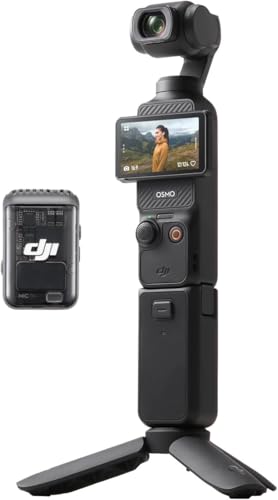
The Osmo Pocket 3 Creator Combo is the alternative for buyers who want the proven Pocket 3 with the accessories that matter most for creators. It uses the same 1-inch CMOS sensor size, 20mm f/2.0 lens, and 2.0-inch touchscreen as the Pocket 4, but with a 4K ceiling of 120fps for slow motion and D-Log M rather than full 10-bit D-Log. The Creator Combo adds a DJI Mic 2 transmitter with a windscreen and clip magnet, a wide-angle lens, a battery handle, an Osmo Mini Tripod, and a carrying bag, alongside the camera, protective cover, wrist strap, and handle with a 1/4-inch thread.
For many creators, this bundle is the more complete kit. The wireless mic improves voice audio more than any camera setting can, the battery handle extends shooting time and gives the camera a fuller grip, and the mini tripod turns the camera into a hands-free setup for talking-head shots and time-lapses. The Pocket 3 weighs 179 grams and its battery is rated for up to 166 minutes of recording, so the battery handle is a genuine part of the package. Image quality remains strong: the 1-inch sensor delivers clean low-light footage and pleasing depth for a pocket camera, and the three-axis gimbal keeps walking footage smooth.
Choose the Pocket 3 Creator Combo if you buy in the US and want official sales channels and manufacturer support, or if you want a wireless mic and battery handle included rather than bought separately. Choose the Pocket 4 instead if the newest tracking, the fastest slow motion, built-in storage, and longer battery life matter more than the official US channel. Either way, both cameras share the same core idea: a small, stabilized, large-sensor camera that fits in a pocket and is ready in seconds.
What to Check Before You Buy
Start by confirming exactly which bundle is on the listing. The Pocket 4 comes in several combos, including Standard, Creator, Travel, Vlog, and audio bundles, and the included accessories differ between them. The Standard Combo covers the camera, cable, gimbal clamp, wrist strap, threaded handle, and carrying pouch, while the Creator Combo adds a mic transmitter, fill light, mini tripod, and more. Read the included-items list on the listing itself rather than assuming a bundle contains a mic or a tripod.
Next, check the seller and the support position, especially for the Pocket 4 in the US. Because DJI has no official US release for this model, Amazon US listings are handled by third-party sellers, and no DJI US warranty promise appears on the listing. Read the seller name and the return window, and treat the return window as your main protection. For the Pocket 3, confirm the listing names the Creator Combo and lists the mic, battery handle, and tripod if those accessories are why you are choosing it.
Then think about storage and power for the way you shoot. The Pocket 4 has 107GB built in, which covers day trips and short projects without a card, but multi-day travel still calls for a microSD card up to 1TB. The sealed battery charges quickly, reaching 80% in 18 minutes, but you cannot swap it, so a portable charger belongs in your kit for long days. For the Pocket 3, the battery handle in the Creator Combo is the simplest way to extend a shoot.
Finally, match the camera to your editing habits. The Pocket 4 records in HEVC, and 10-bit D-Log footage rewards editing software that handles 10-bit color and high-bitrate files. And check the recording modes you will actually use: most vlogs are shot at standard frame rates, so confirm the camera excels at your everyday settings, not only at its headline specification.
FAQ
Is the DJI Osmo Pocket 4 actually released?
Yes. DJI officially announced the Osmo Pocket 4 on April 16, 2026, and it went on sale globally around April 20, 2026. It is a released product, not a rumor. The separate dual-lens Osmo Pocket 4P is a different model with its own launch schedule. The complication is regional: the Pocket 4 has no official US release, so US buyers find it on Amazon through third-party sellers importing stock, while the Pocket 3 remains the model sold through official US channels.
Is the Pocket 4 worth upgrading from the Pocket 3?
It depends on what you shoot. The upgrade is worth it if you use slow motion often, since 4K at 240fps doubles the Pocket 3 ceiling, and if you value the 14 stops of dynamic range, full 10-bit D-Log, ActiveTrack 7.0, built-in 107GB storage, and longer battery life. It is a smaller upgrade if you mostly film in daylight at standard frame rates, because the sensor size, lens, screen, and gimbal concept are shared between the two generations. US buyers should also weigh the official support position, which favors the Pocket 3.
Does the Pocket 4 need a memory card?
No, not for everyday shooting. The Pocket 4 includes 107GB of built-in storage with transfer speeds of up to 800MB/s, so you can record without a card. A microSD card up to 1TB is still supported and is worth adding for long trips or multi-day projects.
How long does the Pocket 4 battery last?
DJI rates the 1545 mAh battery for up to 240 minutes of recording at 1080p and 24fps, with Wi-Fi and the screen off during our research. Real recording time is shorter at 4K, with tracking on, or in cold weather. Fast charging helps: the battery reaches 80% in 18 minutes and a full charge in about 32 minutes. The battery is sealed, so plan around charging rather than swapping.
What is the best Pocket 4 bundle for a beginner?
The Standard Combo is the best starting point for most beginners because it includes the camera and the essentials: a cable, gimbal clamp, wrist strap, threaded handle, and carrying pouch. Add a microSD card and a portable charger for travel. The Creator Combo suits creators who know they need a wireless mic, a fill light, and a mini tripod from the start. If you are buying in the US and want official support, the Pocket 3 Creator Combo is the simpler choice, since it already includes a mic, battery handle, and tripod.
Bottom Line
The DJI Osmo Pocket 4 is a real and meaningful upgrade to the most popular pocket gimbal camera DJI has made. Its 1-inch sensor, 4K 240fps slow motion, 14 stops of dynamic range, 10-bit D-Log, ActiveTrack 7.0, 107GB of built-in storage, and 240-minute battery rating add up to a camera that is easier to shoot with and more flexible to edit. It keeps the pocket size, the mechanical gimbal, and the rotating screen that made the series work.
The decision comes down to where you buy and what you need. If you want the newest Pocket camera and you are comfortable buying the Standard Combo from a third-party Amazon seller in the US, with the return window as your protection, the Pocket 4 is the pick. If you want official US sales and support, a wireless mic and battery handle in the box, and a proven camera at a more accessible point, the Pocket 3 Creator Combo remains an excellent choice. Either way, you get a pocket-sized, stabilized, large-sensor camera that is ready the moment you pull it out.
Disclosure: As an Amazon Associate, we may earn from qualifying purchases.