Key takeaways
- Our guide to the best graphics cards of 2 18 explains the 2018 GTX 10-series and RX 500-series, what still holds up today, and how to buy one safely today.
Introduction
The keyword for this guide reads “best graphics cards of 2 18”, and the only sensible reading of it is the best graphics cards of 2018. That year sat near the end of one of the most interesting eras in PC graphics: NVIDIA’s Pascal-based GeForce GTX 10-series was mature and widely available in factory-overclocked partner designs, AMD’s Polaris-based Radeon RX 500-series was the value alternative for 1080p gaming, and the first ray-tracing cards were still months away. If you were building or upgrading a gaming PC in 2018, these were the cards on the shelf.
This guide looks back at the strongest cards of 2018 and gives honest advice for anyone considering one now. Every card here is a legacy product. None is still manufactured, and the listings that remain on Amazon US are mostly remaining new stock, third-party offers, used cards, or Renewed units. Confirm the listing live before you buy, because stock for a card this old can appear and disappear within days.
Disclosure
As an Amazon Associate, we earn from qualifying purchases.
Quick Picks
| Pick | Card | Memory | Best for |
|---|---|---|---|
| Our pick | EVGA GeForce GTX 1080 Ti FTW3 DT Gaming | 11GB GDDR5X | The strongest 2018 card, for 1440p and 4K play |
| Era standout, no verified listing | NVIDIA GeForce GTX 1080 | 8GB GDDR5X | High-end 1440p gaming in 2018 |
| Era standout, no verified listing | NVIDIA GeForce GTX 1070 Ti | 8GB GDDR5 | Near-1080 performance for less |
| Era standout, no verified listing | EVGA GeForce GTX 1070 SC Gaming ACX 3.0 | 8GB GDDR5 | Balanced 1440p and high-refresh 1080p |
| Era standout, no verified listing | MSI GeForce GTX 1060 Gaming X 6G | 6GB GDDR5 | The mainstream 1080p card of 2018 |
| Era standout, no verified listing | Sapphire Nitro+ Radeon RX 580 8GB | 8GB GDDR5 | The AMD value pick for 1080p gaming |
Only the EVGA GTX 1080 Ti FTW3 DT Gaming carries a purchase link in this guide. The other cards are listed as era context because their Amazon US listings could not be verified as buyable new stock at the time of writing. Each one is explained below, including why it has no link here.
Our Pick: EVGA GeForce GTX 1080 Ti FTW3 DT Gaming
The GeForce GTX 1080 Ti was the fastest consumer gaming graphics card of 2018, and the EVGA FTW3 DT Gaming is one of the best-known partner versions of it. The card is built on NVIDIA’s Pascal architecture with 3,584 CUDA cores, 11GB of GDDR5X memory on a 352-bit interface, and a factory configuration listed at a 1,480 MHz base clock and a 1,582 MHz boost clock. Those figures come from the product listing itself. The FTW3 design pairs that chip with EVGA’s iCX cooling technology, which adds nine thermal sensors across the card to monitor memory and power delivery temperatures, plus RGB lighting and three asynchronous fans.
In 2018 terms, this was the card for 1440p play at high settings or 4K without compromise, and for high-refresh-rate monitors. The 11GB frame buffer was unusually large for a consumer card at the time, and it is one reason the 1080 Ti has aged better than most of its contemporaries: modern games at 1440p can still fit comfortably within it, even though the card has no hardware ray tracing and no DLSS support.
There are important caveats, and they apply to every 1080 Ti listing you will find today. This card is out of production, so any listing is remaining stock, a third-party offer, a used card, or a Renewed unit. The listing linked here was found through search evidence, with the most recent Amazon page crawl about 207 days before this guide was written, and its current stock status could not be confirmed. Check the listing live before buying: confirm that the seller offers a new or clearly described unit, read the condition notes, check the return policy, and confirm the exact model number, which is 11G-P4-6694-KR. If the listing shows only a Renewed unit or a used unit with no clear warranty, weigh that carefully against a newer budget card, which would carry a full warranty and current driver support.
View the EVGA GeForce GTX 1080 Ti FTW3 DT Gaming on Amazon
The 2018 Graphics Card Landscape
NVIDIA’s Pascal generation had launched in 2016, and by 2018 the full stack was established, from the entry-level GTX 1050 through the GTX 1060, 1070, 1070 Ti, 1080, and the flagship 1080 Ti. AMD’s answer was the Polaris-based RX 500-series, led by the RX 580 and RX 570, which competed mainly in the mainstream segment where most buyers actually shopped.
Two forces shaped buying decisions in 2018 more than any benchmark chart. The first was cryptocurrency mining, which drove demand and scarcity for mid-range cards through much of 2017 and into 2018. The second was the arrival of high-refresh-rate 1080p and 1440p monitors at prices ordinary gamers could afford. Once monitors could display more than 60 frames per second, that gap became visible in everyday play.
The other thing to remember is that 2018 was the last full year before ray tracing arrived in consumer GPUs. None of the cards in this guide has dedicated ray-tracing hardware, and none supports DLSS upscaling. That sets a ceiling: modern games that lean on those features will run on these cards only through traditional rendering. If your goal is to play current releases at high settings, a newer card is the better buy. If your goal is to play the games of the 2018 era, or to build a period-correct machine, these cards remain the authentic choice.
The Cards That Defined 2018
NVIDIA GeForce GTX 1080: The High-End Sweet Spot
The GTX 1080 was the second-fastest card in NVIDIA’s 2018 lineup, built on the same Pascal architecture as the 1080 Ti but with 2,560 CUDA cores and 8GB of GDDR5X memory on a 256-bit interface. The Gigabyte G1 Gaming version, model GV-N1080G1 GAMING-8GD, ran at a 1,695 MHz base clock and a 1,835 MHz boost clock in gaming mode, rising to 1,721 MHz base and 1,860 MHz boost in OC mode, with a triple-fan WINDFORCE cooler and RGB lighting.
In 2018, the GTX 1080 was the natural choice for 1440p gaming at high settings and for high-refresh-rate 1080p play, and its 8GB of fast GDDR5X memory gave it headroom for texture-heavy games. There is no verified Amazon US listing for this card in this guide because the listings found during research were either discontinued at other retailers or could not be confirmed as buyable on Amazon US.
NVIDIA GeForce GTX 1070 Ti: Nearly a 1080
The GTX 1070 Ti arrived in November 2017, so it was still a fresh card through most of 2018. It used 2,432 CUDA cores and 8GB of GDDR5 memory on a 256-bit interface, with a reference base clock of 1,607 MHz and a boost clock of 1,683 MHz. That put it very close to the GTX 1080 in raw throughput, with the main difference being the slower GDDR5 memory instead of GDDR5X. The ASUS ROG Strix Advanced Edition, model ROG-STRIX-GTX1070TI-A8G-GAMING, added a large triple-fan cooler, RGB lighting, and an OC mode reaching a 1,759 MHz boost clock.
Contemporary reviews found the 1070 Ti only a small step behind the GTX 1080 in most games, which made it one of the best-value high-end cards of 2018 for buyers willing to overclock. No verified buyable Amazon US listing was found for this card at the time of writing: the listings that surfaced were Renewed units.
EVGA GeForce GTX 1070 SC Gaming ACX 3.0: The Balanced Pick
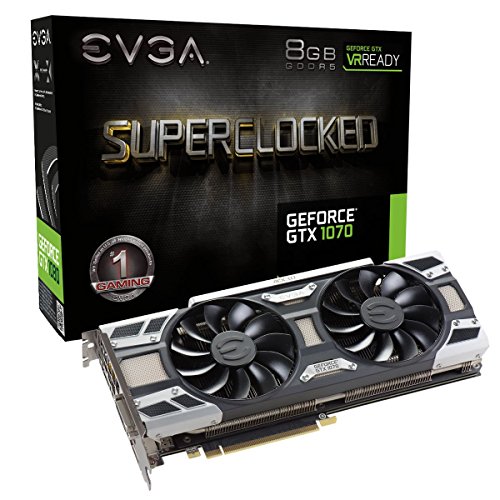
The GTX 1070 was the workhorse of the upper mid-range in 2018. It used 1,920 CUDA cores and 8GB of GDDR5 memory, and the EVGA SC Gaming ACX 3.0 version, model 08G-P4-6173-KR, ran at a 1,594 MHz base clock and a 1,784 MHz boost clock, with EVGA’s ACX 3.0 dual-fan cooling.
This card hit a sweet spot many buyers aimed for in 2018: strong 1440p performance, excellent high-refresh-rate 1080p performance, and enough memory for the games of the day, all in a dual-slot card that fit in most mid-tower cases. The reason it carries no purchase link here is straightforward: a listing check dated 24 November 2026 found this exact model unavailable on Amazon, with no buyable offer. Its ASIN, B01GX5YWAO, is recorded in our notes, but linking to a listing with no buyable offer would not help a reader, so it is listed here as context only.
MSI GeForce GTX 1060 Gaming X 6G: The Mainstream Favourite
If one card defined mainstream PC gaming in 2018, it was the GTX 1060 6GB. It used 1,280 CUDA cores and 6GB of GDDR5 memory on a 192-bit interface, with a 1,506 MHz GPU clock speed listed on the product page. The MSI Gaming X version added a dual-fan TORX 2.0 cooler, a backplate, and support for up to four displays, and it needed a 400-watt system power supply with a single 8-pin PCIe connector.
The 6GB version is the one to look for. NVIDIA also sold a 3GB version of the GTX 1060, which had less memory and fewer cores, and the difference mattered even in 2018 for texture-heavy games. If you are shopping for a used 1060 today, confirm the memory size on the listing before you buy, because the two versions look almost identical. This card has no link in this guide because the Amazon listing found during research, ASIN B01IEKYD5U, showed only a single used unit in Like New condition from a third-party seller at the most recent crawl, about 248 days before this guide was written. That is not a verified buyable new listing, and a single used unit may be gone by the time you read this.
Sapphire Nitro+ Radeon RX 580 8GB: The AMD Value Pick
AMD’s strongest mainstream card of 2018 was the Radeon RX 580, and the Sapphire Nitro+ version was one of the best-regarded partner designs. It used AMD’s Polaris 20 chip with 2,304 stream processors and 8GB of GDDR5 memory on a 256-bit interface, with a boost clock of up to 1,411 MHz and a 500-watt system power supply requirement. It had two HDMI ports, two DisplayPort outputs, and a DVI-D port, and it supported up to five displays.
The RX 580 was the natural rival to the GTX 1060 6GB, and the two traded blows depending on the game. The RX 580 generally offered more memory bandwidth and better performance in games that favoured AMD hardware, while the GTX 1060 was more power-efficient. For a buyer with a FreeSync monitor in 2018, the RX 580 was often the better match. There is no purchase link for this card here because the Amazon US listings found during research were Renewed units, with no confirmed new listing and no ASIN that could be verified from the search evidence. The model number to look for is 11265-01-20G. If you find a listing, confirm its condition and the seller live before buying.
Buying Guide: How to Choose a 2018 Graphics Card Today
Start with your monitor and your games
For 1080p gaming at 60 frames per second, a GTX 1060 6GB or an RX 580 8GB was the standard recommendation in 2018, and both still handle that workload for games of their era. For 1440p, or for 1080p at high refresh rates, the GTX 1070, 1070 Ti, and 1080 were the sensible choices. For 4K, only the 1080 Ti was truly comfortable in 2018, and even it needed settings compromises in the most demanding titles.
Video memory matters more than it used to
In 2018, 6GB was enough for 1080p and 8GB covered 1440p comfortably. The 11GB on the 1080 Ti is a genuine advantage here, and it is one of the reasons that card has held up best. The 3GB GTX 1060, by contrast, is best avoided now: its smaller memory and reduced core count make it a noticeably weaker card than the 6GB version.
Check the power supply and the case
Every card in this guide needs a real power supply, not a generic unit that came with a budget case. The 1080 Ti and 1070 Ti need the most headroom, while the 1060 and RX 580 are more forgiving. Check the manufacturer’s recommended wattage for the exact model, count the PCIe power connectors your supply provides, and measure the space in your case.
New, used, or Renewed: know what you are buying
Almost every 2018 card you find today will be used or Renewed. A Renewed card has been tested and cleaned, and it ships with a limited warranty, usually a minimum of 90 days. Neither is the same as a new card, and the price should reflect that. Check the return window, and test the card thoroughly as soon as it arrives: run a demanding game or a benchmark, watch temperatures, and listen for fan noise or coil whine. If anything seems wrong, use the return window rather than hoping it improves.
Watch out for fakes and mislabelled cards
The used market for older graphics cards includes mislabelled units and cards with modified firmware that report a different model than the hardware actually is. If the card reports a different model, different memory size, or different core count than the listing promised, return it.
Frequently Asked Questions
What were the best graphics cards of 2018?
The strongest consumer card of 2018 was the GeForce GTX 1080 Ti, followed by the GTX 1080, the GTX 1070 Ti, and the GTX 1070. In the mainstream segment, the GTX 1060 6GB and the Radeon RX 580 8GB were the most popular choices.
Is a 2018 graphics card still worth buying today?
It depends on what you want to play. For games released in 2018 and the surrounding years, and for esports titles that are not demanding, these cards still perform well at 1080p and 1440p. For current releases at high settings, or for games that rely on ray tracing and upscaling, a newer card is a better investment.
Which 2018 card is best for 1080p gaming?
The GTX 1060 6GB and the RX 580 8GB were the standard 1080p cards of 2018, and they remain capable at that resolution for games of their era. Between the two, the choice often came down to the monitor: the RX 580 paired well with FreeSync displays, while the GTX 1060 used less power. Avoid the 3GB version of the GTX 1060, which has less memory and fewer cores than the 6GB version.
How much video memory did the best 2018 cards have?
The GTX 1080 Ti had 11GB of GDDR5X memory, the GTX 1080 and GTX 1070 Ti and GTX 1070 had 8GB, the GTX 1060 6GB had 6GB, and the RX 580 came in 8GB and 4GB versions.
Should I buy a used or Renewed 2018 graphics card?
It can be a reasonable choice if the price reflects the condition and the seller offers a return window, but it carries more risk than buying new. Check the seller’s history, read the condition notes carefully, confirm the exact model and memory size, and test the card thoroughly as soon as it arrives. If the listing is vague about condition, or the seller has no return policy, look for a different listing or consider a newer budget card with a full warranty instead.
Conclusion
The best graphics cards of 2018 were a strong generation: the GTX 1080 Ti at the top, the GTX 1080 and 1070 Ti close behind, the GTX 1070 as the balanced high-end pick, and the GTX 1060 6GB and RX 580 8GB serving the mainstream where most gamers actually bought.
Buying one today is a different exercise from buying one in 2018. The cards are no longer manufactured, so every listing is remaining stock, a third-party offer, a used card, or a Renewed unit. That is why this guide links to only one card, the EVGA GTX 1080 Ti FTW3 DT Gaming, and even that listing needs a live check before you buy. If you decide a 2018 card is right for your build, go in with your eyes open: match the card to your monitor, confirm the power supply and case fit, check driver support, and test the card as soon as it arrives.