Key takeaways
- Compare five travel solar chargers that keep phones and power stations running off grid, from pocket-size 20W panels to 110W folding panels for camp.
A travel solar charger turns sunlight into usable power for phones, cameras, headlamps, and small power banks when no wall outlet is in reach. The five panels below range from a 20-watt camp panel that straps to a daypack to 110-watt folding panels for a portable power station at base camp. Every pick is a bare panel with no built-in battery, which keeps the weight down and the battery recalls out of the picture.
A solar panel is not a power bank: it only produces power in direct sun, so it charges devices directly or tops up a power bank during the day, and the bank carries that energy into the night. Rated watts are lab figures, so expect well under the rated figure in real use, especially with partial shade or a low sun angle.
As an Amazon Associate, we earn from qualifying purchases.
Quick Answer
The Anker SOLIX PS100 is the best overall pick, pairing 100 watts with a kickstand and station-ready outputs. The Jackery SolarSaga 100W is the best bifacial pick, the EF ECOFLOW 110W is the best 110-watt value, the BigBlue 28W is the best backpack panel, and the Nomad 20 is the best rugged camp panel.
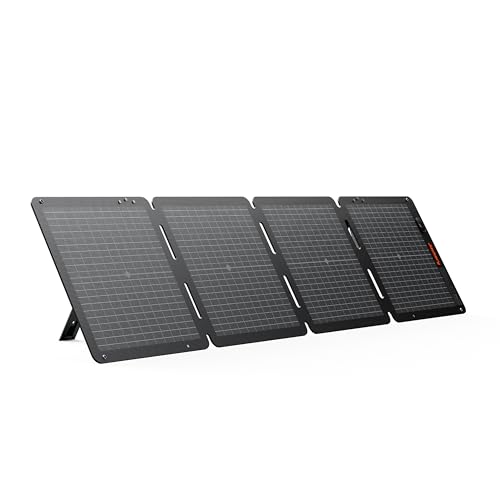
1. Anker SOLIX PS100 — Best Overall
The Anker SOLIX PS100 is the strongest all-around pick here: a full 100 watts in a folding design with an adjustable kickstand. The kickstand matters: a flat panel loses a large share of its output, while an angled panel holds a useful charge rate through the afternoon. This is the panel to pack when a portable power station is part of the kit, since it ships with the cables needed to feed one.
The PS100 uses monocrystalline cells rated at up to 23 percent conversion efficiency, and the Amazon listing rates it IP67 for water and dust protection, so a rain shower at camp is no reason to pack it away in a hurry. One flag: Anker has refreshed this line with a lighter bifacial version listed at about 6.2 pounds with IP68 protection, while the pinned listing is the kickstand version at about 10.5 pounds, so confirm the version before ordering.
Specs
– Rated power: 100 watts
– Cell type: monocrystalline, up to 23 percent efficiency
– Water and dust rating: IP67 per the Amazon listing
– Outputs: XT60 with MC4 cables in the box
– Kickstand: adjustable, built in
– Folded size: about 21.9 by 23.9 by 1.9 inches
– Weight: about 10.5 pounds per the Amazon listing
2. Jackery SolarSaga 100W Bifacial — Best Bifacial Panel
The Jackery SolarSaga 100W Bifacial is the pick for travelers who own a Jackery Explorer station, since its output plugs straight in with no adapter. The bifacial design collects light on both faces, so reflected light off sand, water, or pale ground adds a little extra output. It is built for fast setup at a vehicle base camp rather than for carrying on foot.
Dual aluminum kickstands set it up in seconds, and a magnetic closure plus a zippered pouch keep it tidy in transit. A USB-C port at 15 watts and a USB-A port at 12 watts charge a phone or headlamp straight from the panel while the station charges from the main output. The panel surface is rated IP65 for dust and light splashes, though the port covers are only splash-resistant, so keep the ports dry in rain. At 9.1 pounds, this is a car-camping panel.
Specs
– Rated power: 100 watts
– Cell type: bifacial monocrystalline, up to 23 percent efficiency
– Water and dust rating: IP65 on the panel surface
– Outputs: USB-C 15 watts, USB-A 12 watts, DC output for Jackery stations
– Kickstand: dual integrated aluminum legs
– Folded size: 24 by 21 by 1.4 inches
– Weight: 9.1 pounds
3. EF ECOFLOW 110W — Best 110-Watt Panel
The EF ECOFLOW 110W is the highest-output panel here and the best value among the station-size picks. Ten extra watts over the 100-watt class shortens station recharge times on a good solar day, and the panel folds into its own carry case, which protects the cells and doubles as a prop at camp. Its standard MC4 connector pairs with EcoFlow RIVER and DELTA stations and many other compatible solar generators.
Efficiency is rated at up to 23 percent, and its IP68 water and dust rating is the strongest weather protection in this lineup. That is a real advantage in wet climates, since the panel can sit out through rain that would send the other picks under cover. At about 8.8 pounds it is the lightest of the three station-size panels here and the easiest to carry any distance from the car.
Specs
– Rated power: 110 watts
– Cell type: monocrystalline, up to 23 percent efficiency
– Water and dust rating: IP68
– Outputs: MC4 connector for EcoFlow and compatible power stations
– Carry case: included, doubles as a prop
– Weight: about 8.8 pounds
– Folded size: not stated in the records reviewed
4. BigBlue 28W — Best Backpack Panel
The BigBlue 28W is the best pick for hikers and backpackers: the lightest panel here by a wide margin, and it straps to the outside of a pack. At about 1.5 pounds it adds less weight than a paperback and folds small enough to slip into a pack lid. SunPower cells sit behind the output, and USB-C and USB-A ports let a phone, headlamp, or small power bank charge while you walk, provided the panel faces the sun.
Twenty-eight watts is a phone-charging class of output, not a station-charging class: it keeps a phone alive across a long day on the trail rather than refilling a large battery. It is rated IPX4 for rain and splashes, not submersion. One caution: several closely named BigBlue 28-watt variants sell under separate listings, including an ammeter version sold through other regional stores, so pin only the listing named here.
Specs
– Rated power: 28 watts
– Cell type: SunPower monocrystalline cells
– Water resistance: IPX4
– Outputs: USB-C and USB-A, up to 4.8 amps combined
– Weight: about 1.5 pounds
– Design: foldable, attaches to a backpack
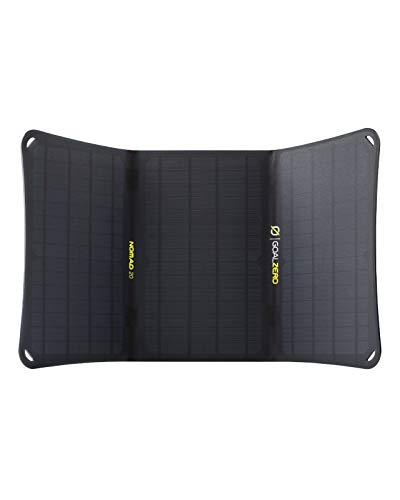
5. Goal Zero Nomad 20 — Best Rugged Camp Panel
The Goal Zero Nomad 20 is the toughest small panel here and the best pick for travelers who want a panel that survives being strapped to a pack, dropped on rocks, and used season after season. Twenty watts is modest next to the station panels, but it is the right size for phones, GPS units, headlamps, and small power banks on a camping trip.
A built-in 8-millimeter cable and a USB port charge both Goal Zero power banks and ordinary USB devices, and additional panels can be chained together for faster charging. An adjustable kickstand clicks into place at several angles, and a built-in dock holds a Goal Zero Flip bank while it charges. One flag: Goal Zero’s own site shows the panel sold out on one collection page, so check the live Amazon offer and confirm the listing is the standalone Nomad 20, not a kit.
Specs
– Rated power: 20 watts
– Cell type: monocrystalline
– Voltage: 14 to 22 volts
– Outputs: 8-millimeter cable and USB port, chainable
– Kickstand: adjustable, built in
– Warranty: two years
– Weight: about 2.28 pounds
How to Choose
For a portable power station, buy a 100-watt or 110-watt folding panel with the right connector: Jackery uses its own DC plug, EcoFlow uses MC4, and Anker uses XT60. For a phone on the trail, a 20-watt to 28-watt backpack panel is the right size, and anything heavier is dead weight. Weight is the second filter: a station panel weighs 9 to 11 pounds and belongs in a car, while a backpack panel weighs under 2.5 pounds.
USB-C is the modern standard for phones and small devices, while USB-A still covers headlamps and older gear. A panel with no USB ports can only feed a power station, so check the port list if the phone should charge straight from the panel. Weather ratings matter too: IP68 survives rain, IP65 handles splashes, IPX4 covers light rain only, and no portable panel should be submerged.
The relevant recall is the Spector and Co. Super Off-Road 12,000 milliamp-hour Solar Wireless Power Bank, recalled by the Consumer Product Safety Commission on June 25, 2026 under recall number 26-575, because its lithium-ion battery can swell and overheat, posing a burn hazard. Two reports of swelling were received, with no injuries, and the remedy is a refund. That product is a solar power bank, a battery with a panel bonded to it, given away as a promotional item from January 2019 through December 2023. None of the five picks here is that product, and none has an onboard battery at all. The Anker power-bank recalls for models A1263, A1257, A1647, A1652, A1681, A1689, and A1642, plus the PowerCore 10000, cover power banks only, not solar panels, so the Anker PS100 is not covered. The HALO Bolt ACDC 58830 stop-use warning covers a jump-starter power bank, and the Tesla Powerwall 2 recall covers a home battery system.
Who Should Skip
Skip a solar charger entirely if trips stay near wall outlets, since a wall charger and a power bank cover that case better for less money and less weight. Skip the station-size panels if the trip is on foot: a 9-pound to 11-pound panel is a poor trade when a 28-watt backpack panel or a charged power bank does the job. Skip any panel with an integrated battery if the goal is a pure panel, since a bonded battery adds weight and heat risk in sun. For a cloudy week, reset expectations: a panel in overcast weather produces a small fraction of its rated output, so a pre-charged power bank is the reliable backup.
Frequently Asked Questions
Can a travel solar charger replace a power bank?
No. A solar charger only produces power in direct sun, so it cannot charge devices at night or in deep shade. The usual setup is a panel that tops up a power bank during the day, with the bank carrying energy into the evening.
How long does a solar charger take to charge a phone?
It depends on the panel size, the sun, and the phone. A 28-watt panel in strong midday sun can add a useful charge in an hour or two, while a 20-watt panel takes longer, and cloud cover, shade, and a low sun angle stretch the time.
Do solar chargers work on cloudy days?
Yes, but output drops sharply: a panel under heavy cloud may produce only a small fraction of its rated watts, and some phones stop and restart charging when the output dips. Angle the panel toward the brightest part of the sky.
Can I take a solar charger on a plane?
Yes, in most cases. A bare solar panel with no battery is not a battery device, so it travels like any other piece of gear. Panels with a built-in battery follow airline lithium battery rules, which is one more reason the bare panels here are the simpler travel choice.
Final Verdict
For most travelers, the Anker SOLIX PS100 is the best travel solar charger: 100 watts, a kickstand, station-ready cables, and weather protection in one folding package. Jackery station owners should take the SolarSaga 100W Bifacial instead, and travelers who want the most watts per carry should take the EF ECOFLOW 110W. Hikers should take the BigBlue 28W, and campers who value toughness over watts should take the Nomad 20. Whichever panel fits the trip, pair it with a charged power bank and treat the rated watts as a lab figure, not a promise.