Key takeaways
- Five manual travel coffee grinders compared for pour over, AeroPress, and French press — compact, light, and built to grind evenly on the road.
A good travel coffee grinder turns hotel rooms and campsites into a proper brew bar. The best ones are manual burr grinders: no motor, no cord, no battery, and a grind even enough for pour over, AeroPress, and French press. The five grinders below were chosen for packability, burr quality, and adjustment range, each a different answer to how much weight a traveler will carry for fresh coffee.
This guide sticks to manual burr grinders: blade grinders chop beans unevenly, and electric grinders add weight, noise, and a power cord. Mugs and kettles already have their own guides on tagpass.co.
As an Amazon Associate, we earn from qualifying purchases.
Quick Answer
Pick the Comandante C40 MK4 for the most consistent grind, the VSSL JAVA for rugged camping, the 1Zpresso Q Air for the smallest pack, the TIMEMORE Chestnut C2S for the best balance of grind quality and weight, and the JavaPresse for the lowest-cost start.
1. Comandante C40 MK4 Nitro Blade, Liquid Amber — Best Overall

The Comandante C40 MK4 is the reference hand grinder other travel grinders are measured against. The 39 mm Nitro Blade conical burr is cut from high-nitrogen stainless steel, and the stepped adjustment moves about 25 to 30 microns per click, fine enough to dial in a pour over or an AeroPress with repeatable settings. Made in Germany, it ships with polymer and glass jars, so the glass jar can stay home.
Capacity is about 40 g, enough for two full mugs, and the grinder stands about 160 mm tall with a body about 61 mm across. At about 740 g it is the heaviest pick here by a wide margin, so it suits car travel and hotel stays, where coffee quality matters more than weight. The under-burr adjustment is slower to change than an external dial.
Specs
– Burr: 39 mm Nitro Blade conical, high-nitrogen stainless steel
– Adjustment: stepped, about 25 to 30 microns per click
– Capacity: about 40 g of beans
– Weight: about 740 g
– Size: about 160 mm tall, about 61 mm diameter
– Jars: one polymer, one glass
– Origin: made in Germany
2. VSSL JAVA, Black — Best for Camping
VSSL is an outdoor gear maker, and the JAVA reads like camp equipment that happens to grind coffee. The body is machined from military-grade aluminum, the crank handle doubles as a carabiner rated over 200 lb, and the whole grinder is about 6 inches tall and 2 inches across, slim enough for an AeroPress chamber. It weighs about 396 g, light for a metal grinder of this build quality.
Inside, a 38 mm stainless steel conical burr runs on dual bearings, and the adjustment offers 50 settings from fine espresso range to coarse French press. Capacity is 20 g, a single strong mug, and the maker backs it with a limited lifetime guarantee. The trade-offs are the narrow body and small capacity: two people means two loads, and fine settings demand more effort than the larger grinders here.
Specs
– Burr: 38 mm stainless steel conical, dual-bearing shaft
– Adjustment: 50 settings, fine to coarse
– Capacity: 20 g of beans
– Weight: about 396 g
– Size: about 6 in tall, about 2 in diameter
– Body: military-grade aluminum
– Handle: crank doubles as carabiner, rated over 200 lb
– Guarantee: limited lifetime guarantee
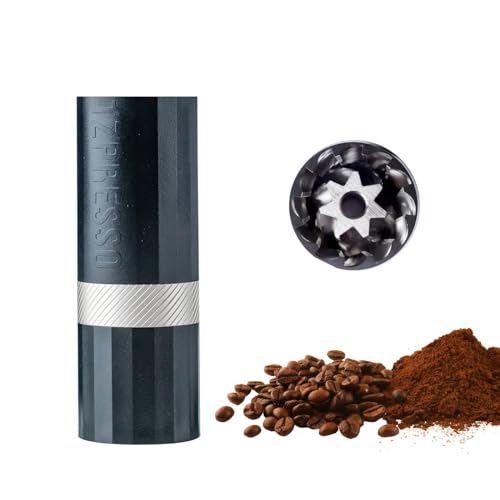
3. 1Zpresso Q Air, Black — Best Compact
The Q Air is the smallest grinder in this guide and the one most clearly designed around travel. It weighs about 365 g, stands 145 mm tall, and measures 46 mm across, and it fits inside an AeroPress plunger, taking no extra space in a kit that already includes one. The polycarbonate catch cup saves most of the weight, while the body stays aluminum.
The burr is a 38 mm heptagonal stainless steel conical set, and the numerical adjustment offers 30 clicks per rotation. Capacity is 15 to 20 g depending on bean type, so it is a single-cup grinder. The maker states the Q Air is optimized for pour over and filter methods, not espresso, so portable-espresso brewers should look at the VSSL JAVA or the Comandante instead.
Specs
– Burr: 38 mm heptagonal stainless steel conical
– Adjustment: numerical, 30 clicks per rotation
– Capacity: 15 to 20 g of beans
– Weight: about 365 g
– Size: about 145 mm tall, about 46 mm diameter
– Body: aluminum with a polycarbonate catch cup
– Fit: slides inside an AeroPress plunger
– Best for: pour over and filter brewing
4. TIMEMORE Chestnut C2S, White — Best Value
The Chestnut C2S updates the grinder that made TIMEMORE a household name among coffee travelers, and the changes land exactly where the original needed them. The body is now a full metal unibody machined from CNC stainless steel, fixing the fragile top cover of the earlier C2, and the 38 mm CNC stainless steel conical burr is held steady by a double-bearing central axis. Adjustment runs through 36 levels, covering fine to coarse with clear steps between them.
Capacity is 25 g, the body is about 52 mm across, and the grinder weighs about 15 oz, mid-pack for carry weight. It grinds a 15 g pour over dose in well under a minute, with consistency a small step below the pricier 1Zpresso and Comandante grinders at a far lower cost. Pin the white finish in this listing, since other colorways sell under separate listings.
Specs
– Burr: 38 mm CNC stainless steel conical
– Adjustment: 36 levels, fine to coarse
– Capacity: 25 g of beans
– Weight: about 15 oz
– Body diameter: about 52 mm
– Shaft: double-bearing central axis
– Body: CNC stainless steel unibody
– Finish: white
5. JavaPresse Manual Stainless Steel Coffee Grinder — Best Low-Cost Starter
The JavaPresse is the cheapest way into fresh-ground travel coffee, and it has stayed a best-selling manual grinder for years because it does the basics well. The stainless steel body holds a ceramic conical burr with 18 settings, covering fine espresso range through coarse French press, and the detachable crank keeps the packed shape slim. It stands about 7.5 inches tall with a body about 1.8 inches across and weighs about 9.4 oz, the lightest grinder in this guide.
Capacity is 20 to 30 g depending on bean size, enough for one to two cups. The trade-offs are speed and consistency: it is one of the slower grinders here, and the wide steps make fine espresso dialing harder than on the Comandante or the VSSL. For pour over, drip, and French press on the road it is more than adequate, and the six-month warranty is the shortest in this guide.
Specs
– Burr: ceramic conical
– Adjustment: 18 settings, fine to coarse
– Capacity: 20 to 30 g of beans
– Weight: about 9.4 oz
– Size: about 7.5 in tall, about 1.8 in body diameter
– Body: brushed stainless steel
– Crank: detachable hand crank
– Warranty: six months
How to Choose
Start with brew method. Pour over and AeroPress need a grinder that holds a medium-fine setting steadily, which all five picks do, while French press needs a coarse setting with few fines, favoring the larger burrs in the Comandante and the TIMEMORE. Espresso is the hardest case: only the Comandante and the VSSL JAVA have fine enough steps for a portable espresso maker, and the Q Air is explicitly not built for it.
Next, weigh capacity against pack weight. A 20 g grinder makes one mug, a 25 g grinder makes one generous mug, and a 40 g grinder makes two, so the Comandante covers two people in one load while the VSSL JAVA and Q Air need two. On foot, every gram counts, and the JavaPresse and the Q Air are the lightest options.
Burr material matters too. Steel burrs stay sharp longer and cut more cleanly at fine settings, while ceramic burrs resist heat and never rust but can chip if dropped on a hard surface. A grinder that fits inside an AeroPress chamber or plunger, like the VSSL JAVA and the Q Air, saves real space. Finally, an external numbered dial is easier to repeat than an internal dial, and small increments are easier to dial in than wide jumps.
Who Should Skip
Skip a manual grinder entirely if the trip involves grinding for a group every morning: hand grinding 60 g or more before breakfast is slow work, and a small electric grinder or pre-ground coffee is the honest choice. Skip the Comandante if the bag is already at its weight limit: at about 740 g it weighs roughly twice as much as the lightest pick here, and it suits car travel and hotel stays better.
Skip the 1Zpresso Q Air if espresso is the main brew method, since the maker states it is optimized for filter brewing. Skip the JavaPresse if precise espresso dialing matters, since its 18 settings jump too far between steps. Travelers with wrist or grip issues should think carefully too: hand grinding takes steady effort, and a larger grinder like the Comandante needs less force per turn.
Safety Notes
No CPSC recall covers manual burr coffee grinders as a class, and none of the five picks appears in any recall notice. The record that matters most is the June 2009 recall of Starbucks Barista Blade Grinders and Seattle’s Best Coffee Blade Grinders, CPSC 09-244, about 530,000 units sold between March 2002 and March 2009. Those grinders could fail to turn off or turn on unexpectedly, with 176 reports and three lacerations, and the remedy was a free replacement. That recall covers electric blade grinders only: every grinder here is a manual burr grinder with no motor, no switch, and no blade, so none of them is covered.
Two other records should not be confused with grinders: the Kidisle KC101B single-serve coffee maker, recalled in June 2026 under CPSC 26-557, and Sensio Bella Pro Series and Cooks steam espresso machines, recalled in March 2025 under CPSC 25-191. Both are electric brewing appliances, and neither covers any pick here. Keep fingers clear of burrs while cleaning, and let the grinder dry fully before packing it away.
Frequently Asked Questions
Can a hand grinder really grind fine enough for espresso?
Yes, with the right grinder. The Comandante C40 MK4 and the VSSL JAVA have fine steps that reach espresso range, the JavaPresse can reach it but its wide steps make precise dialing hard, and the 1Zpresso Q Air is built for filter brewing.
How much coffee does a travel grinder hold per load?
The Q Air holds 15 to 20 g, the VSSL JAVA 20 g, the TIMEMORE C2S 25 g, the JavaPresse 20 to 30 g, and the Comandante C40 MK4 about 40 g, the only pick that covers two mugs in one load.
Are manual grinders allowed in carry-on luggage?
Yes, in general. A manual grinder has no battery and no blade, so it passes through security like any kitchen tool. Whole beans travel well in a sealed bag, and fresh grinding at the destination keeps more aroma.
Do ceramic burrs or steel burrs last longer?
Steel burrs generally stay sharp longer and cut more cleanly at fine settings. Ceramic burrs resist heat and never rust, but they can chip if dropped. Both last for years with normal care and regular brushing.
Final Verdict
For most travelers, the TIMEMORE Chestnut C2S gets the balance right: a steel burr, 36 adjustment levels, 25 g capacity, and a carry weight that disappears into a bag. Campers and hikers should take the VSSL JAVA for its rugged body and carabiner handle, or the 1Zpresso Q Air for the smallest pack. Travelers who want the most consistent cup and do not mind the weight should take the Comandante C40 MK4, and first-timers should start with the JavaPresse, which costs the least and still grinds well enough for pour over, drip, and French press.