Key takeaways
- Compare five countertop juicers, from fast centrifugal extractors to slow masticating presses, with maker-stated specs on motors, chutes and cleanup.
Countertop juicers fall into two camps, and the difference shapes everything from prep time to cleanup. Centrifugal juicers spin a mesh basket at high speed, shredding produce against a cutting disc and flinging the juice outward while the pulp collects in a separate bin. Masticating juicers, often called slow or cold press juicers, turn an auger at low speed to crush produce and press it through a strainer. Neither design is automatically better; the right pick depends on what gets juiced most and how much counter space the machine can claim.
This guide compares five current models across both camps: two centrifugal machines built for speed and three masticating machines built for slow, steady pressing. Every specification below is stated by the maker, because juicer type, motor power and speed figures are maker-stated only and are not measured the same way across brands. Feed chute sizes and pulp container capacities are likewise listed per maker, and any juice-yield wording is the maker’s own phrasing rather than a tested result.
As an Amazon Associate, we earn from qualifying purchases.
Quick answer
For fast, high-volume juicing with minimal prep, the Breville Juice Fountain Plus JE98XL pairs an 850-watt motor with a 3-inch chute that swallows whole apples. For slow pressing with pulp control, the Ninja NeverClog JC151 is compact and simple, while the Kuvings REVO830 adds a second auto-cut chute for long vegetables. The Omega VSJ843QS suits small counters, and the Mueller Juicer Ultra Power is the straightforward centrifugal value pick.
How to choose
Start with juicer type. Centrifugal models finish a glass in seconds and usually cost less, but the high-speed basket works best with firm produce such as apples, carrots and beets, and the pulp tends to come out wetter. Masticating models turn far more slowly, which makes them quieter in maker descriptions and better suited to leafy greens, but a batch takes minutes rather than seconds and the feed chutes are often narrower, so produce needs more cutting.
Motor power and speeds are maker-stated only. Centrifugal makers quote wattage and basket RPM, while masticating makers quote low auger RPM figures such as 43 or 50 RPM. These numbers describe the design, not a verified performance score, so treat them as a way to tell models apart rather than a ranking. Two-speed centrifugal machines let soft fruit run slower than hard roots, which makers say reduces strain on the motor.
Feed chute size decides prep work. A 3-inch centrifugal chute accepts many whole fruits, while narrow masticating chutes need produce cut into strips. Wide-mouth slow juicers and dual-chute designs narrow that gap. Pulp container capacity matters for batch size: a large pulp bin and a big juice jug mean fewer stops mid-batch, while compact machines trade capacity for a smaller footprint.
Cleanup deserves an honest look before buying. Makers state which parts are dishwasher safe, and that varies even within one brand’s range. A cleaning brush is included with many models for the mesh basket or strainer. Finally, follow each maker’s manual on safety: always feed produce with the pusher provided, never with fingers, keep the locking arm engaged where one is fitted, and unplug the machine before disassembly and cleaning.
Breville Juice Fountain Plus JE98XL
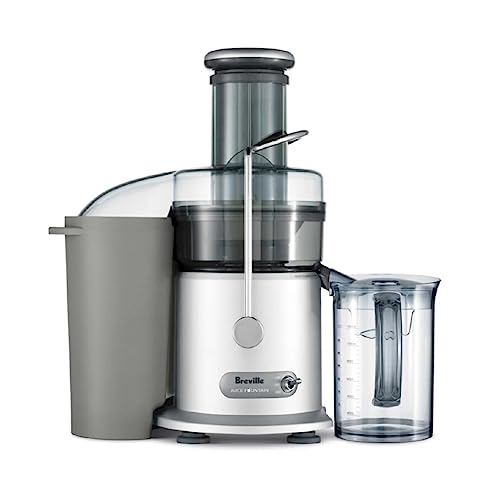
The Juice Fountain Plus is Breville’s long-running centrifugal design, built around a heavy-duty 850-watt motor and a two-speed control. Breville states the low speed runs at 6,500 RPM for softer fruit and the high speed at 13,000 RPM for hard vegetables, so one machine covers oranges in the morning and carrots for a soup base later. The cutting disc is titanium reinforced, and the Italian-made micro mesh filter basket is stainless steel, per the maker.
The 3-inch extra-wide feed chute is the practical headline: Breville states it takes whole apples and similar produce without pre-cutting, which removes most of the prep from a juicing session. Juice collects in a 1-liter jug with a built-in froth separator, and pulp ejects into a 2.6-liter container, so several servings can be made before anything needs emptying. A safety locking arm keeps the machine from running unless the cover is locked in place, per the maker’s manual.
Trade-offs are the usual centrifugal ones. The footprint is substantial, the pulp bin and jug need storage space, and the mesh basket needs a brush scrub after leafy or fibrous produce. For households juicing firm produce in volume and wanting it done quickly, it remains the benchmark layout in this group.
Specs
- Type: Centrifugal, maker-stated
- Motor: 850 watts, maker-stated
- Speeds: 2 (6,500 and 13,000 RPM, maker-stated)
- Feed chute: 3 inches, extra wide
- Juice jug: 1 liter with froth separator
- Pulp container: 2.6 liters
Mueller Juicer Ultra Power

Mueller’s Juicer Ultra Power takes the same centrifugal layout and trims it down. The maker lists a maximum power of 1,100 watts and two speed settings, with the low range stated at 12,000 to 15,000 RPM for soft fruit and the high range at 15,000 to 18,000 RPM for hard produce. A stainless steel cutting disc and micro mesh filter do the extraction, and the anti-drip spout is designed to keep the counter cleaner between glasses, per the maker.
The feed chute is 3 inches wide, matching the Breville on whole-fruit feeding, and the containers are generously sized for the class: Mueller states a 34 fluid ounce juice container and a 68 fluid ounce pulp container. Safety features listed by the maker include a locking arm that must be upright for the motor to start and an overload protection system that shuts the motor down if it is strained.
The compromises are build and refinement rather than function. The housing uses more plastic than the Breville, and there is no froth separator in the jug. As an entry point into centrifugal juicing, though, the spec sheet covers the essentials: wide chute, two speeds, big containers and a compact body that stores easily.
Specs
- Type: Centrifugal, maker-stated
- Motor: 1,100 watts maximum power, maker-stated
- Speeds: 2 (12,000 to 15,000 and 15,000 to 18,000 RPM, maker-stated)
- Feed chute: 3 inches
- Juice container: 34 fluid ounces
- Pulp container: 68 fluid ounces
Kuvings Whole Slow Juicer REVO830

The REVO830 is Kuvings’ answer to the slow juicer’s biggest annoyance, prep work. It has two feed chutes: an extra-wide 88 mm chute for whole apples and beets, and a 48 mm chute with an automatic cutting feature that, per Kuvings, chops long ingredients such as carrots and celery as they feed in. The auger itself turns at a maker-stated 50 RPM, driven by a 240-watt motor, which is strong for a masticating machine.
Because the auger does the cutting, the REVO830 asks for less knife work than most slow juicers while keeping the slow-press format that handles leafy greens and soft fruit without the froth a centrifugal basket produces. The listing includes smoothie and sorbet strainers alongside the juice strainer, so the same machine handles thicker blends and frozen desserts, per the maker. The matte black version carries the model code REVO830B.
The trade-offs are size and counter space: this is a tall, heavy machine that earns its place only in kitchens that juice often. Parts are numerous, and the strainers need prompt rinsing. For daily juicers who want slow pressing without dicing everything first, it is the most convenience-focused design in this guide.
Specs
- Type: Masticating (slow press), maker-stated
- Motor: 240 watts, maker-stated
- Auger speed: 50 RPM, maker-stated
- Feed chutes: 88 mm wide chute and 48 mm auto-cut chute
- Included strainers: Juice, smoothie and sorbet, per the listing
- Finish: Matte black (REVO830B)
Ninja NeverClog Cold Press Juicer JC151

Ninja built the JC151 around a single complaint about slow juicers: clogging at the pulp outlet. The maker describes a design that keeps pulp moving, with a reverse function for clearing blockages, and Total Pulp Control delivered through two interchangeable pulp filters, so the juice can be made with more pulp or less depending on which filter is fitted. The motor is a maker-stated 150 watts.
Capacity is sized for one or two people at a time: a 24 ounce juice jug and a 36 ounce pulp container, both stated by Ninja. The footprint is one of the smallest here, and Ninja states the parts are dishwasher safe, which makes it the lowest-effort cleanup in this group alongside a quick rinse of the auger and filter. Assembly is a simple stack of bowl, auger and filter, and the control is a single dial with a reverse setting.
The limits follow from the size. Big batches mean emptying the pulp container mid-run, and the feed chute needs produce cut into pieces rather than fed whole. For apartment kitchens and first-time slow juicers who value easy cleaning over batch size, the JC151 is the most approachable masticating option here.
Specs
- Type: Masticating (cold press), maker-stated
- Motor: 150 watts, maker-stated
- Pulp control: 2 interchangeable pulp filters
- Juice jug: 24 ounces
- Pulp container: 36 ounces
- Care: Dishwasher-safe parts, per the maker
Omega VSJ843QS Vertical Slow Juicer

The VSJ843QS is Omega’s compact vertical masticating juicer. Its auger turns at a maker-stated 43 RPM and uses a 3-stage design that, per Omega, crushes, squeezes and extracts in sequence, with automatic pulp ejection so juicing can run continuously rather than in small batches. The motor is rated by the maker at 150 watts, and the vertical layout keeps the footprint close to that of a kettle, which suits crowded counters.
A no-drip juice tap lets the bowl fill and mix before pouring, and it also makes the maker’s suggested self-cleaning rinse simpler: fill with water, run briefly, and empty. Omega states the machine handles fruits, vegetables and leafy greens, and the slow speed keeps the operation quiet in the maker’s description. The maker also states a 15-year warranty for this model, the longest coverage figure quoted in this guide.
The narrow chute means carrots and apples need cutting into strips, and throughput is slow compared with the centrifugal pair. Pulp exits in a steady stream rather than filling an internal bin. For small kitchens committed to slow juicing, including greens, it is the most space-efficient pick here.
Specs
- Type: Masticating vertical, maker-stated
- Motor: 150 watts, maker-stated
- Auger speed: 43 RPM, maker-stated
- Auger: 3-stage with automatic pulp ejection
- Feature: No-drip juice tap
- Warranty: 15 years, maker-stated
Comparing the alternatives
Beyond these five, the market splits into a few other shapes worth knowing about. Horizontal masticating juicers add a long auger and often handle nut butters and pasta attachments, but they take more counter depth. Twin-gear juicers press at very low speeds and sit at the top of the price range. Citrus-only presses and reamers do one job well and nothing else, while high-speed centrifugal models from other brands largely mirror the Breville and Mueller layout with different chute and container sizes. Blender-based juicing, using a strainer bag after blending, is the no-new-appliance route, though it is slower and messier per glass. Matching the machine type to the produce juiced most often matters more than any single spec.
FAQ
What is the difference between centrifugal and masticating juicers?
Centrifugal juicers shred produce against a spinning mesh basket, working in seconds and suiting firm fruit and vegetables. Masticating juicers crush produce with a slow auger, taking minutes per batch and handling leafy greens more effectively. Makers describe slow juicers as quieter; centrifugal models usually cost less and juice faster.
Which type handles leafy greens better?
Masticating models, per maker guidance, because the auger can grip and press leaves that a centrifugal basket tends to fling aside. Feeding greens rolled or packed between firmer produce helps in both designs. The Kuvings, Ninja and Omega picks here are the greens-friendly options in this guide.
How should fresh juice be stored?
Makers generally recommend drinking juice promptly after making it. If it must be stored, use a sealed container in the refrigerator and follow the individual maker’s guidance on timing. Filling the container to the top to limit air exposure is a common maker suggestion.
Are the parts dishwasher safe?
It depends on the model and the part. Ninja states the JC151 parts are dishwasher safe, while other makers in this guide direct some parts to hand washing. Check the manual for the specific model, and rinse strainers and baskets soon after use either way, since dried pulp is harder to remove.
Final verdict
Choose by produce and patience. The Breville Juice Fountain Plus JE98XL is the fast, whole-fruit centrifugal pick, and the Mueller Juicer Ultra Power covers the same ground in a smaller, simpler package. Among the slow juicers, the Kuvings REVO830 removes the most prep, the Ninja JC151 is the easiest to clean and store, and the Omega VSJ843QS fits the tightest counters with the longest maker-stated warranty. Whichever design wins, use the pusher rather than fingers, unplug before cleaning, and let the maker’s manual settle any spec question.
Product and ASIN Reference
| Product | ASIN |
|---|---|
| Breville Juice Fountain Plus JE98XL | B003R28HWQ |
| Mueller Juicer Ultra Power (SD80A) | B07D3C6NVL |
| Kuvings Whole Slow Juicer REVO830 | B0BZRH41TH |
| Ninja NeverClog Cold Press Juicer JC151 | B0BR8HZL9V |
| Omega VSJ843QS Vertical Slow Juicer | B00LIAGKSC |