Key takeaways
- Travel adapter vs voltage converter: plug shape versus voltage change, wattage limits, and five picks for trips with US or dual-voltage gear.
A travel adapter and a voltage converter sit side by side in every travel shop, and they are bought interchangeably by mistake all the time. They solve two different problems. An adapter changes only the shape of your plug so it fits a foreign wall socket. A converter actually changes the voltage coming out of that socket. Picking an adapter when you needed a converter can leave a single-voltage appliance damaged within seconds, while packing a converter you never needed adds bulk and a strict wattage ceiling to your bag.
The deciding factor is the fine print on your own chargers. Most phone, laptop, tablet, and camera chargers are dual voltage and only need an adapter. A smaller set of US appliances, mostly older or heat-and-motor gear rated for 110V only, need the voltage stepped down. This guide explains the difference, compares the two categories head to head, and profiles five current models: three adapters and two step-down converters.
As an Amazon Associate, we earn from qualifying purchases.
Table of Contents
- The Short Answer
- What a Travel Adapter Does, and Does Not Do
- What a Voltage Converter Does, and Its Limits
- Head-to-Head: Adapter vs Converter
- The Adapter Picks
- The Converter Picks
- How to Choose Between an Adapter and a Converter
- FAQ
- Conclusion
The Short Answer
If every device you pack is labeled with an input range such as 100-240V, buy an adapter and stop there. That covers nearly all phones, laptops, tablets, e-readers, and camera chargers sold in the last two decades. If you are bringing a US appliance labeled 110V or 120V only, such as a basic hair straightener, a CPAP machine without a dual-voltage supply, or an electric toothbrush charger, you need a step-down converter for that item, or you should leave it at home. Many travelers end up with one of each: an adapter as the everyday piece, and a small converter reserved for the one single-voltage device that has to come along.
What a Travel Adapter Does, and Does Not Do
A travel adapter is a mechanical bridge. Inside the housing there is no circuitry that changes the electricity itself; it simply routes the wall current through a different arrangement of prongs. Universal models carry sliding or swappable prongs for the main world plug types: Type A for North America and Japan, Type C for most of Europe, Type G for the United Kingdom and Ireland, and Type I for Australia, New Zealand, and China. Between those four shapes, a single universal adapter covers more than 150 countries.
Because the voltage passes through untouched, whatever comes out of a European wall socket at 220-240V arrives at your device at 220-240V. That is perfectly fine for a dual-voltage charger, which is designed to accept that range. It is a genuine hazard for a 110V-only appliance, which can overheat, trip its own protection, or fail outright. Every adapter in this guide states plainly in its listing that it is not a voltage converter, and that warning is the single most important line on the box.
Modern adapters add convenience features on top of the basic bridge. Built-in USB-A and USB-C ports let you charge phones and tablets without bringing their bricks, an AC socket handles one plug-in device, and a replaceable fuse plus safety shutters protect the connection. None of those extras change the core rule: an adapter handles shape, never voltage.
What a Voltage Converter Does, and Its Limits
A voltage converter contains a transformer or electronic step-down circuit that takes 220-240V wall power and delivers roughly 110-120V, the range US appliances expect. Travel converters are almost always step-down only, built for travelers from North America and Japan heading to higher-voltage regions. They are not designed to run the other direction.
The trade-off is capacity. A transformer small enough to travel with tops out at a few hundred watts, and both converters profiled below carry explicit warnings that follow from that physics. Heating appliances are the problem category: hair dryers, kettles, steam irons, and coffee machines either exceed the wattage limit outright or are excluded by the manufacturers regardless of wattage, because their heating elements draw sustained high current. The FOVAL unit below is a partial exception in positioning, since it is built for lower-wattage styling tools such as straighteners and curling irons under its 230W ceiling, but it still rules out hair dryers and heaters.
Converters also add size, weight, and a fan or heat to manage, and they usually trail a short power cable with interchangeable plug tips rather than folding flat. In exchange, they do the one job an adapter cannot: they make a single-voltage US device safe to run on foreign power, within their wattage limit.
Head-to-Head: Adapter vs Converter
Voltage handling. An adapter passes wall voltage through unchanged. A converter steps 220-240V down to about 110-120V. This is the entire functional difference, and everything else follows from it.
Plug coverage. Universal adapters build four or more plug types into one folding unit. Converters typically ship with a cable and a set of separate plug tips, which covers similar ground but with more loose pieces to keep track of.
Wattage ceiling. Adapters are limited mainly by their fuse, commonly 8A or 10A, which translates to a maximum power rating in the 880W to 2400W range depending on local voltage. Converters cap out far lower, at 230W to 250W for the travel models here, and exclude heating appliances.
Size and weight. Adapters weigh a few ounces and disappear into a carry-on pocket. Converters are closer to a small power brick with a cable, and they earn that space only when a single-voltage device truly needs them.
Safety features. Adapters rely on fuses, shutters, and plug locks. Converters add overload and overheat protection around the transformer, and they need it, because running near the wattage ceiling generates real heat.
| Feature | Travel Adapter | Voltage Converter |
|---|---|---|
| Changes plug shape | Yes | Yes, via plug tips |
| Changes voltage | No | Yes, steps down to 110-120V |
| Typical wattage limit | 880W to 2400W, fuse dependent | 230W to 250W |
| Hair dryers and kettles | Only if dual voltage | Not supported |
| Size | Pocket size, a few ounces | Brick size, with cable |
| Best for | Dual-voltage electronics | Single-voltage US devices |

The Adapter Picks
EPICKA TA-105 Universal Travel Adapter

The TA-105 is the classic all-in-one design: four sliding plug types in a single cube, one AC socket, and enough USB ports to retire most of your charging bricks. It is the budget-tier default for travelers whose gear is entirely dual voltage.
Specs:
- Plug types: Type A, C, G, and I sliders covering more than 150 countries
- AC outlets: 1
- USB ports: 4 USB-A at 2.4A each and 1 USB-C at 3A, 5.6A total DC output
- Max power: 880W at 110V, 1920W at 240V
- Protection: Built-in 8A replaceable fuse, safety shutters, plug lock system
- Certifications: RoHS, CE, and FCC
- Size and weight: 2.8 x 1.97 x 2.04 inches, 5.4 ounces
- Voltage conversion: None
Two honest limits come straight from the listing. The plug set does not include the large Type M used in South Africa or the Type D used in India, and the USB-C port is a charging port rather than a high-wattage laptop supply. For phones, tablets, cameras, and a laptop running through its own dual-voltage brick, neither limit matters much.
Ceptics UP-10KU International Power Adapter

Ceptics takes the same universal shape and trades some USB-A ports for faster USB-C charging. The USB-C port supports 30W Power Delivery, enough to charge a phone quickly or keep a small ultrabook topped up, and the whole unit is noticeably lighter than the EPICKA.
Specs:
- Plug types: Type A, C, G, and I output with a universal input socket
- AC outlets: 1
- USB ports: 2 USB-A and 1 USB-C with 30W Power Delivery
- Input rating: Up to 240V
- Size and weight: 2 x 2.75 x 2 inches, 3.5 ounces
- Warranty: 1 year
- Voltage conversion: None
- Tier: Budget to mid-range
The UP-10KU suits travelers who carry fewer devices but want them charged faster. With one AC outlet and three USB ports it handles a phone, a tablet, and one plug-in gadget at once. Like every adapter here, it passes voltage through untouched, so the dual-voltage check still applies to anything you plug into it.
EPICKA TA-105 Pro GaN Universal Travel Adapter
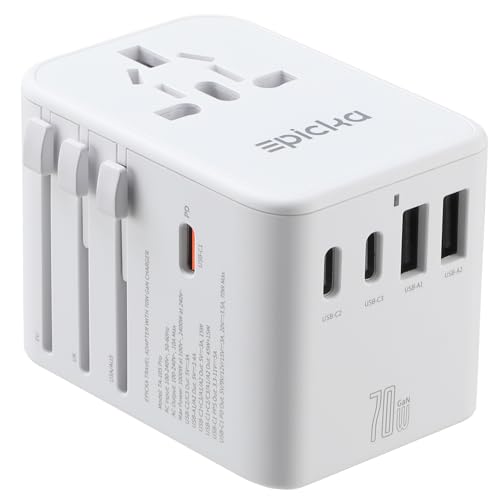
The TA-105 Pro is the mid-range step up for people who want to leave the laptop brick at home. GaN circuitry pushes up to 70W through its first USB-C port, which is proper laptop charging territory, while the same four-plug universal body covers more than 200 countries and regions according to the listing.
Specs:
- Plug types: Type A, C, G, and I covering more than 200 countries and regions
- AC outlets: 1
- USB ports: 3 USB-C and 2 USB-A, up to 70W on the primary USB-C port
- Max power: 1000W at 100V, 2400W at 240V
- Protection: 10A fuse
- Voltage conversion: None
- Tier: Mid-range
The Pro makes the most sense for a two-bag or one-bag traveler running a USB-C laptop, a phone, and earbuds from a single wall socket. Everyone else is paying for wattage they will never use, and the standard TA-105 above remains the better value shape of the same idea.
The Converter Picks
BESTEK 250W Power Converter
The BESTEK is the converter most US travelers end up with, because it combines the step-down transformer with a genuinely useful charging hub. Three AC sockets and four USB ports can run up to seven devices at once, as long as the combined AC load stays under the 250W ceiling.
Specs:
- Conversion: Steps 100-240V input down to 110-120V output
- Max power: 250W across AC and USB
- AC outlets: 3
- USB ports: 4, sharing 6A total
- Plug coverage: EU, UK, AU, US, and India adapters included, more than 160 countries
- Cable: Detachable EU power cable, 5 feet
- Not supported: Hair dryers, kettles, steam irons, coffee machines, and anything over 250W
- Tier: Mid-range
The intended load is small electronics: CPAP machines within the wattage limit, shavers, toothbrush chargers, and similar gear, alongside ordinary USB charging. Read the exclusion list as a hard boundary rather than fine print, since a heating appliance can overload the transformer even when its label wattage looks close to the limit.
FOVAL 230W Power Step Down Converter
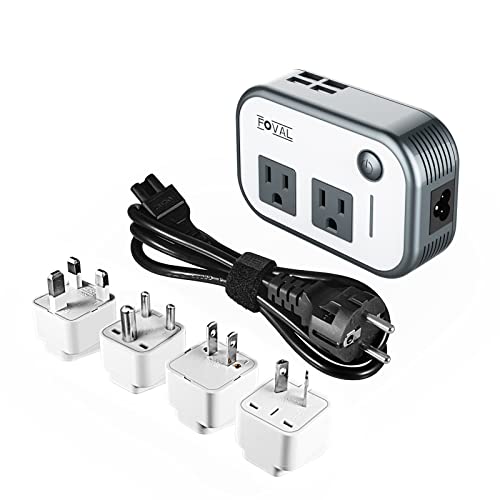
FOVAL aims its converter at a narrower job: keeping US styling tools and small personal-care devices alive on foreign voltage. It is rated for hair straighteners, curling irons, hot air brushes, and electric toothbrushes that stay under its 230W maximum, which is exactly the category of single-voltage gear travelers most often refuse to leave behind.
Specs:
- Conversion: Steps 220V input down to 110V, from 100-240V at 50/60Hz
- AC output: 100-120V at 60Hz
- Max power: 230W
- USB ports: 4 at 5V and 2.4A
- Plug coverage: EU power cable plus US, UK, AU, and India adapters
- Not supported: Hair dryers, electric heaters, and any device over 230W
- Tier: Budget
The FOVAL is lighter on outlets than the BESTEK and has no third AC socket to spare, but it is the more focused tool if a straightener or curling iron is the whole reason a converter is in your bag. Check the wattage printed on the tool itself before packing, since styling tools vary widely and a high-wattage model will exceed this unit.
How to Choose Between an Adapter and a Converter
Start with the label, not the product page. Every charger and appliance carries an input line in small print. If it reads 100-240V, the device is dual voltage and an adapter is all it needs. If it reads 110V, 120V, or a narrow range around those numbers, it is single voltage and needs a converter abroad, full stop.
Next, do the wattage math for anything single voltage. Find the watt rating on the device and compare it with the converter ceiling of 230W or 250W. If the device is a hair dryer, kettle, iron, or coffee machine, the answer is no regardless of the math; pack a dual-voltage travel version of that appliance instead, and run it through a plain adapter.
Finally, count your sockets. A hotel room often offers one reachable outlet. An adapter with four or five USB ports, or a converter hub with three AC sockets, can be the difference between rotating devices all evening and waking up to everything charged. Choose the category by voltage first, then choose the model by ports and plugs.
FAQ
Can I use a travel adapter with a hair dryer abroad?
Only if the hair dryer itself is dual voltage, with 100-240V printed on it, and even then it must stay under the adapter maximum power rating. A 110V-only dryer on a plain adapter in a 220V country will overheat or fail. Converters in this guide do not support hair dryers either, so a dual-voltage travel dryer plus an adapter is the standard solution.
Do phones and laptops need a voltage converter?
Almost never. Phone, tablet, and laptop chargers are dual voltage by design and accept 100-240V, so an adapter is sufficient. The input range is printed on the charger brick or plug. If a charger genuinely shows only 110V, treat it as single voltage and use a converter within its wattage limit.
Can a converter replace an adapter completely?
Functionally it can, since the converters here include plug tips for the major regions and also charge USB devices. In practice most travelers still prefer a small adapter for everyday charging, because converters are bulkier, trail a cable, and impose a low wattage ceiling on their AC outlets. The converter earns its place when a single-voltage device has to work.
What happens if I plug a 110V-only device into 220V with just an adapter?
The device receives double its rated voltage. Motors can run dangerously fast, heating elements can overheat, and electronics can fail immediately or be damaged in ways that show up later. The adapter fuse may blow and save the device, or it may not. This is the one mistake in this category with real consequences, which is why the label check comes first.
Conclusion
Adapter or converter is not a question of quality; it is a question of what your devices say on their labels. Dual-voltage gear, which is most modern electronics, needs only the shape change an adapter provides, and the EPICKA TA-105, Ceptics UP-10KU, and EPICKA TA-105 Pro cover that job at three levels of USB charging speed. A single-voltage US device needs the voltage change only a converter provides, and the BESTEK 250W and FOVAL 230W handle that job for small electronics and styling tools within strict wattage limits. Read your labels, respect the ceilings, and the right choice makes itself.