Key takeaways
- Compare five home espresso machines from De'Longhi, Breville, KitchenAid and Ninja, covering heating systems, built-in grinders and milk frothing options.
A home espresso machine puts the core of a coffee shop on your counter: a pump that pushes hot water through finely ground coffee, a steam wand for milk, and, on some models, a grinder built right in. The five machines in this guide cover the main ways to get there, from a simple manual pump machine with no grinder to a three-in-one system that also brews drip coffee and cold brew. Every pick below is a current model from a major maker, and each one takes a different approach to heating, grinding and frothing.
That variety is the point. Two of these machines leave grinding to a separate grinder you supply, two build the grinder in, and one adds grind guidance and hands-free frothing on top. Heating systems range from a traditional boiler to fast thermoblock-style designs. All pressure figures, capacities and feature names in this guide are stated by the makers themselves, and the sections below flag where a headline number deserves a second look before it drives your decision.
As an Amazon Associate, we earn from qualifying purchases.
Quick answer
For most home users, the Breville Barista Pro is the most complete package here, pairing a built-in conical burr grinder with a fast ThermoJet heating system and a manual steam wand. The De’Longhi Dedica Arte fits narrow counters, the Stilosa is the simplest starting point, the KitchenAid KES6503 suits buyers who already own a grinder, and the Ninja Luxe Café ES601 adds drip coffee and cold brew.
How to choose a home espresso machine
Start with the pump number, and take it with a grain of salt. Pump pressure figures are stated by the makers, and nearly every machine in this guide is rated at 15 bar by its maker. That figure is the pump’s maximum rating, not a quality score: a higher headline bar number does not by itself mean a better shot, and extraction quality depends far more on grind size, dose, tamping and water temperature. Treat the bar rating as a checkbox that a machine is a true pump espresso maker, not as a ranking.
Heating is the next real difference. A traditional boiler, like the stainless steel boiler in the Stilosa, holds a reserve of hot water and is the oldest, simplest design. Thermoblock and thermocoil systems, used by the Dedica Arte and the KitchenAid, heat water on demand as it flows through a heated channel. Breville’s ThermoJet goes further in the same direction, and Breville states a heat-up time of three seconds. Faster heating means less waiting before the first shot; boiler machines trade that speed for simplicity.
Decide on the grinder question early. The Barista Pro and the Ninja build a conical burr grinder into the machine, which saves counter space and keeps dose and grind in one workflow. The Stilosa, Dedica Arte and KitchenAid have no built-in grinder, so you will need a separate burr grinder or pre-ground coffee; both De’Longhi models also accept ESE pods. Milk is the last fork in the road: four of these machines use a manual steam wand you guide yourself, while the Ninja’s Dual Froth System froths hands-free with preset textures, as Ninja states.
One safety note applies to every machine here. Espresso machines combine hot water, steam and pressure. Follow each maker’s descaling schedule and pressure-release guidance in the manual, let pressure release fully before removing the portafilter, and keep the steam wand pointed away from hands when purging it.
De’Longhi Stilosa (EC260BK)
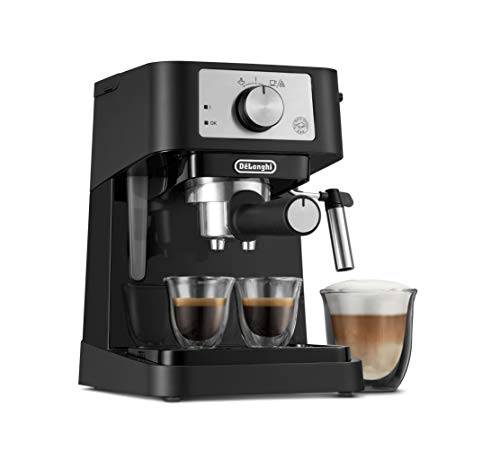
The Stilosa is the straightforward entry point in this group: a manual pump machine with a maker-stated 15-bar pump, a stainless steel boiler and a manual panarello steam wand for frothing milk for lattes and cappuccinos. You control the shot from start to finish, starting and stopping the pump yourself, which makes it a forgiving way to learn the basics of tamping and timing.
The portafilter works with ground coffee in the included single and double filter baskets, and De’Longhi also rates it for ESE pods when you want a no-measure option. A tamper is included in the box. There is no built-in grinder, so plan on a separate burr grinder or pre-ground espresso coffee. The footprint is compact for a boiler machine, at 13.5 by 8.07 by 11.22 inches per the maker, and the water tank removes for filling.
Specs
- Model: EC260BK
- Pump: 15 bar (maker-stated)
- Heating: Stainless steel boiler
- Milk frothing: Manual panarello steam wand
- Built-in grinder: No
- Water tank: 1 liter, removable
- Also accepts: ESE pods; tamper included
De’Longhi Dedica Arte (EC885M)

The Dedica Arte is built for narrow counters. De’Longhi puts its width at about 15 centimeters, roughly six inches, which makes it one of the slimmest pump machines in this guide. Inside, a thermoblock heating system brings water up to temperature on demand rather than holding a boiler full of hot water, and the pump is rated at 15 bar by the maker.
Its MyLatteArt steam wand is a manual wand shaped, as De’Longhi describes it, for producing a dense microfoam for latte art, and you stay in control of texture and temperature. De’Longhi states three brewing temperature levels, so you can adjust heat for different roasts. Like the Stilosa, it takes ground coffee or ESE pods, and there is no built-in grinder. The removable tank holds 1.1 liters, generous for a machine this narrow.
Specs
- Model: EC885M
- Pump: 15 bar (maker-stated)
- Heating: Thermoblock
- Milk frothing: MyLatteArt manual steam wand
- Built-in grinder: No
- Water tank: 1.1 liters, removable
- Width: About 6 inches (maker-stated)
KitchenAid Semi-Automatic Espresso Machine (KES6503)

KitchenAid’s semi-automatic machine is the traditionalist of the group: a metal-bodied unit built around a 58-millimeter portafilter, the commercial basket size, which opens up a wide range of aftermarket baskets and tampers. KitchenAid states a 15-bar Italian pump and a thermocoil heating system that heats water as it is needed for brewing and steaming.
A commercial-style steam wand handles milk frothing manually, and a cup warmer on top keeps cups from chilling a fresh shot. There is no built-in grinder on this model, so it fits best in a kitchen that already has a capable burr grinder, or with pre-ground coffee. The removable water tank holds 1.4 liters. For buyers who like the ritual of grinding, dosing and tamping as separate steps, this is the most classically laid-out machine here.
Specs
- Model: KES6503 (KES6503SX)
- Pump: 15 bar (maker-stated)
- Heating: Thermocoil
- Portafilter: 58 mm
- Milk frothing: Manual steam wand
- Built-in grinder: No
- Water tank: 1.4 liters, removable
Breville Barista Pro (BES878BSS)
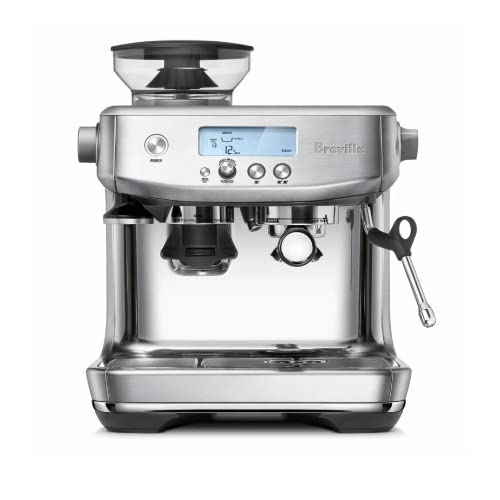
The Barista Pro is the all-in-one step up. Breville’s ThermoJet heating system is stated by Breville to reach brewing temperature in three seconds, and an integrated conical burr grinder feeds straight into the 54-millimeter portafilter, so grinding, dosing and tamping all happen at one station. The pump is rated at 15 bar by Breville, and an LCD display walks through grind size, shot volume and timing.
Milk is handled by a manual steam wand, keeping texture under your control, and Breville describes the wand’s steam pressure as suited to producing a fine microfoam. The removable water tank holds 67 ounces, the largest in this guide alongside the Ninja, which suits households pulling several drinks in a row. If you want a single machine that covers grinding and brewing with the least waiting, this is the most complete package of the five.
Specs
- Model: BES878BSS
- Pump: 15 bar (maker-stated)
- Heating: ThermoJet (maker states 3-second heat-up)
- Milk frothing: Manual steam wand
- Built-in grinder: Yes, integrated conical burr
- Water tank: 67 ounces, removable
- Display: LCD
Ninja Luxe Café Premier (ES601)
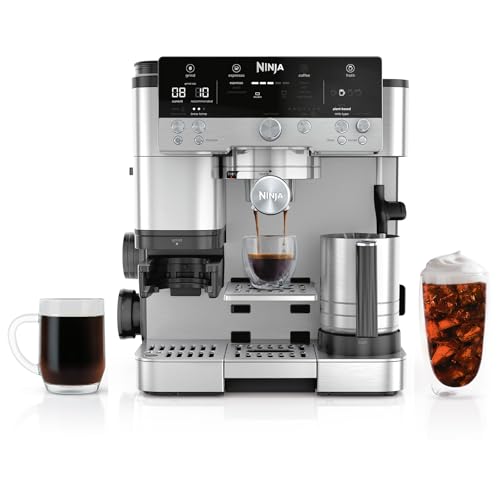
The Ninja Luxe Café Premier takes a different brief: it is a three-in-one machine that, per Ninja, brews espresso, drip coffee and rapid cold brew from the same unit. An integrated conical burr grinder offers 25 grind settings as stated by Ninja, and its Barista Assist Technology recommends a grind size for each drink and doses by weight using a built-in scale, which removes much of the trial and error for newer users.
Milk works differently here too. The Dual Froth System is a hands-free frother: Ninja states it produces preset froth styles, from steamed milk to cold foam, without holding a pitcher under a wand. An assisted tamper is included to keep puck preparation consistent. The removable reservoir holds 70 ounces per Ninja, the largest in this guide. Households split between espresso drinks and regular drip coffee will get the most from this design.
Specs
- Model: ES601
- Type: 3-in-1 espresso, drip coffee and cold brew (maker-stated)
- Pump: Pressure managed by Barista Assist system (per maker)
- Milk frothing: Dual Froth System, hands-free
- Built-in grinder: Yes, integrated conical burr, 25 settings (maker-stated)
- Water tank: 70 ounces, removable
- Extras: Assisted tamper, built-in dosing scale
How these compare with other ways to make espresso
Fully automatic bean-to-cup machines go one step past the Barista Pro and Ninja: they grind, tamp and brew at the touch of a button, trading practical control for maximum convenience, and they sit at the top of the home price range. Pod machines are the opposite pole: they are fast and tidy, but they lock you into one capsule system and give up fresh grinding entirely. Stovetop moka pots cost very little and make a strong, espresso-like coffee, though they do not produce true pump espresso or steamed milk. Manual lever machines offer the most direct control of all, at the price of a steep learning curve. The five machines above sit in the productive middle: real pump extraction with as much automation as you choose to pay for.
FAQ
Do I need a built-in grinder?
Not necessarily. A built-in grinder, as on the Barista Pro and the Ninja, saves space and simplifies dosing. A separate burr grinder usually offers finer adjustment and can be upgraded on its own, which is the route the Stilosa, Dedica Arte and KitchenAid assume. What matters most is a consistent, fine grind, whichever box it comes from.
What does the bar number on an espresso machine actually mean?
It is the pump’s maximum pressure rating, stated by the maker. Espresso extracts at well below that maximum, so a 15-bar or higher rating does not by itself promise a better-tasting shot. Grind consistency, dose, tamping and stable water temperature have far more effect on the result than the headline number.
How often do espresso machines need descaling?
It depends on your water hardness and how much you brew. Makers typically signal descaling with an indicator light or a set interval in the manual. Follow the schedule and the pressure-release steps in your machine’s manual, since scale buildup affects both temperature stability and pump life.
Can these machines use pre-ground coffee or pods?
Yes, with limits. All five accept pre-ground coffee in their filter baskets, though fresh-ground coffee gives you control over extraction. The two De’Longhi models also accept ESE pods. The Barista Pro and Ninja are designed around whole beans for their built-in grinders, but both can work with pre-ground coffee when needed, per their makers.
Final verdict
Pick the Breville Barista Pro if you want one machine that grinds and brews with minimal heat-up time and you are happy frothing milk by hand. Pick the Ninja Luxe Café ES601 if your household splits its drinking between espresso, drip and cold brew and you want grind guidance and hands-free frothing. The KitchenAid KES6503 is the choice for a classic, grinder-separate setup built around a 58-millimeter portafilter. Between the two De’Longhi models, the Dedica Arte wins on its slim thermoblock design and temperature settings, while the Stilosa is the simplest route into manual espresso, with a boiler, a panarello wand and pods as a fallback.
Product and ASIN Reference
| Product | ASIN |
|---|---|
| De’Longhi Stilosa Espresso Machine (EC260BK) | B08C96BG9H |
| De’Longhi Dedica Arte Espresso Machine (EC885M) | B09HLB4DP4 |
| KitchenAid Semi-Automatic Espresso Machine (KES6503) | B09B19NBGR |
| Breville Barista Pro Espresso Machine (BES878BSS) | B08133HX34 |
| Ninja Luxe Café Premier Espresso Machine (ES601) | B0D45PK5V4 |