Our Short List of 3

- Best for: Highway commuters and economy-minded owners of late-model gasoline cars.
- Viscosity: 0W-20
- Liquid volume: 160 fluid ounces (5 Quart)
- Item model number: 120758
- Formula: Triple Action Formula

- Best for: Drivers stretching intervals on turbocharged or hard-worked gasoline engines, including hybrids.
- SAE J300 viscosity grade: 0W-20
- Size: 5 Quarts
- Model: 03124
- UPC: 079191231241

- Best for: Mixed-use family vehicles needing balanced, everyday full synthetic protection.
- SAE J300 viscosity grade: 0W-20
- Size: 5 QT
- Manufacturer part number: 881150
- UPC: 074130031777
All 5 Picks at a Glance
| Product | Specs | Action |
|---|---|---|
| Mobil 1 Advanced Fuel Economy Full Synthetic Motor Oil 0W-20, 5 Quart |
| Check price on Amazon |
| Castrol EDGE 0W-20 Advanced Full Synthetic Motor Oil, 5 Quarts |
| Check price on Amazon |
| Valvoline Advanced Full Synthetic SAE 0W-20 Motor Oil 5 QT |
| Check price on Amazon |
 Valvoline Restore & Protect Full Synthetic 0W-20 Motor Oil 5 Quart |
| Check price on Amazon |
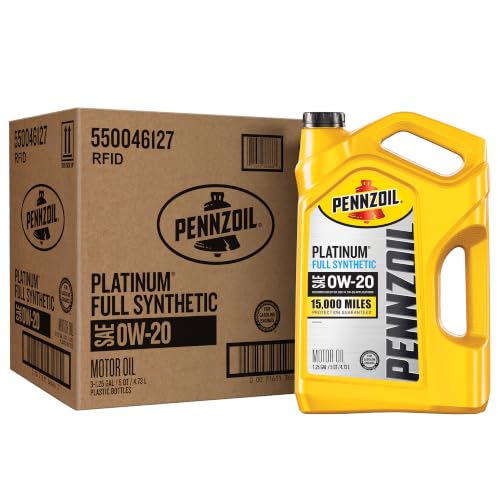 Pennzoil Platinum Full Synthetic 0W-20 Motor Oil (5-Quart, Case of 3) |
| Check price on Amazon |
Key takeaways
- Compare the best 0W-20 full synthetic motor oils for modern gasoline engines, with picks for fuel economy, deposit cleanup, hybrids, and bulk buying.
Choosing a 0W-20 full synthetic oil looks simple until you stand in front of five jugs that all promise protection, cleanliness, and better mileage. The real decision is not the viscosity grade, because your owner’s manual already fixed that. It is which formulation matches how your engine actually lives: short cold trips, long highway commutes, a hybrid that restarts constantly, or an older motor quietly building piston deposits. Picking on habit alone can leave the one problem your engine has completely unaddressed.
This guide serves daily drivers of late-model sedans and crossovers, hybrid owners, and anyone maintaining a higher-mileage gasoline engine at home. Every pick below was chosen from the names, specifications, and approvals printed on its Amazon product page, so the differences described here come from the listings themselves rather than from marketing roundups.
Quick Picks
As an Amazon Associate we earn from qualifying purchases
| Product | Best for | Key spec from title |
|---|---|---|
| Mobil 1 Advanced Fuel Economy Full Synthetic Motor Oil 0W-20, 5 Quart | Fuel-economy-focused daily driving | Triple Action Formula, 5 Quart |
| Castrol EDGE 0W-20 Advanced Full Synthetic Motor Oil, 5 Quarts | Long drain intervals and hard use | Advanced Full Synthetic, 5 Quarts |
| Valvoline Advanced Full Synthetic SAE 0W-20 Motor Oil 5 QT | All-round wear and deposit defense | Advanced Full Synthetic, 5 QT |
| Valvoline Restore & Protect Full Synthetic 0W-20 Motor Oil 5 Quart | Engines with existing piston deposits | Restore & Protect, 5 Quart |
| Pennzoil Platinum Full Synthetic 0W-20 Motor Oil (5-Quart, Case of 3) | Stocking up for several oil changes | Full Synthetic, Case of 3 |
How to Choose
Match the approvals on the back label to your manual
A 0W-20 grade alone does not make an oil correct for your car. Your manual also names industry and manufacturer specifications, and the jug has to carry them. Look for the current ILSAC and API categories for gasoline engines, plus any maker-specific approval your brand requires, such as a Ford or Chrysler specification code. Two oils can share a viscosity grade while only one lists the approval your engine was designed around. Read the specification lines on the listing carefully and compare them word for word with the manual before ordering, especially on newer turbocharged models.
Decide what problem the oil should solve
Full synthetic 0W-20 oils split into distinct families. Fuel-economy lines use low-viscosity formulations aimed at squeezing more distance from each tank. Extended-performance lines are built to hold up across longer intervals between changes. Cleanup-focused formulas target deposits already sitting on pistons in older engines. A hybrid-specific oil instead prioritizes protection across constant stop-start cycles. None of these is universally better; each trades emphasis. Naming your engine’s main stress first, whether that is cold starts, sludge history, or long commutes, turns a wall of similar jugs into a short list with a clear winner.
Check the pack size against your sump capacity
Most cars that call for 0W-20 take somewhere around four to six quarts with a filter change, but the exact figure varies by engine. A single five-quart jug covers the majority of passenger cars with a little left for topping up. Larger engines, and households maintaining two vehicles on the same grade, may do better with a multi-jug case that lowers the hassle of reordering. Check your manual’s stated capacity with a filter replacement, then buy the format that covers it without leaving you a quart short on a Sunday afternoon.
Plan the interval around your driving pattern
The mileage figure printed on a jug describes the oil’s protection capability under the maker’s stated conditions, not a promise that your car can stretch that far. Severe service, meaning short trips, dusty roads, towing, or long idling, shortens any interval regardless of the oil chosen. Your vehicle manufacturer’s schedule and the oil life monitor, when fitted, remain the authority. Choose a longer-interval oil if your driving is mostly steady highway work; if your routine is five-minute school runs, a standard interval with a quality oil serves the engine better than any extended claim.
The 5 Best Options
Mobil 1 Advanced Fuel Economy Full Synthetic Motor Oil 0W-20, 5 Quart
- Best for: Highway commuters and economy-minded owners of late-model gasoline cars.
- Viscosity: 0W-20
- Liquid volume: 160 fluid ounces (5 Quart)
- Item model number: 120758
- Formula: Triple Action Formula
Highway commuters and economy-minded owners of late-model gasoline cars.
Confirm your manual does not require a maker-specific approval beyond the ILSAC and API categories printed for this listing.
This is the pick for drivers whose 0W-20 requirement is really about efficiency. The listing describes a low-viscosity formulation intended to help improve fuel economy, paired with Mobil 1’s Triple Action Formula for performance, protection, and cleanliness. It is positioned to protect critical engine parts for up to 10,000 miles between oil changes while controlling oxidation and holding viscosity. For a commuter car that racks up steady miles and whose manual asks for nothing more exotic than a modern ILSAC oil, this jug covers the brief without paying for capabilities the engine will never use.
Castrol EDGE 0W-20 Advanced Full Synthetic Motor Oil, 5 Quarts
- Best for: Drivers stretching intervals on turbocharged or hard-worked gasoline engines, including hybrids.
- SAE J300 viscosity grade: 0W-20
- Size: 5 Quarts
- Model: 03124
- UPC: 079191231241
Drivers stretching intervals on turbocharged or hard-worked gasoline engines, including hybrids.
A long protection claim only applies when your vehicle manufacturer permits the longer interval, so verify the schedule in your manual first.
Castrol’s flagship line suits engines that work hard between changes, including turbocharged motors and vehicles driven in stop-and-go heat. The listing presents EDGE as an advanced full synthetic built around strength under pressure, and the label carries a protection claim stretching to 20,000 miles, the longest horizon among the single jugs gathered here. It also states suitability for hybrids, which broadens its fit beyond conventional gasoline cars. If your schedule makes frequent changes impractical and your manual allows extended intervals, this is the formulation designed to be left in the sump longer.
Valvoline Advanced Full Synthetic SAE 0W-20 Motor Oil 5 QT
- Best for: Mixed-use family vehicles needing balanced, everyday full synthetic protection.
- SAE J300 viscosity grade: 0W-20
- Size: 5 QT
- Manufacturer part number: 881150
- UPC: 074130031777
Mixed-use family vehicles needing balanced, everyday full synthetic protection.
Check the jug size against your engine’s capacity, since some larger 0W-20 engines need more than five quarts with a filter.
Valvoline’s mainstream full synthetic is the straightforward all-rounder of this group. The listing frames it as advanced protection against the four main causes of engine breakdown: wear, friction, heat, and deposits. Nothing in its positioning is niche, which is precisely its appeal for a family car that does a bit of everything, school runs in winter, loaded road trips in summer, and long stretches of commuting in between. It carries the dexos1 Gen 3 mark shown on the label imagery, a useful box ticked for owners of GM vehicles that specify that approval by name.
Valvoline Restore & Protect Full Synthetic 0W-20 Motor Oil 5 Quart
- Best for: Higher-mileage engines with suspected piston deposits and a history of stretched intervals.
- Size: 5 Quart
- Model: 904538-EA
- Meets the requirements of: ILSAC GF-7A, API SQ, API SP, API SN with SN PLUS, Resource Conserving
- Additional specifications: Ford WSS-M2C962-A1, Chrysler MS-6395
Higher-mileage engines with suspected piston deposits and a history of stretched intervals.
The deposit-removal claim is built on consecutive use, so plan on several changes with this oil before judging the result.
This line exists for engines that already have a deposit problem rather than ones hoping to avoid it. The listing describes Active Clean Technology aimed at removing piston deposits across consecutive oil changes, with a Liqui-Shield component intended to keep new deposits from forming afterward. That makes it a deliberate multi-change strategy, not a one jug cure, and the listing is explicit that the cleaning builds over four consecutive changes. Owners of aging cars with sluggish response or a history of neglected intervals will find this the most purpose-built option here.
Pennzoil Platinum Full Synthetic 0W-20 Motor Oil (5-Quart, Case of 3)
- Best for: Multi-car households and planners who want several changes covered in one order.
- SAE J300 viscosity grade: 0W-20
- Size: 3-Pack of 5-Quart jugs
- Model: PENNZOIL – 550046127 – 3/PACK 0W20
- Global Trade Identification Number: 00071611366663
Multi-car households and planners who want several changes covered in one order.
You are committing to three jugs, so confirm both your current and next vehicle actually specify 0W-20 before choosing the case.
Pennzoil Platinum is the household-stocking option, sold here as three five-quart jugs in a single case. The listing backs the oil with a 15,000-mile protection guarantee, and the Platinum line is made from natural gas rather than crude oil, a distinction Pennzoil prints prominently on its product pages. For a two-car household where both vehicles take 0W-20, or a single car whose owner simply dislikes reordering, the case format removes the recurring errand and keeps the same formulation on the shelf for the next two changes after this one.
Which One Fits Your Situation
Your commute is long, steady, and mostly highway
Sustained cruising is the gentlest work an engine does, and it is where a fuel-economy formulation earns its keep. Choose the Mobil 1 Advanced Fuel Economy jug, whose low-viscosity design and 10,000-mile protection positioning suit cars that cover distance in long, warm runs. Pair it with your manufacturer’s normal interval and a fresh filter each time, and the efficiency focus of the oil aligns with the way the car is actually used every day.
Your engine is older and its history is patchy
When service records are thin and the odometer is high, deposits are the likeliest hidden issue. The Valvoline Restore & Protect oil is built for exactly this case, working across consecutive changes to remove piston deposits while defending against new ones. Commit to it for several changes in a row rather than alternating brands, since the listing’s cleaning claim depends on continuous use, and keep intervals conservative until the engine’s condition is better understood.
You run a hybrid with constant restarts
Hybrid powertrains shut down and relight the engine far more often than conventional cars, which changes what the oil endures. The Castrol EDGE listing states suitability for hybrids alongside its long protection horizon, making it a sensible match for that stop-start duty cycle. Confirm the specification codes in your hybrid’s manual match the label, then follow the manufacturer’s interval, since hybrid oil life monitors account for the engine’s unusual running pattern.
Two cars in the driveway share the same grade
Households maintaining a pair of 0W-20 vehicles burn through jugs quickly, and mid-job shortages are a real annoyance. The Pennzoil Platinum case of three five-quart jugs keeps enough oil on the shelf for several services across both cars. Its stated 15,000-mile protection guarantee gives scheduling flexibility, and standardizing on one formulation simplifies records, filters aside, for the whole household fleet.
Common Mistakes
- Buying by viscosity alone and ignoring the API, ILSAC, and manufacturer approvals your manual also requires.
- Stretching an oil change to the jug’s maximum protection figure when your driving qualifies as severe service.
- Switching to a thicker grade such as 5W-30 because an older engine sounds noisy, instead of diagnosing the noise.
- Mixing a cleanup oil into a rotation of random brands, which undermines formulations designed to work over consecutive changes.
- Forgetting the filter, or reusing the old one, which sends a fresh fill of oil straight through trapped contaminants.
Frequently Asked Questions
Can I switch between these brands at each oil change?
Yes, provided every oil you use meets the grade and specifications in your owner’s manual. Modern full synthetic 0W-20 oils are compatible with one another, and draining and refilling with a different brand is routine. The exception is a cleanup formulation such as Restore & Protect, whose listing bases its deposit-removal claim on consecutive use, so rotating away from it mid-course weakens the point of choosing it.
Is 0W-20 too thin to protect an engine in hot weather?
No, not for an engine designed around it. The 20 in the grade describes the oil’s viscosity at operating temperature, and engines built for 0W-20 have clearances and oil pumps matched to that flow. In a hot climate the oil still forms the film the manufacturer engineered for. Problems arise when a different grade is substituted on guesswork, not when the specified grade is used as intended.
How often should I change 0W-20 full synthetic oil?
Follow the interval in your owner’s manual or the reading of the car’s oil life monitor, whichever system your vehicle uses. Jug labels state how long the oil can protect under the maker’s conditions, but severe service such as short trips, towing, or dusty roads shortens real-world intervals. When in doubt, the manufacturer’s severe-service schedule is the safer guide for your engine.
Does my hybrid really need a specific 0W-20 oil?
A hybrid needs the same grade and approvals as any other engine, but its constant restarts place unusual demands on the oil, including moisture and fuel dilution from frequent cold running. Some listings, including the Castrol EDGE one above, state hybrid suitability explicitly. If your manual names no hybrid-specific requirement, any 0W-20 carrying the correct approvals works; if it does name one, match it exactly.