Our Short List of 3
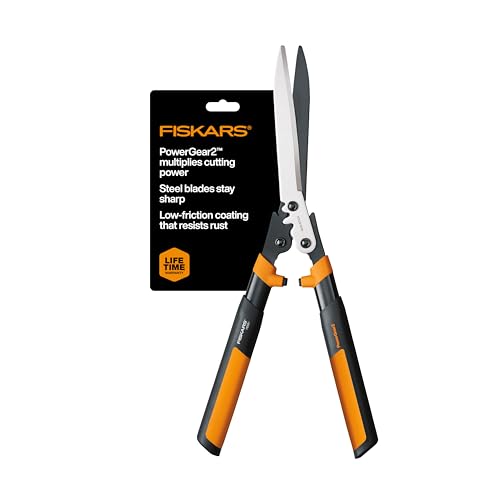
- Best for: Repeated shaping of waist- to shoulder-high hedges where hand comfort decides the pace.
- Blade length: 10 inches
- Blade: precision-ground steel with low-friction coating
- Overall length: 23 inches
- Mechanism: PowerGear2 gear drive

- Best for: Tall privacy hedges and deep beds where reach matters more than fine detail.
- Handle length: adjusts from 25 to 33 inches
- Blade length: 10 inches
- Blade: serrated alloy steel, self-sharpening Gator-Blade edge
- Blade type: bypass

- Best for: Tall bushes and borders where stems slide on straight blades.
- Overall length: 25 inches closed, 33 inches extended
- Blade: wavy edge, forged carbon steel
- Handles: telescopic steel with non-slip grips
- Shock-absorbing bumpers
All 3 Picks at a Glance
| Product | Specs | Action |
|---|---|---|
| Fiskars PowerGear2 Hedge Shears, 23-Inch |
| Check price on Amazon |
| Fiskars Power-Lever Extendable Hedge Shears |
| Check price on Amazon |
| TABOR TOOLS B212A Telescopic Hedge Shears |
| Check price on Amazon |
Key takeaways
- Three manual hedge shears compared on listing specs: a geared Fiskars, an extendable Fiskars and a wavy-blade Tabor, with blade and handle details.
The real decision with hedge shears is how your hedges fight back. Soft new growth on a waist-high boxwood needs a light tool that glides along a flat face; a tall privet screen needs reach more than finesse; and woody, springy stems that slide toward the blade tips need an edge shape that holds them in place. Choosing on brand alone ignores all three, which is how a well-made pair of shears ends up feeling wrong for the yard it works in.
This roundup is for homeowners shaping formal hedges, gardeners maintaining tall privacy screens without living on a ladder, and anyone whose hands give out before the hedge is finished. The three picks below cover a geared fixed-length shear, a telescoping lever model and a wavy-blade telescopic pair. Every detail comes from the products’ Amazon listings and product information: blade lengths, handle ranges, materials and listed weights, with nothing added from outside sources.
Quick Picks
As an Amazon Associate we earn from qualifying purchases.
| Product | Best for | Key spec from title |
|---|---|---|
| Fiskars PowerGear2 Hedge Shears | Geared help for everyday shaping | 10-inch precision-ground steel blade |
| Fiskars Power-Lever Extendable Hedge Shears | Tall hedges without a ladder | Handles adjust from 25 to 33 inches |
| TABOR TOOLS B212A Telescopic Hedge Shears | Grip for springy, sliding stems | Wavy forged carbon steel blade |
How to Choose
Blade shape decides the finish
Straight blades shear a flat plane cleanly, which is why formal boxwood and yew respond well to them: the edge passes through soft tips without tearing. Wavy blades trade a little of that fineness for grip, because each curve traps stems that would otherwise slide toward the tips, where leverage is weakest. Serrated edges grip hardest of all and suit coarse, woody growth, though they can leave a rougher face on tender new shoots. Match the edge to the growth you cut most often, not the toughest branch you meet twice a year, and the finish takes care of itself.
Handle length sets your working height
Fixed shears around 23 inches keep the pivot close to your body, which gives control for flat faces and corners at waist to chest height. Telescoping handles that run from about 25 to 33 inches buy reach for the tops of tall screens and the far side of deep beds, so more of the job happens with both feet on the ground. The trade-off is weight and balance: extended steel handles shift the load outward and tire shoulders faster. If your hedges sit below shoulder height, the shorter fixed tool is usually the calmer, more accurate choice.
Leverage help matters more than blade size
A plain pivot asks your hands to supply all the force, which is fine for soft tips and short sessions. Geared and compound-lever designs multiply that force at the pivot, so the same squeeze moves thicker stems and leaves your grip fresher at the end of a long run along a hedge face. The listings below describe one mechanism that multiplies leverage through gears and another that doubles it through a lever arrangement. If arthritis, smaller hands or dense old hedges are part of your reality, leverage help is the first feature to pay attention to.
Weight, bumpers and upkeep decide day two
Shears that feel fine for ten minutes can punish wrists over an afternoon, so compare the listed weights before anything else: the picks here run from 2.5 to about 3.24 pounds. Shock-absorbing bumpers soften the jolt each time the handles close fully, and cushioned grips spread pressure across the palm instead of concentrating it. Upkeep separates tools just as much over a season of use. Low-friction coatings slow sap build-up and rust, self-sharpening edges reduce bench time, and an adjustable tension knob lets you reset blade play as the pivot wears in.
The 3 Best Options
Fiskars PowerGear2 Hedge Shears, 23-Inch
- Best for: Repeated shaping of waist- to shoulder-high hedges where hand comfort decides the pace.
- Blade length: 10 inches
- Blade: precision-ground steel with low-friction coating
- Overall length: 23 inches
- Mechanism: PowerGear2 gear drive
Repeated shaping of waist- to shoulder-high hedges where hand comfort decides the pace.
The fixed 23-inch length gives no extra reach, so tall screens still mean a ladder or a different tool.
Gardeners who shape the same hedges several times a season will feel the point of this one quickly. The PowerGear2 mechanism multiplies leverage at the pivot, so trimming runs of privet, boxwood or yew ask less of your hands than a plain pivot of the same size, while the 23-inch frame keeps the blades close enough for flat, controlled passes. SoftGrip handles and shock-absorbing bumpers suit longer sessions, and at 2.5 pounds it is the lightest pick here. It is a fixed-length tool, so its comfort zone is hedges you can reach from the ground at waist to shoulder height.
Fiskars Power-Lever Extendable Hedge Shears
- Best for: Tall privacy hedges and deep beds where reach matters more than fine detail.
- Handle length: adjusts from 25 to 33 inches
- Blade length: 10 inches
- Blade: serrated alloy steel, self-sharpening Gator-Blade edge
- Blade type: bypass
Tall privacy hedges and deep beds where reach matters more than fine detail.
Serrated edges grip well but leave a coarser finish on soft new growth, and the tool grows front-heavy at full extension.
This is the pick for hedges that outgrew a standard pair of shears. The steel handles telescope from 25 to 33 inches and lock at the length you set, which puts the tops of tall screens and the back of deep beds within reach while your feet stay planted. A Power-Lever mechanism adds leverage at the pivot, and the serrated Gator-Blade edge grips stems instead of pushing them along the blade toward the tips. The design is self-sharpening, so the edge maintains itself as you work through a long hedge run from one end to the other.
TABOR TOOLS B212A Telescopic Hedge Shears
- Best for: Tall bushes and borders where stems slide on straight blades.
- Overall length: 25 inches closed, 33 inches extended
- Blade: wavy edge, forged carbon steel
- Handles: telescopic steel with non-slip grips
- Shock-absorbing bumpers
Tall bushes and borders where stems slide on straight blades.
The heaviest option here, and the wavy edge gives a slightly less fine finish than a straight blade on soft tips.
Springy growth is where straight blades lose their argument, and this Tabor answers with a wavy edge. Each curve of the forged carbon steel blade traps stems as the handles close, so boxwood, privet and tall bush tips stay put instead of sliding toward the weak end of the cut. The steel handles telescope from 25 to 33 inches, shock-absorbing bumpers soften each full close, and a tension adjustment lets you tune blade play as the pivot settles in. At 3.24 pounds it is the heaviest pick here, which suits deliberate, reach-first work better than fast detail passes.
Which One Fits Your Situation
A formal hedge you shape several times a year
Choose the PowerGear2. A flat face at waist height rewards control and low effort more than reach, and the geared pivot keeps your grip fresh across repeated passes. The 23-inch frame stays close to your body for corners and ends, and the low-friction coating shrugs off the sap that boxwood and privet leave behind during a long shaping session in warm weather.
A tall privacy screen and no ladder
Choose the Power-Lever Extendable. Set the handles near their 33-inch maximum and the tops of most screens come into range from the ground, with the serrated edge holding stems that sit far from your hands. Work in shorter pulls rather than full sweeps, because leverage drops as the handles lengthen, and let the lever mechanism do most of the squeezing for you.
Springy growth that slides out of straight blades
Choose the TABOR B212A. The wavy edge exists for exactly this problem: stems lodge in the curves instead of skating toward the tips, so each close finishes the cut instead of pushing growth aside. Extend the handles for the back of deep borders, shorten them for face work, and use the tension adjustment when the blades begin to fold leaves rather than slice them.
One tool for a mixed yard on a long afternoon
Begin with the PowerGear2 if most of your hedging sits at comfortable height, because its 2.5 pounds and shock-absorbing bumpers ask the least of your arms over hours of work. Add the Tabor only when tall or sliding growth is a regular problem rather than an annual one; a second, heavier telescopic pair earns its storage space only when it solves a recurring reach problem.
Common Mistakes
- Reaching for hedge shears when a stem really needs loppers: the blades fold or twist on woody branches, and the pivot loosens long before the branch gives way.
- Trimming the top first and the faces second, which drops clippings into the finished face and hides the line you are trying to hold.
- Letting sap dry on the blades between sessions; a quick wipe and a drop of oil after work keeps the coating doing its job.
- Extending telescopic handles to full length for every cut, even at waist height, which trades away control for reach you do not need.
- Storing shears closed and damp in a shed corner, where moisture sits between the blades and rust spots form along the edge.
Frequently Asked Questions
How long should hedge shear blades be?
For most home hedges, blades around 10 inches balance coverage with control: each pass clears a useful width of face without the tip wandering. Shorter blades suit tight topiary corners, while longer blades speed up long flat runs but amplify every wobble in your hands. All three picks here use blades in that general working range, paired with handles sized for different heights.
Are wavy blades better than straight blades?
Neither wins everywhere. A wavy edge grips stems and stops them sliding toward the tips, which helps on springy, leafy growth and tall bushes. A straight edge leaves the finer finish on formal faces, where a flat plane matters more than grip. Choose by the growth you cut most often, and accept the small compromise on the other kind of trimming.
Can hedge shears cut thick branches?
Hedge shears are built for soft tips and light stems spread across a wide face, not for single thick branches. Forcing woody growth twists the blades, opens the pivot and leaves crushed stems behind. Keep a pair of loppers for anything that resists a clean close, and use the shears for the shaping work they are shaped for.
How do I stop the blades gumming up?
Wipe the blades with a cloth as soon as the session ends, before sap hardens, then add a light film of oil along each edge. Coated blades, like the low-friction finish on the PowerGear2 above, release sap more easily, but they still benefit from the same routine. Store the shears dry and slightly open so moisture cannot sit between the blades.