Key takeaways
- Compare the best whetstones for home sharpening, from a coarse 400/1000 repair kit to Japanese 1000/6000 stones and a fine 5000-grit finisher.
A dull kitchen knife slows down prep and makes every cut less predictable, because the blade slides instead of biting into food. Pull-through and electric sharpeners remove metal quickly, but a water whetstone gives you direct control over the sharpening angle and the finish you leave on the edge, and it works on a wide range of blade steels and knife styles. For home cooks willing to learn a simple, repeatable motion, a whetstone is the most flexible sharpening tool you can own.

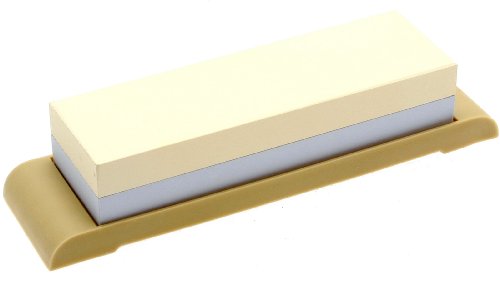
The five picks below cover the main jobs a home sharpener actually faces. There are two-sided combination stones that pair a sharpening grit with a finishing grit, a Japanese starter set with an angle holder, a compact dual-grit stone for small kitchens, a large combination waterstone, and a single-grit ceramic finishing stone. Each entry lists grit ratings, dimensions, and included accessories exactly as the maker states them, so you can match a stone to the knives you own and the condition those knives are in.
As an Amazon Associate, we earn from qualifying purchases.
Quick answer
If you buy only one stone, make it a 1000/6000 combination like the King Whetstone Starter Set, which covers routine sharpening and finishing in a single block. For knives that are very dull or lightly chipped, start with the Sharp Pebble 400/1000 kit. Add the Shapton Pro 5000 later when you want a finer, more polished finish.
1. Sharp Pebble Premium Whetstone Kit, 400/1000
The Sharp Pebble 400/1000 kit is built around the first stage of sharpening: repairing an edge that has gone properly dull. The 400-grit side is the coarse face, meant for reworking tired edges and light nicks, while the 1000-grit side does the regular sharpening that most kitchen knives need. Sharp Pebble bundles the stone with a flattening stone, which matters because a water stone gradually wears hollow in the middle, and the included non-slip rubber base helps keep the block steady on the counter while you work.
Because both faces sit at the coarse-to-medium end of the range, this kit is a starting point rather than a complete system. It pairs naturally with a finer stone later, but on its own it handles the heavy lifting that finer stones are too slow to do.
Specs
- Grit: 400 on one side, 1000 on the other
- Model: SP_400
- Included: flattening stone and non-slip rubber base
- Stone type: water stone, used with water
Who it’s for / who should skip
For: beginners whose knives are very dull, and anyone who needs a coarse repair grit in the drawer. Skip it if your knives only need light maintenance and polishing, because there is no fine finishing side in this kit.
2. King Whetstone Starter Set, 1000/6000
King, made by the Matsunaga Stone Company in Japan, is the name most often attached to the classic 1000/6000 combination stone, and this starter set wraps that pairing in a beginner-friendly bundle. The 1000-grit side handles the main sharpening work, and the maker describes the 6000-grit side as the finish-sharpening face. Alongside the stone you get a knife angle holder that clips onto the blade spine to help hold a steady angle, a wiping cloth, and a stable plastic base.
The 1000/6000 pairing is popular for a reason: one side restores a working edge on a dull knife, and the other refines it, so a single purchase covers the full routine for most home kitchens. The angle holder is a useful training aid while the motion is still new.
Specs
- Grit: 1000 on one side, 6000 on the other
- Origin: made in Japan
- Included: knife angle holder, wiping cloth, and plastic base
- Stone type: combination water stone
Who it’s for / who should skip
For: first-time whetstone users who want one stone that sharpens and finishes, plus a guide to help learn the angle. Skip it if your knives have chips or serious damage, because there is no coarse repair grit in this set.
3. Norton Combination Waterstone, 1000/4000
Norton’s 1000/4000 combination waterstone, model 61463624450, stands out for its size. The working face measures 8 by 3 inches, wider than the typical combination stone, which gives longer knives and wider blades more room per stroke and can make it easier to keep a consistent angle. The abrasive is aluminum oxide in a bond that releases fresh particles as you sharpen, and Norton designs the stone to be soaked in water before use.
The 1000-grit side sets the edge and the 4000-grit side refines it. The finish from 4000 grit is a practical working finish for everyday cooking rather than a mirror polish, which suits cooks who sharpen often and cook daily.
Specs
- Grit: 1000 on one side, 4000 on the other
- Model: 61463624450, also listed as NT450
- Working surface: 8 by 3 inches
- Abrasive: aluminum oxide water stone, soaking required before use
Who it’s for / who should skip
For: cooks with longer chef’s knives who want a broad, stable sharpening surface and a sensible two-step grit range. Skip it if storage space is tight or you want the finest possible polish, since the range stops at 4000 grit.
4. Suehiro Japanese Sharpening Stone, 1000/3000
Suehiro is one of Japan’s long-established stone makers, and this compact dual-sided stone pairs a 1000-grit face for sharpening with a 3000-grit face for finishing. The maker describes the 1000 side as the standard sharpening grit and the 3000 side as the fine side for finishing work. A rubber base is included to hold the stone in place, and the smaller footprint suits kitchens where drawer and counter space are limited.
The 1000/3000 pairing is a step finer than a basic sharpening stone without jumping to a full polishing grit, which makes it a sensible single-stone routine for knives that are maintained regularly rather than rescued from neglect.
Specs
- Grit: 1000 on one side, 3000 on the other
- Included: rubber base
- Stone type: dual-sided water stone
- Format: compact combination stone
Who it’s for / who should skip
For: home cooks with limited storage who sharpen regularly and want sharpening and finishing in one small block. Skip it if you regularly sharpen long blades and would rather have the wider working surface of the Norton stone above.
5. Shapton Pro Kuromaku Ceramic Whetstone, 5000
The Shapton Pro 5000, model K0704 in the wine colorway, is a single-grit finishing stone from Shapton’s Kuromaku professional series. It is a ceramic stone designed as a splash-and-go: you wet the surface and start sharpening, with no soaking step. Shapton lists the stone at 210 by 70 by 15 millimeters, and the storage case doubles as a stone holder while you work.
A 5000-grit stone is not where you start with a dull knife. It is the step after a 1000-grit stone, refining the edge and smoothing the scratch pattern left by coarser abrasives. For cooks who already own a medium stone and want a cleaner finish, it is the natural next purchase.
Specs
- Grit: 5000, single-grit finishing stone
- Model: K0704, wine colorway
- Dimensions: 210 by 70 by 15 millimeters
- Stone type: ceramic, splash-and-go with no soaking
- Holder: storage case doubles as a stone holder
Who it’s for / who should skip
For: sharpeners who already own a medium-grit stone and want a finer finish, especially on Japanese-style knives. Skip it as your only stone, because 5000 grit alone is too fine to restore a dull edge in reasonable time.
How whetstones compare with other sharpeners
A honing rod does not really sharpen; it straightens a bent edge between sharpening sessions, so it complements a whetstone rather than replacing one. Pull-through and electric sharpeners are faster to learn and need no soaking or flattening, but they remove metal at a fixed angle and offer less control over the finish. Diamond plates stay flat and cut quickly, yet they leave a coarser scratch pattern and feel very different under the blade. Oil stones and natural Arkansas stones are durable alternatives, but they work more slowly than water stones of a similar grit. For most home kitchens, a combination water stone remains the most versatile single purchase, with a finer stone or a flattening stone added later as skills and interest grow.
When choosing between the stones above, think in terms of a progression rather than one perfect grit. A practical setup pairs a sharpening grit near 1000 with one finer step for finishing, and adds a coarse grit only if damaged knives are common in your kitchen. Also consider the working surface: a wider stone gives longer blades more room per stroke, while a compact stone stores more easily and is often enough for shorter utility and paring knives.
FAQ
What grit should a beginner start with?
A 1000-grit face is the standard starting point for a dull kitchen knife, and a combination stone that adds a finer side, such as 3000 or 6000, covers finishing too. Coarser grits around 400 are for repair work on damaged edges, and grits of 5000 and above are for refining an edge that is already sharp.
Do all whetstones need soaking before use?
No. Many traditional water stones are soaked in water until bubbles stop rising, following the time given in the maker’s instructions. Splash-and-go ceramic stones such as the Shapton Pro 5000 are only wetted on the surface and should be used as the maker directs, so always check the instructions packed with your stone.
Can a whetstone fix a chipped knife edge?
Small nicks can be worked out on a coarse grit such as the 400 side of the Sharp Pebble kit, by sharpening until the edge line is even again. Large chips and broken tips remove a lot of steel and take a long time by hand, so those repairs are often better handled by a professional sharpener.
How do I keep a whetstone flat?
Water stones wear unevenly, so check the surface against a straight edge and flatten it when a hollow develops. A flattening stone, included in the Sharp Pebble kit, is rubbed across the wet stone until the surface is level again. Flattening a little and often is easier than correcting a deeply dished stone.
Final verdict
For most home cooks, the King Whetstone Starter Set is the easiest recommendation: the 1000/6000 pairing covers sharpening and finishing, and the angle holder shortens the learning curve. If your knives are genuinely dull or nicked, begin with the Sharp Pebble 400/1000 kit instead and add a finer stone later. The Norton 1000/4000 suits cooks who want a larger working surface, the Suehiro 1000/3000 is the compact option, and the Shapton Pro 5000 is the finishing upgrade once a medium stone is already in the drawer.
Product and ASIN Reference
| Product | ASIN |
|---|---|
| Sharp Pebble Premium Whetstone Kit, 400/1000 | B01LVZ2OZU |
| King Whetstone Starter Set, 1000/6000 | B07V96KH7M |
| Norton Combination Waterstone, 1000/4000 | B07G4HBYKP |
| Suehiro Japanese Sharpening Stone, 1000/3000 | B00IJZ6ZZM |
| Shapton Pro Kuromaku Ceramic Whetstone, 5000 (K0704) | B001TPH8YG |