Our Short List of 3

- Best for: Lawns with moss patches plus moss on patios, decks, and roofs nearby.
- 32 fluid ounce ready-to-spray bottle
- Treats up to 500 square feet
- Active ingredient: potassium soap of fatty acids, 22.11 percent
- Kills moss, algae, lichen, mold, and mildew

- Best for: Lawns where moss grows alongside algae, lichens, or liverworts and a fast result matters.
- 32 fluid ounce bottle with hose-end applicator
- Treats up to 500 square feet
- Active ingredient: potassium salts with fatty acids
- Controls moss, algae, lichens, and liverworts
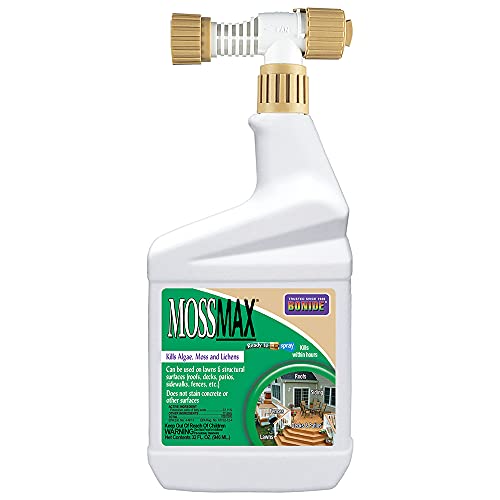
- Best for: Lawns and outdoor surfaces where the spray will also touch decks, fences, and paths.
- 32 fluid ounce ready-to-spray bottle
- Treats up to 500 square feet per the product label
- Active ingredient: potassium salts of fatty acids, 22.11 percent
- Kills moss, algae, and lichens
All 3 Picks at a Glance
| Product | Specs | Action |
|---|---|---|
| BioAdvanced 2-in-1 Moss and Algae Killer |
| Check price on Amazon |
| Scotts MossEx 3-in-1 Ready-Spray |
| Check price on Amazon |
| Bonide MossMax Ready-to-Spray |
| Check price on Amazon |
Key takeaways
- Compare the best liquid moss killers for lawns, with coverage, active ingredients, hose-end applicators, and lawn safety from Amazon listings.
Moss takes hold where grass is thin, damp, and shaded, and the real choice is not which bottle looks strongest but which liquid fits the size of the lawn, the surfaces around it, and the weather on spray day. A liquid moss killer works by soaking the moss so it turns yellow, then brown, and dies back, leaving the grass room to fill in. Granules need spreading and watering in, while a liquid goes on through a hose-end sprayer in one pass.
This guide is for homeowners with mossy patches in the lawn, for people whose moss also creeps onto patios and paths, and for anyone who wants a ready-to-spray bottle rather than a bag of granules. Each product below was picked from its name and specifications on its Amazon product page, with its volume, coverage, active ingredient, and applicator stated as the listing shows them.
Quick Picks
As an Amazon Associate we earn from qualifying purchases.
| Product | Best for | Key spec from title |
|---|---|---|
| BioAdvanced 2-in-1 Moss and Algae Killer | Lawns with moss patches plus nearby patios and roofs | 32 oz ready-to-spray for lawns, roofs, and patios |
| Scotts MossEx 3-in-1 Ready-Spray | Fast action on moss, algae, lichens, and liverworts | 32 fl. oz. hose-end applicator, treats 500 sq. ft. |
| Bonide MossMax Ready-to-Spray | Lawns and outdoor surfaces with a nonstaining formula | 32 oz ready-to-spray for algae, moss, and lichens |
How to Choose
Pick the applicator style that suits your lawn
Liquid moss killers come as ready-to-spray hose-end bottles or as concentrates that need mixing, and the applicator decides how much work the job takes. All three bottles in this guide attach to a garden hose, so you turn on the water and spray while keeping the sprayer moving for even coverage. A hose-end bottle suits lawns up to a few hundred square feet, while a large lawn may need a second bottle or a concentrate mixed in a pump sprayer. Check the coverage on the label before buying, since a single 32 ounce bottle in this guide treats 500 square feet.
Read the active ingredient and the lawn-safety claim
Most liquid moss killers for lawns use potassium salts of fatty acids, which attack moss and algae while leaving grass unharmed when used as directed. The BioAdvanced and Bonide bottles both list potassium soap of fatty acids at the same strength, while the Scotts bottle lists potassium salts with fatty acids as its active ingredient. Iron-based formulas are a different family, and they can stain concrete and stone, so they suit lawn-only use. If your moss sits next to a pale patio or pale stone edging, a nonstaining fatty-acid formula is the safer pick.
Match coverage to the size of the problem
A bottle that treats 500 square feet covers a modest lawn or a set of mossy patches, but a full front and back lawn will need several bottles or a larger size. Measure the mossy area rather than the whole lawn, since spot treatment uses far less product than a blanket spray. The BioAdvanced, Scotts, and Bonide bottles in this guide each treat 500 square feet per bottle, so count the bottles against the area you plan to spray. Buying one bottle short means a half-finished job and a second trip to the store.
Time the application around weather and temperature
Liquid moss killer needs a dry window to work, and heat changes how it behaves on grass. The Scotts label says to apply when no rain is expected for the next 24 hours, and not to use it on lawns when the temperature exceeds 85 degrees Fahrenheit. The BioAdvanced listing says it can be used any time of year, while the Bonide label advises a test spray on a small area first. Spray on a calm, dry day, keep the sprayer moving, and avoid windy conditions that carry the mist onto flower beds.
The 3 Best Options
BioAdvanced 2-in-1 Moss and Algae Killer
- Best for: Lawns with moss patches plus moss on patios, decks, and roofs nearby.
- 32 fluid ounce ready-to-spray bottle
- Treats up to 500 square feet
- Active ingredient: potassium soap of fatty acids, 22.11 percent
- Kills moss, algae, lichen, mold, and mildew
Lawns with moss patches plus moss on patios, decks, and roofs nearby.
Dead moss must be removed by hand or washed away after treatment, since the spray kills the moss but does not clear it.
The BioAdvanced 2-in-1 is the pick for lawns where moss also shows up on nearby patios, fences, and roofs, because one formula covers all of those surfaces. Its ready-to-spray bottle attaches to a garden hose, and the listing says moss turns yellow, then brown, within hours, with protection lasting for months. The non-bleach formula will not stain surfaces or harm lawns when used as directed, so it suits the edges where lawn meets concrete.
Watch out for: Dead moss must be removed by hand or washed away after treatment, since the spray kills the moss but does not clear it.
Scotts MossEx 3-in-1 Ready-Spray
- Best for: Lawns where moss grows alongside algae, lichens, or liverworts and a fast result matters.
- 32 fluid ounce bottle with hose-end applicator
- Treats up to 500 square feet
- Active ingredient: potassium salts with fatty acids
- Controls moss, algae, lichens, and liverworts
Lawns where moss grows alongside algae, lichens, or liverworts and a fast result matters.
The label says not to use it on lawns when the temperature exceeds 85 degrees Fahrenheit, and to apply only when no rain is expected for the next 24 hours.
The Scotts MossEx 3-in-1 is the pick for a fast result across several growths at once, because it controls moss, algae, lichens, and liverworts with one hose-end spray. Its fast-acting liquid starts working within hours and does not stain concrete or other surfaces, which helps when the moss runs from the lawn onto paths and patios. The bottle connects to a garden hose and can be used any time during the year, as long as the weather and temperature rules on the label are followed.
Watch out for: The label says not to use it on lawns when the temperature exceeds 85 degrees Fahrenheit, and to apply only when no rain is expected for the next 24 hours.
Bonide MossMax Ready-to-Spray
- Best for: Lawns and outdoor surfaces where the spray will also touch decks, fences, and paths.
- 32 fluid ounce ready-to-spray bottle
- Treats up to 500 square feet per the product label
- Active ingredient: potassium salts of fatty acids, 22.11 percent
- Kills moss, algae, and lichens
Lawns and outdoor surfaces where the spray will also touch decks, fences, and paths.
The label advises a test spray on a small area before treating the whole lawn, and dead moss still needs raking away once it has died.
The Bonide MossMax is the pick for lawns and outdoor surfaces where a nonstaining finish matters, because its ready-to-spray bottle treats moss, algae, and lichens without discolouring the surfaces it touches. It attaches directly to a garden hose, so the water mixes with the concentrate as you spray, and the label lists lawns, gardens, patios, roofs, decks, and walkways among its uses. Its active ingredient matches the BioAdvanced formula at the same strength, which makes it a straightforward alternative when that bottle is unavailable.
Watch out for: The label advises a test spray on a small area before treating the whole lawn, and dead moss still needs raking away once it has died.
Which One Fits Your Situation
Your moss is only in the lawn, with thin grass underneath
Choose the BioAdvanced 2-in-1, because it is made for lawns and will not harm grass when used as directed, and its formula keeps working for months after one application. Spray the mossy patches evenly, then rake out the dead moss once it has turned brown so the grass can fill the bare spots. Overseed the thin areas after treatment if the lawn is patchy.
Your moss grows with algae and lichen on lawns and patios
Choose the Scotts MossEx 3-in-1, because it is the only bottle here that also lists liverworts alongside moss, algae, and lichens. Its hose-end applicator covers lawn and patio in one pass, and its non-staining formula suits concrete edges. Plan the job for a dry day below 85 degrees Fahrenheit, with no rain expected for the next 24 hours.
Your spray will hit decks, fences, and pale stone as well as grass
Choose the Bonide MossMax, because its nonstaining formula is made for mixed outdoor surfaces including decks, fences, and walkways. Its hose-end bottle makes the job quick, and the label covers lawns, roofs, and patios. Test a small area first, as the label advises, especially on pale stone or painted wood.
You want the longest gap before the moss comes back
Choose the BioAdvanced 2-in-1, because its listing states that a single application lasts for months, with protection that can stretch up to a year. That suits shaded lawns where moss returns every season. Even so, moss will come back if the shade and damp stay, so improving drainage and thinning overhanging branches matters as much as the spray.
Common Mistakes
- Spraying right before rain, which washes the liquid off the moss before it can work.
- Ignoring the temperature limit on the Scotts label and spraying a lawn on a hot afternoon above 85 degrees Fahrenheit.
- Leaving dead moss in place, where it smothers the grass and blocks new growth from filling in.
- Spraying only the visible centre of a patch and missing the thin edges where moss is already spreading.
- Using a formula made for roofs and walks on a lawn, or a lawn-only formula on a roof, when the label limits where it can be used.
Frequently Asked Questions
How fast does a liquid moss killer work?
Most liquid moss killers start working within hours, and the moss usually turns yellow, then brown, over the next few days. The BioAdvanced and Scotts listings both describe results within hours, with the dead moss ready to remove after a few days. Cool, damp weather can slow the visible change, so give the treatment a full week before judging it and re-spraying.
Will a liquid moss killer harm my grass?
Fatty-acid formulas such as the three in this guide are made to kill moss without harming lawns when used as directed, and the BioAdvanced listing states this directly. Problems usually come from spraying in hot weather, overlapping passes until the grass is soaked, or using a formula meant for hard surfaces. Follow the label rate, keep the sprayer moving, and water the lawn normally after the waiting period.
Do I need to remove the dead moss after spraying?
Yes, the spray kills the moss but does not dissolve it, so dead moss left on the lawn blocks light and air from the grass underneath. Rake it out once it has turned brown and feels dry, then overseed bare patches if the lawn is thin. On patios and paths, dead moss can be brushed off or washed away with a hose.
When is the best time of year to apply liquid moss killer?
Moss grows most actively in damp, cool weather, so spring and autumn are the usual windows, and the Scotts label says its spray can be used any time during the year. Avoid hot afternoons above 85 degrees Fahrenheit and days when rain is expected within 24 hours. A calm, dry day with mild temperatures gives the liquid time to soak into the moss.