Key takeaways
- The best bike for bigger guys starts with frame strength, wheel build and tyre volume. The Mongoose Dolomite fat bike leads, with fit guidance for tall riders.
Bigger riders — taller, heavier, or both — get poorly served by generic bike advice. A frame that flexes under a lighter rider can feel alarming under a stronger one. Wheels built for low weight pop spokes. Narrow tyres pinch-flat on kerbs that other riders roll over. The good news is that the qualities that make a bike work for a bigger guy are knowable and checkable: frame material and construction, wheel spoke count and rim width, tyre volume, gearing low enough for hills at combined weight, and contact points that spread load instead of concentrating it.
This guide leads with the bike in this class that carries a verified Amazon US listing, then works through the fit and specification checks that matter more than brand for larger riders, and closes with setup advice that makes any suitable bike ride better.
Disclosure: As an Amazon Associate, this site may earn from qualifying purchases made through links in this article, at no additional cost to you.
The pick: Mongoose Dolomite — ASIN B00J7J40TM
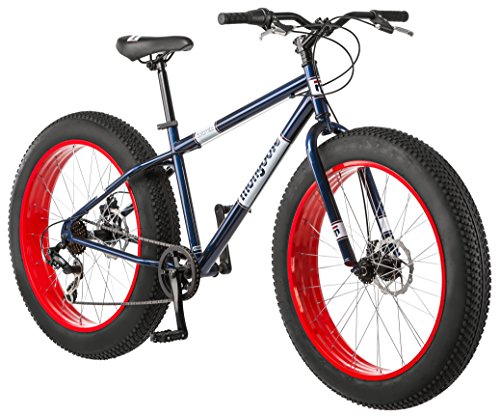
The Mongoose Dolomite (model R4144) is the fat-tyre mountain bike that has become the default answer for bigger riders on a mainstream budget, and the reasoning is structural rather than fashionable. It is built on a steel frame — steel’s strength and tolerance for flex suit heavier loads well — with 26-inch wheels wearing tyres about 4 inches wide, a seven-speed drivetrain, and disc brakes.
The wide tyres are the heart of the case. A 4-inch tyre at suitable pressure presents a large contact patch that spreads the rider’s weight, floats over gravel, sand and broken surfaces that would stop a narrow tyre, and adds a measure of pneumatic cushioning between the rider and the road. For a heavier rider, that volume is not a gimmick; it directly reduces pinch flats and rim impacts. The steel frame and the bike’s overall build give it a sturdiness that lightweight aluminium hybrids in the same class do not attempt.
One point requires honesty about the published record. Sources describing this bike state its rider capacity inconsistently — figures around 300 pounds and around 350 pounds both appear in reputable descriptions of the model. Because the sources conflict, this article prints no single capacity figure. Riders near or above those figures should confirm the current maker’s stated limit for the exact model year before buying, and should treat any single unsourced number — including in older guides — with suspicion.
The Dolomite’s limits should also be plain. It is a heavy bike, and the seven-speed range is adequate rather than generous on steep hills. It is a fat bike, with the rolling feel that implies on smooth pavement. Within its brief — a strong, simple, wide-tyred bike that carries bigger riders over mixed surfaces — it remains the benchmark in its class.
What bigger guys should check on any bike
Frame material and design. Steel and aluminium both work; construction matters more than material. Look for frames without visible weight-saving extremes — oversized thin-wall tubing and minimalist dropouts are designed around lighter riders. Cruiser and fat-bike frames, and mountain frames generally, are built with more margin than road frames.
Wheels are the weak point. Spokes fail before frames do. More spokes, well tensioned, on a double-wall rim is the specification to want. If you buy a bike and spokes start loosening or breaking in the first months, a wheelbuilder can re-tension or rebuild the rear wheel with heavier-gauge spokes — a common and worthwhile upgrade for heavy riders.
Tyre volume and pressure. Wider tyres let you run pressure that supports your weight without the tyre squirming or the rim striking through. Use a pressure calculator that accounts for total system weight — rider plus bike plus luggage — rather than the maximum printed on the sidewall.
Gearing. Combined weight shows up on hills. A low gear that lets you spin up a gradient seated is worth more than top-end speed. Seven speeds with a wide-range cassette can be enough on gentle terrain; hillier country argues for more gears and a smaller front ring.
Brakes. Disc brakes, mechanical or hydraulic, stop heavier system weights more consistently than rim brakes, especially in the wet. The Dolomite’s discs are part of its suitability, not a decoration.
Contact points. A wider saddle that supports the sit bones, grips that fill the hand, and pedals with a broad platform all spread load. Saddle choice in particular is anatomy, not weight — measure sit-bone width rather than assuming wider is always better.
Fit for taller riders
Height and weight are separate problems. Tall riders need reach and stack that a one-size fat bike may not fully provide: check the maker’s stated height range, confirm the seatpost can extend to give near-full leg extension without passing its minimum-insertion mark, and expect to possibly fit a longer stem or higher-rise bar. Riders well over six feet should compare the Dolomite’s geometry against the largest frames in any range they consider, because a strong bike that is too small will still ride badly.
Setup that makes the difference
Set tyre pressure by weight, not habit: too soft and the bike wallows and risks rim strikes; too hard and the wide tyres lose the cushioning that justifies them. Check spoke tension after the first few rides — new wheels settle, and catching a loose spoke early prevents a broken one later. Keep the drivetrain clean and the chain lubricated; heavier riders put more force through every link. Finally, stand on climbs when you need to, but learn to spin seated where possible — standing loads the rear wheel and cranks hardest, and smooth power is kinder to the whole machine.
Carrying loads, and the total-weight mindset
Bigger riders should think in total system weight from the start, because every component limit on the bike refers to it: rider, bike, clothing, water, luggage. A rider near a bike’s stated limit who then adds a rack and panniers for commuting has quietly exceeded the design brief, and the parts that complain first are the rear wheel and the tyres. If you plan to carry loads, add their weight to your own when judging a bike, prefer a rear wheel with generous spoke count, and treat rack load limits as seriously as frame limits. The Dolomite’s fat tyres forgive a lot here — volume is margin — but no tyre repeals the arithmetic entirely.
Weight distribution matters as well. Loads carried low and centred, in panniers, disturb a bike far less than the same weight in a backpack, which raises the centre of gravity and loads the saddle and hands. For bigger riders already asking a lot of their contact points, moving the luggage onto the bike is one of the highest-value changes available, and it costs a rack rather than a new bicycle.
The first month: conditioning and adjustments
New bigger riders often blame the bike for discomforts that are really conditioning. Sit bones unaccustomed to riding protest for the first two or three weeks and then adapt; hands and shoulders complain if the bar position is wrong, which is fixable; knees complain if the saddle is too low, which is also fixable. Change one thing at a time, in small steps, and keep notes if you can. Saddle height is the first adjustment to learn: set it so the knee keeps a slight bend at the bottom of the stroke, and mark the post with tape so a slipped post is obvious.
Build distance gradually. The cardiovascular system adapts faster than the contact points do, and the classic beginner pattern — a triumphant long ride in week one, a sore retreat in week two — is avoidable with modest progression. Check the bike over after the first few rides: spoke tension, bolt tightness at the stem and seatpost, and tyre pressure. New bikes settle, and heavy riders accelerate the settling.
When a standard bike is not the answer
There is a point beyond which adapting a mainstream bike stops being sensible, and honesty requires naming it. Riders well above the capacity figures quoted for bikes like the Dolomite, or riders whose height puts them outside one-size frames entirely, are served better by the small number of makers who build specifically for large riders — reinforced frames, wheels built for the load from the first spoke, and geometry drawn at the right scale. Those bikes cost more because the production runs are small and the components are chosen without compromise. For riders in that territory, such a bike is not an indulgence; it is the difference between a machine that works and a machine that is a recurring repair bill. Everyone below that territory can ride a well-chosen mainstream bike like the one in this guide with confidence.
Gearing changes that help bigger riders
If your terrain outruns the stock gearing — a common report from heavier riders, for whom every gradient is effectively steeper — the drivetrain is modifiable. A smaller front chainring or a wider-range cassette lowers every gear at once and converts walked hills into ridden ones. On a seven-speed fat bike the cassette options are narrower than on modern wide-range drivetrains, but even a modest change at the low end transforms hill country usability, because the gear you need is the bottom one and everything above it is surplus. A bike shop can confirm compatibility with the rear derailleur’s capacity in minutes. Pair the change with the tyre-pressure discipline described earlier — pressure set for your actual weight — and a bike that struggled on your local hills becomes a bike that climbs them slowly and surely, which is all that most riders ever needed.
Verdict
The Mongoose Dolomite (B00J7J40TM) earns its place as this guide’s pick on structure: a steel frame, 4-inch tyres, disc brakes and a simple drivetrain, in a package with a long record among larger riders. Confirm the maker’s current capacity figure for your weight before buying, set the bike up by the checks above, and it will do the job its reputation describes. Bigger riders are not a niche the industry can ignore — they are a large share of the people who want to ride — and a bike chosen on structure rather than marketing is the right answer for them.