Key takeaways
- Compare travel coolers and cooler backpacks for road trips, hikes, and beach days, then choose the right size, carry style, and ice retention.
A travel cooler and a cooler backpack solve the same problem in very different ways. One gives you a rigid box that protects food, holds ice for a long stretch, and doubles as a seat at a campsite. The other frees both hands, spreads weight across your shoulders, and follows you down a trail, across sand, or through an airport terminal.
The right choice depends on how far you will carry cold food and drink, how many people you are feeding, and how much space you have in a car or an overhead bin. A hard cooler wins on capacity and ice retention for a group. A cooler backpack wins on mobility for one or two people on the move. This guide compares the two formats, then looks at five real products across both styles.
As an Amazon Associate, we earn from qualifying purchases.
Quick Answer
Choose a travel cooler when you are driving, staying in one place, or feeding a group, because it holds more and keeps ice longer. Choose a cooler backpack when you will walk or hike, because it keeps both hands free. For a short solo day trip, a backpack is usually simpler. For a family road trip, a hard cooler is usually better.
Travel Cooler vs Cooler Backpack at a Glance
A traditional travel cooler is a hard or soft chest with a lid, a handle, and often a drain plug. Hard models use thick insulated walls and a tight-sealing lid to slow warming. They are stable in a car trunk, easy to load, and simple to clean. Their main drawback is bulk: even a compact hard cooler takes up a fixed footprint, and a full one is heavy to lift.
A cooler backpack is a soft insulated bag with shoulder straps. It is built for movement, with weight close to your back and a narrow profile for crowded paths. Its main drawback is capacity: most hold enough for a day trip for one or two people. A hard cooler will usually keep ice longer, so count cans, bottles, and food containers, not just the headline size.
1. YETI Roadie 24 Hard Cooler

The YETI Roadie 24 is a compact hard cooler for car travel, short camping trips, and days when a small group needs cold drinks within easy reach. It is a rigid chest that sits flat in a trunk and keeps contents protected from shifting luggage. The size suits two people for a weekend or a small family for a day out.
Its rotomolded body and thick insulation are designed for long ice retention in warm conditions. A drain plug empties meltwater without tipping the cooler, and the shoulder strap helps with short carries. This is the pick for travellers who drive and stay put, not for long walks or steep trails.
Specs
- Type: Hard travel cooler
- Capacity: 24-quart class, for cans and ice for a small group
- Construction: Rotomolded body, thick insulated walls
- Drain: Drain plug for meltwater
- Carry: Shoulder strap and top handle
- Best for: Road trips, car camping, and beach days
- Tier: Premium
2. Coleman Classic Series 316 Marine Cooler, 52-Quart

The Coleman Classic Series 316 Marine Cooler in the 52-quart size is a larger hard travel cooler for group trips, boating, and family camping. It holds far more than a compact hard cooler, making it a strong base cooler for a weekend away. The marine design adds a fully insulated lid and body, plus UV protection for sun exposure on a boat or a beach.
Inside, the space is wide and open, so large bottles, food containers, and bagged ice fit without careful stacking. The trade-off is size and weight: a full 52-quart cooler is a two-person lift and needs real trunk space. It is not meant for trails, but for a driving trip it removes the need for a second cooler.
Specs
- Type: Hard travel cooler, marine style
- Capacity: 52 quarts, sized for a group trip
- Construction: Fully insulated lid and body
- Ice retention: Designed to keep ice for multiple days
- Carry: Side handles for two-person lifting
- Best for: Family camping, boating, and road trips
- Tier: Mid-range
3. YETI Hopper M20 Backpack Cooler

The YETI Hopper M20 is the backpack answer to the Roadie. It is a soft-sided cooler with backpack straps, a magnetic top closure, and a wide mouth opening for easy loading. It is built for travellers who want cold drinks on a walk, a hike, or a day moving between stops, with both hands free.
The M20 holds up to 18 cans, or a mix of cans, bottles, and ice, in a tall, narrow shape that sits close to the back. ColdCell insulation and a leakproof liner help it hold cold through a day outing, while the DryHide shell resists scuffs and splashes. The main limit is size: it is a day-trip cooler for one or two people, not a group cooler for a weekend.
Specs
- Type: Cooler backpack, soft-sided
- Capacity: 18 cans, or 26 pounds of ice
- Dimensions: 9.9 by 15.3 by 18.1 inches
- Weight: 8 pounds empty
- Material: Nylon shell, foam insulation
- Closure: MagShield magnetic access
- Carry: Padded backpack straps
- Best for: Hiking, boating, and beach walks
- Tier: Premium
4. RTIC Backpack Cooler, 24 Can

The RTIC Backpack Cooler in the 24-can size is a practical mid-range option for travellers who want backpack convenience without a premium build. It is a soft insulated bag with shoulder straps and a waterproof outer layer, with room for a day of drinks, sandwiches, and snacks for two people. It is simple and light, and easy to pack in a suitcase or store flat when empty.
For travel, the appeal is flexibility. You can wear it through an airport, carry it to a picnic spot, or stash it in a car trunk as a second cooler for drinks while a hard cooler holds food. It will not keep ice as long as a thick-walled hard cooler, and soft walls offer less protection for fragile containers.
Specs
- Type: Cooler backpack, soft-sided
- Capacity: 24 cans
- Construction: Insulated soft bag with waterproof outer layer
- Closure: Zippered top opening
- Carry: Adjustable backpack straps
- Best for: Day trips, picnics, beach walks, and travel as a second cooler
- Tier: Mid-range
5. TOURIT Cooler Backpack, 30 Cans
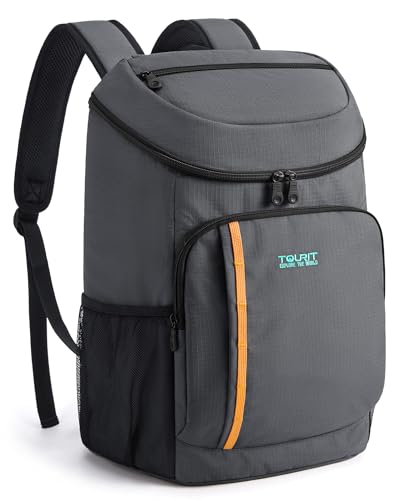
The TOURIT Cooler Backpack in the 30-can size is a budget-friendly backpack cooler for travellers who need more room than a lunch bag but still want to walk hands-free. It is lightweight and leakproof, with a large main compartment for cans, bottles, and food containers for a group day out. The soft shape is easy to carry on a trail, a beach path, or a city walk.
For a family day trip, the extra capacity is useful: drinks for several people, plus snacks and sandwiches, fit in one bag instead of two totes. The insulated lining helps keep contents cold through the day. This is not a multi-day ice chest. Treat it as a day cooler for food and drink eaten the same day.
Specs
- Type: Cooler backpack, soft-sided
- Capacity: 30 cans
- Construction: Lightweight insulated bag with leakproof lining
- Closure: Zippered top opening
- Carry: Adjustable backpack straps
- Best for: Group day trips, picnics, hiking, beach days, and travel
- Tier: Budget
How to Choose
Start with your travel day. If you will drive to one spot and stay there, a travel cooler is the stronger base: it holds more, keeps ice longer, and protects food better. If you will walk, hike, or move between stops, a cooler backpack is the stronger base, keeping your hands free and spreading the load across your back.
Next, count people and hours. One or two people on a half-day outing can manage with a backpack cooler. Three or more people, or a full day in warm weather, will usually need a hard cooler, or a hard cooler plus a backpack for the final walk. Perishable food pushes the choice toward a hard cooler. A hard cooler needs trunk space but rinses out easily. A backpack cooler packs light but should be dried fully before storage.
Who Should Skip
Skip a large hard cooler if you travel alone, use public transport, or walk long distances from your vehicle. A full 52-quart cooler is heavy and bulky, and will be a burden on a trail or in a crowded terminal. A compact hard cooler or a backpack cooler will serve a solo traveller better.
Skip a cooler backpack if you need to keep food cold for more than a day, feed a large group, or protect fragile containers. Soft walls do not insulate as long as thick hard walls. Skip both formats if your trip is short and your destination has cold storage, such as a hotel fridge.
Frequently Asked Questions
Which is better for a road trip, a travel cooler or a cooler backpack?
A travel cooler is usually better for a road trip because it holds more, keeps ice longer, and sits securely in a trunk. A cooler backpack works as a second cooler for walks away from the car, but it should not replace the main cooler on a group road trip.
Can a cooler backpack keep ice all day?
A good cooler backpack can keep drinks cold for a day outing if it is pre-chilled, loaded with cold cans, and kept out of direct sun. It will not match a thick-walled hard cooler for multi-day ice retention, so use the contents the same day.
How many cans should I plan for?
Plan by people and hours, not by the headline capacity. A backpack rated for 24 or 30 cans will hold less once you add ice and food. For two people, a 24-can backpack is a useful starting point. For a group, a 52-quart hard cooler gives more room for food and ice together.
Is a hard cooler allowed on a flight?
A hard cooler can travel as checked luggage if it meets the airline size and weight limits, but rules vary by carrier. A soft backpack cooler is easier to pack empty in a suitcase. Check the airline rules before you travel.
Final Verdict
For most travellers, the choice is not either-or. A travel cooler is the better base for driving trips, group outings, and multi-day camping, while a cooler backpack is the better tool for walking, hiking, and day trips on foot. If you must choose only one, pick the format that matches your longest carry.
A solo hiker or a couple on a day trip will get more use from a backpack cooler such as the YETI Hopper M20, the RTIC 24-can backpack, or the TOURIT 30-can backpack. A family on a road trip will get more use from a hard cooler such as the YETI Roadie 24 or the Coleman 52-quart marine cooler. If you travel in both styles, own one of each.