Key takeaways
- Travel pouch vs packing cube compared on capacity, weight, access and organization, with five real picks to help you choose the right system for your trip.
Table of Contents
- The Short Answer
- What Is a Travel Pouch
- What Is a Packing Cube
- Head-to-Head Comparison
- The Five Products Compared
- How to Choose Between Them
- FAQ
- Conclusion
The Short Answer
A travel pouch and a packing cube solve different problems inside the same suitcase. A flat travel pouch is a small, zippered organizer built for little items: charging cables, earbuds, adapters, toiletries, jewelry, and the other loose pieces that vanish into the corners of a bag. A packing cube is a larger fabric box with a zipper, built for clothing: shirts, pants, underwear, and socks, sorted into categories and stacked like drawers.
If your packing pain is tangled cords and small essentials scattered everywhere, choose the pouch. If your pain is a suitcase full of clothes that turns into a wrinkled pile by day two, choose the cubes. Many travelers end up carrying both, because the two formats barely overlap in what they hold.
As an Amazon Associate, we earn from qualifying purchases.
What Is a Travel Pouch
A travel pouch is a compact, flat organizer, usually between seven and ten inches long, with a zipper closure and a divided interior. The classic layout uses elastic loops to hold cables in place, mesh pockets for small parts like SD cards and USB drives, and one or two larger compartments for a charger, power bank, or phone. Padding is common, because the pouch is meant to protect electronics as much as organize them.
Pouches are not limited to tech. The same flat format is sold for toiletries, cosmetics, jewelry, and documents, and the design logic is identical: one slim case, many small slots, everything visible the moment the zipper opens. A pouch lives in a personal item, a carry-on pocket, or the top of a suitcase, and it comes out at security checks, on the plane, and at the hotel desk.
The limits are just as clear. A pouch has almost no depth, so it cannot swallow clothing beyond a single rolled layer. It organizes the smallest ten percent of your packing list extremely well and does nothing for the other ninety percent.
What Is a Packing Cube
A packing cube is a lightweight rectangular bag, typically made from nylon or polyester, with a zipper running around three sides and often a mesh panel on top so the contents stay visible. Cubes come in graduated sizes, and they are almost always sold in sets: a large cube for pants and sweaters, a medium for shirts, a small one for underwear and socks, plus extras like a shoe bag or a laundry bag.
The cube approach treats the suitcase as a chest of drawers. Each category of clothing gets its own cube, the cubes stack in a grid, and unpacking at the hotel means lifting the cubes into a drawer rather than rebuilding piles of loose clothes. Rolling clothes inside a cube also reduces the air pockets that make a suitcase feel full before it really is.
Cubes do have weaknesses. They add a small amount of weight and fabric bulk of their own, their fixed shapes do not always match odd luggage interiors, and they are the wrong tool for tiny items, which rattle around inside a big cube and come out just as disorganized as before.
Head-to-Head Comparison
Capacity and What Fits
This is the widest gap between the two formats. A travel pouch holds the small stuff: a phone charger, two or three cables, earbuds, a power bank, memory cards, and similar bits. Even the largest organizer pouches top out at the size of a paperback book. A packing cube set, by contrast, is sized for an entire wardrobe. The largest cubes in a set run seventeen inches or more on the long side and four inches deep, enough for several folded sweaters.
Organization and Access
A pouch organizes at the level of the individual item. Elastic loops, mesh pockets, and dividers give every cable and adapter its own slot, so the thing you want is visible and reachable in seconds. A cube organizes at the level of the category. It will not tell you where one specific shirt is, but it guarantees the shirt is in the shirt cube and nowhere else. Pouches win on precision, cubes win on scale.
Weight and Space in the Bag
Pouches are featherweight, usually a few ounces, and their flat shape slips into gaps that would otherwise go unused. Cube sets weigh more in total, commonly around a pound for a full set, and they ask for a real share of the suitcase. In return, cubes can make the main compartment pack tighter by replacing loose, air-filled piles with flat, stackable blocks. On a short trip with a small bag, a pouch is nearly free; cubes only earn their space on trips long enough to fill them.
Materials and Durability
Pouch listings emphasize padded, water-resistant fabrics, because the contents are electronics and a spilled drink or a rainy transfer is a real risk. Cube listings emphasize thin, light fabrics and smooth zippers, because the contents are clothes and the enemy is added weight. Both formats live or die by their zippers, so reinforced pulls and finished seams are the specs worth comparing on either side.
Best Use Cases
Choose a travel pouch for business trips, carry-on-only travel, and any trip where the small essentials matter more than the wardrobe. Choose packing cubes for family travel, long trips, shared suitcases, and anyone who unpacks into hotel drawers. Choose both if you travel with a full suitcase and a full set of gadgets, which describes most people on most trips.
The Five Products Compared
1. BAGSMART Electronics Organizer Travel Case (Travel Pouch, Mid-Range)

The BAGSMART organizer is the reference design for the flat pouch format: a padded, water-resistant case that opens flat and keeps every small item in its own loop or pocket. It carries five small elastic loops for cables, earphones, or pens, two larger loops sized for longer cables or a computer mouse, a mesh zippered pocket, five elasticized mesh segments, and a pocket under the zippered section for chargers, USB drives, a power bank, or a USB-C hub. A dedicated SD card pouch rounds out the layout.
Specs
- Dimensions: 9.8 x 6.7 x 1.4 inches
- Weight: 0.24 pounds
- Closure: dual zipper
- Storage: 5 small elastic loops, 2 large elastic loops, 1 mesh zippered pocket, 5 mesh segments, SD card pouch
- Material: water-resistant fabric with padding
- Color referenced: Grey
2. FYY Electronic Organizer (Travel Pouch, Budget)
The FYY organizer takes the same idea smaller and thicker. At 7.5 x 4.3 x 2.2 inches, it is closer to a compact wallet than a flat case, with a double-layer interior that trades footprint for depth. Seven mesh pockets and a main compartment hold cords, a charger, a phone, USB drives, and earphones, while the waterproof oxford shell and soft sponge lining protect the contents from splashes and bumps. A hand strap makes it easy to pull from a bag one-handed.
Specs
- Dimensions: 7.5 x 4.3 x 2.2 inches
- Layout: double-layer interior
- Storage: 7 mesh pockets plus a main compartment
- Material: waterproof oxford fabric with soft sponge padding
- Closure: zipper, with hand strap
- Color referenced: Green
3. ProCase Electronic Organizer Cord Pouch, Roll-Up (Travel Pouch, Premium)
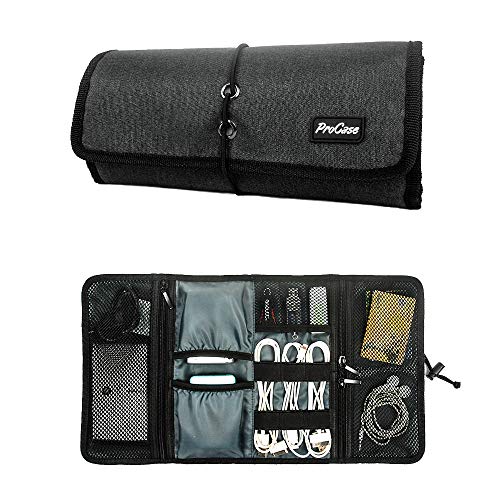
ProCase replaces the book-style case with a roll-up wrap. Open, it measures 17 x 9 inches and lays out one large zippered mesh pocket for a hard drive, power bank, or phone, two smaller zippered pockets, two open pockets for a charger or mouse, three mesh pockets for USB drives and memory cards, and six elastic loops for cables and pens. Rolled shut, it collapses to 9 x 4.5 x 0.5 inches and secures with an elastic strap, so the amount of space it takes up tracks how much is inside it. The shell is heavy-duty, water-resistant nylon.
Specs
- Dimensions: 17 x 9 inches open; 9 x 4.5 x 0.5 inches rolled
- Weight: 4.9 ounces
- Storage: 1 large mesh zip pocket, 2 small zip pockets, 2 open pockets, 3 mesh pockets, 6 elastic loops
- Material: water-resistant nylon
- Closure: elastic strap
- Model: WRAP-N419-Black
4. BAGAIL 8 Set Packing Cubes (Packing Cubes, Budget)

The BAGAIL set is the full-system option: eight pieces in graduated sizes, from extra small to extra large, covering clothing cubes for outfits and bulkier items plus a toiletry bag, a shoe bag, and a drawstring laundry bag. The fabric is a smooth, water-repellent material, and the cubes use mesh panels so contents stay visible without opening each one. Because the set includes bags for shoes and worn laundry, it organizes the whole suitcase rather than just the clean clothes in it.
Specs
- Pieces: 8
- Sizes: graduated set from extra small to extra large
- Includes: clothing cubes, toiletry bag, shoe bag, drawstring laundry bag
- Material: water-repellent fabric with mesh panels
- Closure: zipper
- Model: PACKnew008
5. Veken 8 Set Packing Cubes (Packing Cubes, Premium)
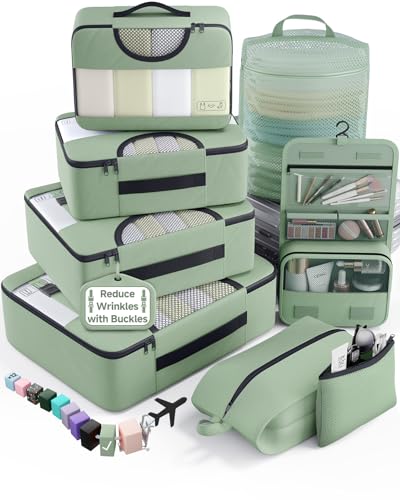
The Veken set also runs to eight pieces, but it adds structure. The extra large organizer measures 17.1 x 12.1 x 4 inches and the large 13.7 x 12.7 x 4.1 inches, and both include buckle straps to hold folded clothes in place. Alongside the medium and small cubes, the set adds a shoe bag, a laundry bag, an open toiletry bag, and a flat accessories bag at 9.8 x 6.3 inches, which blurs the line with the pouch category. The polyester fabric contains recycled material, and the whole set weighs 1.21 pounds.
Specs
- Pieces: 8
- Extra large cube: 17.1 x 12.1 x 4 inches; large cube: 13.7 x 12.7 x 4.1 inches
- Medium cube: 13.7 x 9.7 x 4.1 inches; small cube: 10.6 x 6.7 x 4 inches
- Includes: shoe bag, laundry bag, toiletry bag, accessories bag
- Extras: buckle straps on the two largest cubes
- Material: polyester with recycled content
- Total weight: 1.21 pounds
- Model: POT3V340
How to Choose Between Them
Start with the mess you actually have. If your cables, chargers, and small essentials are the problem, a pouch fixes it for a few ounces of added weight, and the only real choice is format: a flat book-style case for a structured layout, a roll-up for a kit that changes size, or a compact double-layer pouch for the smallest carry. If your clothes are the problem, a cube set fixes it, and the choice is about coverage: a basic graduated set for clothing alone, or a full kit with shoe and laundry bags for the complete suitcase.
Also consider the bag itself. Pouches fit personal items and daypacks where cubes cannot go. Cubes need a suitcase or large duffel to make sense. For trips of one or two nights, a pouch alone is usually enough. For a week or more, cubes carry the wardrobe and a pouch still earns its place for the tech kit, which is why the honest answer for frequent travelers is one of each.
FAQ
Can a packing cube replace a travel pouch for cables and chargers?
Not well. A cube has one large compartment, so cables and small adapters shift around inside it and come out tangled. The flat accessories bag included in some cube sets helps, but a dedicated pouch with elastic loops and mesh pockets keeps each small item in a fixed slot, which is the entire point for tech gear.
Do packing cubes actually save space in a suitcase?
They save usable space rather than raw volume. Cubes do not compress clothing unless they are a dedicated compression design, but they replace loose piles full of air gaps with flat, stackable blocks, and they stop soft items from migrating into corners. The result is a suitcase that packs tighter and stays organized, even if the total volume is similar.
Which is better for carry-on-only travel, a pouch or packing cubes?
Both fit, but they earn their place differently. A pouch is almost always worth it, because it weighs a few ounces and holds the items you need during the flight. Cubes are worth it when the carry-on holds several days of clothing; for a single overnight change of clothes, one small cube or none at all is enough.
How many packing cubes does one suitcase need?
A graduated set of four clothing cubes covers most suitcases: one large, one or two medium, and one small for underwear and socks. Larger eight-piece sets add shoe, laundry, and toiletry bags, which suit longer trips and shared luggage. Buying a full set is usually simpler than matching individual cubes, because the sizes are designed to stack together.
Conclusion
The travel pouch vs packing cube question has a clean answer: they organize different layers of the same bag. A pouch brings order to the smallest, most losable items you carry, with loops and pockets sized for cables, chargers, and cards. A packing cube set brings order to the clothing that fills most of the suitcase, sorting it into stackable categories that survive the trip. Pick the pouch for tech and small essentials, pick the cubes for the wardrobe, and do not be surprised when the right answer for your next long trip is both.