Key takeaways
- RFID wallet vs RFID sleeve: compare blocking coverage, capacity and convenience, with five real picks to protect your cards and passport while traveling.
Table of Contents
- The Short Answer
- RFID Wallet vs RFID Sleeve at a Glance
- The RFID Wallet Picks
- The RFID Sleeve Picks
- Head-to-Head: The Factors That Matter
- Which One Should You Choose?
- FAQ
- Conclusion
Contactless bank cards and chip passports are designed to share data with a reader held close by, which is exactly what makes travelers wonder whether that data can also be skimmed by a reader they never see. RFID blocking gear answers that worry with a shielding layer that keeps a card’s chip from responding until you take it out. There are two ways to add that layer to your carry: replace your wallet with an RFID wallet that has the shielding built in, or keep your current wallet and slip each card into its own RFID sleeve.
The right choice depends on how you carry, not on which format blocks better, because both use similar shielding aimed at the same signals. A wallet protects everything inside it at once and adds organization. Sleeves protect card by card, work inside any wallet or bag you already own, and often add passport coverage for very little bulk. This guide compares the two formats on coverage, capacity, convenience and durability, then recommends five real products — three RFID wallets and two sleeve sets — across budget, mid-range and premium tiers.
As an Amazon Associate, we earn from qualifying purchases.
The Short Answer
Pick an RFID wallet if you carry the same few cards every day and want protection that is always on, with no extra step between paying and putting your card away. Pick RFID sleeves if you like the wallet you already own, split cards between several bags, or want an inexpensive way to shield a passport and spare cards for the whole family. Many travelers end up with both: a blocking wallet for daily cards and sleeves for the passport and backup cards.
RFID Wallet vs RFID Sleeve at a Glance
| Factor | RFID Wallet | RFID Sleeve |
|---|---|---|
| How protection works | Shielding lining built into the wallet walls | Each card sits inside its own shielded envelope |
| Coverage | Every card inside the wallet while it is closed | Only the cards you place inside sleeves |
| Passport protection | Only on larger passport-wallet models | Passport sleeves are included in many sets |
| Effect on your current wallet | Replaces it | Keeps it and works inside it |
| Organization | Card slots, ID windows and cash pockets built in | None — sleeves are single-card envelopes |
| Bulk added | The thickness of the wallet itself | A thin layer around each card |
| Best for | Daily carry, minimalists, one-wallet travelers | Families, multiple bags, occasional travelers |
The RFID Wallet Picks
1. Travelambo Slim Wallet Front Pocket Minimalist Leather RFID Blocking — Budget

The Travelambo is the minimalist end of the wallet side: a front-pocket card wallet cut from cowhide leather that measures just 0.12 inches thick before you load it. Six card slots and an ID window cover the daily essentials, and the shielding is built into the lining, so every card inside is covered whenever the wallet is in your pocket. The brand states the blocking was tested for the 13.56 MHz frequency that credit cards, debit cards, driver licenses and ID cards use, and it is upfront that some 142 kHz cards, such as certain access badges and hotel room keys, are not blocked. If you want genuine leather, the slimmest possible profile and protection that needs no routine beyond using the wallet, this is the budget pick.
Specs:
- Material: Cowhide leather
- Dimensions: 3.1 x 4.4 x 0.12 inches
- Capacity: 6 card slots plus ID window
- RFID blocking: Shielding lining, specified for 13.56 MHz signals
- Known limitation: Does not block some 142 kHz access, ID badge and hotel cards
- Model: Tra424
- Tier: Budget
2. Buffway Slim Minimalist Front Pocket RFID Blocking Wallet — Mid-Range

The Buffway takes the same front-pocket idea and adds organization. Its eight compartments split into four card slots, a clear ID window with a finger glide, two side-slip pockets for membership or transit cards, and a middle pocket for folded bills and receipts. The faux leather body is about an eighth of an inch thick when empty, so it still disappears into a front pocket or a small travel purse. Buffway describes its integrated layer as blocking 13 to 14 MHz electronic signals, while noting it cannot block 125 kHz signals such as hotel room keys and some access cards. Choose it over the Travelambo if you carry more than the bare minimum and want a pocket for cash without moving up to a full travel wallet.
Specs:
- Material: Faux leather with polyester lining
- Dimensions: 3 1/8 x 4 7/16 inches, 1/8 inch thick when empty
- Capacity: 8 compartments — 4 card slots, 1 ID window, 2 side-slip pockets, 1 middle cash pocket
- RFID blocking: Integrated layer specified for 13–14 MHz signals
- Known limitation: Does not block 125 kHz hotel key and access card signals
- Model: BW-WL-VC-BL (Alaska Black)
- Tier: Mid-range
3. ZOPPEN Multi-purpose RFID Blocking Travel Passport Wallet (Ver.4) — Premium

The Zoppen shows how far the wallet format stretches. This tri-fold document organizer is built around a passport pocket, then adds eight card slots, a coin slot, room for paper money, a SIM and SD card pocket, and a keychain, all closed with a button snap. It is the only pick here that shields a passport and your cards in one piece of gear, making it the natural choice for international trips. The trade-off is size: at 6.5 by 4.49 inches folded and roughly an inch thick, it is a travel wallet, not a front-pocket everyday carry. The brand specifies its shielding sheet for the 13.56 MHz frequency used by payment cards and passport chips.
Specs:
- Material: Faux leather with polyester lining
- Form factor: Tri-fold with button closure
- Dimensions: 6.5 x 4.49 x 0.98 inches; weight 180 grams
- Capacity: 8 card slots, 10 pockets total, passport pocket, coin slot, SIM and SD card pocket
- Included: Keychain
- RFID blocking: Shielding sheet specified for 13.56 MHz signals
- Model: TB001 (T01 Passport Holder), Lavender Purple
- Tier: Premium
The RFID Sleeve Picks
4. VENTURE 4TH RFID Blocking Sleeves (5 Credit Card and 1 Passport Sleeve) — Budget

The Venture 4th set is the simplest way to try the sleeve format: five credit card sleeves and one passport sleeve, each a slim envelope with an aluminum lining. The card sleeves are sized for standard credit cards and enhanced driver licenses, and the brand states they shield contactless smart cards built to the ISO 14443 and 15693 standards plus EPC Gen 1 and Gen 2 tags, which covers most tap-to-pay cards. Because each sleeve adds almost no thickness, the set slips into the wallet or money belt you already use, and the sleeves are water resistant. One passport sleeve limits it to solo travelers, but as a starter set for one person’s everyday cards it covers the essentials.
Specs:
- Set contents: 5 credit card sleeves and 1 passport sleeve
- Material: Aluminum-lined sleeves
- Fit: Standard-size credit cards and enhanced driver licenses
- RFID blocking: Specified for ISO 14443/15693 and EPC Gen 1/Gen 2 contactless cards
- Water resistance: Yes, per the listing
- Model: V4-01-RFID-BLK-6
- Tier: Budget
5. Boxiki Travel RFID Blocking Sleeves, Set with Color Coding — Mid-Range
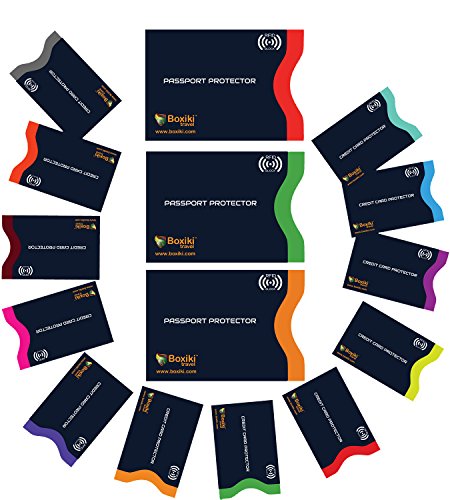
Boxiki’s set is built for households rather than individuals. The 15-piece set combines 12 credit card sleeves with 3 passport sleeves, and the sleeves are color coded so each family member’s cards and passport get their own color. The sleeves use an RFID blocking material with an aluminum foil coating, described by the brand as water and tear resistant, and the whole set weighs under two ounces, so it adds nothing noticeable to a carry-on. There is no organization beyond the color system — no wallet, closure or document pocket — but for protecting several people’s cards and passports in whatever bags they already own, this is the most flexible pick in the guide.
Specs:
- Set contents: 15 sleeves — 12 credit card sleeves and 3 passport sleeves
- Material: RFID blocking material with aluminum foil coating
- Organization: Color-coded sleeves
- Durability: Water and tear resistant, per the brand
- Weight: 1.76 ounces for the set
- Color: Navy Blue
- Tier: Mid-range
Head-to-Head: The Factors That Matter
What the shielding blocks. Both formats aim at the same target: the 13.56 MHz frequency used by contactless credit and debit cards, many ID cards and chip passports. The wallet makers are consistent about the gap: low-frequency proximity cards around 125 kHz, used by many hotel keys and building access badges, are generally not blocked by either format.
Coverage gaps. A wallet shields everything inside it, but only while the cards are inside and the wallet is closed; a card left in a coat pocket is unprotected. Sleeves invert the trade-off: each sleeved card is shielded wherever it goes, even loose in a bag, but any card you did not sleeve stays exposed. Sleeves also protect one card per envelope, so covering a thick stack takes several sleeves, while a wallet covers its full slot count at once.
Capacity and organization. Wallets win on structure. Even the slim Travelambo sorts six cards and an ID, the Buffway adds cash and side pockets, and the Zoppen organizes an entire trip’s documents. Sleeves deliberately do none of this — they are single-card envelopes that rely on your existing wallet or organizer for structure, which is either their biggest weakness or their whole point.
Passport and document coverage. A standard card wallet cannot hold a passport at all. Your options are a passport-format wallet like the Zoppen, which keeps the passport and cards together in one shielded organizer, or passport sleeves, which let the passport live in a hotel safe, day bag or document pouch while still being shielded. For families, sleeves scale better: one Boxiki set covers three passports, while passport wallets are bought one traveler at a time.
Durability and replacement. A wallet’s shielding is sewn into the lining and lasts as long as the wallet does. Sleeves are thin foil-lined envelopes; they are inexpensive to replace and easy to retire when they crease or tear. Frequent travelers who shuffle cards daily will wear sleeves out faster than someone who sleeves a passport twice a year.
Cost structure in tiers. Sleeves sit at the budget end almost by definition, since a set protects cards carried in a wallet you already own. Wallets spread across all three tiers, from slim card holders to full document organizers. If you were replacing your wallet anyway, built-in shielding adds little; if not, sleeves reach the same frequency coverage for less.
Which One Should You Choose?
Choose an RFID wallet if you carry one wallet everywhere, want your most-used cards protected without thinking about it, and would enjoy the upgrade in organization. The Travelambo suits minimalists, the Buffway suits card-and-cash carriers, and the Zoppen suits international travelers who want the passport in the same shielded place.
Choose RFID sleeves if your current wallet is exactly how you like it, your cards live in more than one bag, or you are buying protection for more than one person. The Venture 4th set covers one traveler’s cards and passport; the Boxiki set covers a family’s.
Skip both formats if none of your cards are contactless and you are not carrying a chip passport — shielding only matters for chips that answer a reader. And if your main worry is physical theft rather than skimming, neither format helps; look at the money belts and neck wallets covered elsewhere on this site instead.
FAQ
Do RFID wallets and sleeves block the same signals?
Yes, in the ways that matter. Both formats use shielding material specified for the 13.56 MHz frequency used by contactless payment cards and chip passports. Both also share the same blind spot: low-frequency cards around 125 kHz, such as many hotel keys and access badges, are generally not blocked, as the wallet brands state in their own specs.
Will an RFID sleeve fit inside my existing wallet?
Sleeves are cut slightly larger than a standard credit card and are designed to slide into ordinary wallet slots, card cases and phone card holders. Each sleeved card makes its slot a little thicker, so very tight minimalist wallets may hold one or two fewer cards once sleeves are added.
Can one sleeve protect several cards at once?
Sleeves are sized for a single card, and the shielding works on whatever is inside the envelope. In practice, one card per sleeve is the intended use and keeps cards easy to remove. A wallet shields its whole contents at once, which is one reason heavy card carriers often prefer the wallet format.
Do I need RFID protection for my passport?
Chip passports respond to readers at the same 13.56 MHz frequency as contactless cards, so the same shielding applies. A card-size wallet cannot hold a passport, so passport coverage means either a passport-format wallet like the Zoppen or a set that includes passport sleeves, like both sleeve sets recommended above.
Conclusion
RFID wallet vs RFID sleeve is not a contest between strong and weak protection — both formats shield the same 13.56 MHz signals that contactless cards and passports use, and both leave low-frequency access cards unblocked. The decision is about your carry. A wallet builds protection into the thing you reach for every day and adds organization, with the Zoppen extending the idea to full travel documents. Sleeves keep the wallet you love, travel anywhere a card travels, and scale cheaply across passports and family members. Match the format to how you already move through an airport, and either one does its job quietly.