Key takeaways
- Rolling vs duffel travel bags compared: wheels and handles against light, flexible carry, with five verified picks to help you choose the right bag.
The short answer: choose a rolling duffel if your loads are heavy and your routes are paved — airports, stations, and hotel corridors — and choose a classic carry duffel if you want the lightest, simplest bag, one that flexes into tight spaces and stores flat. Wheels trade weight for effort. A rolling duffel adds several pounds of frame, handle, and wheel hardware, but it carries the load for you on smooth ground. A carry duffel skips all of that hardware, so it weighs very little empty and squeezes into overhead bins, car trunks, and closet corners — but every pound you pack lands on your shoulder. Match the bag to how far you will actually move it on foot, and the choice makes itself.
As an Amazon Associate, we earn from qualifying purchases.
Table of Contents
- What Rolling Duffels Do Best
- What Classic Carry Duffels Do Best
- Head-to-Head: The Five Differences That Matter
- The Rolling Picks
- The Carry Picks
- How to Choose: Verdict by Trip Type
- FAQ
- Conclusion
What Rolling Duffels Do Best
A rolling duffel is built for heavy loads on smooth surfaces. Two wheels and a telescoping handle move the weight to the ground, so a bag packed with boots, winter layers, or sports gear rolls behind you through a terminal instead of hanging off one shoulder. That difference is minor across a parking lot and enormous across a connecting flight, a long station concourse, or the walk from a taxi rank to a hotel desk.
Rolling duffels also tend to be the more structured branch of the duffel family. Many use a drop-bottom design, with a separate lower compartment for shoes, boots, or dirty gear and a main section above it, and some let you zip the divider away to create one huge space. Reinforced bases, corner guards, and compression straps help them survive checked-baggage handling, and their shape stays predictable when full, which makes them easier to stack in a trunk or a luggage hold.
The trade-offs are weight and flexibility. The lightest rolling duffel in this comparison weighs 7.1 pounds empty — more than three times the lightest carry duffel — and the biggest tops 10 pounds before you pack a single shirt. Wheels and frames also fix the bag’s shape, so a rolling duffel cannot be stuffed into a half-empty overhead bin or folded into a drawer between trips, and the wheel housings and handle are extra parts that rough ground, curbs, and cobblestones punish.
What Classic Carry Duffels Do Best
A classic carry duffel is built for lightness and simplicity. With no frame, wheels, or handle mechanism, even a large 60-liter model can weigh under two pounds, which leaves more of your baggage allowance for what you actually pack. The soft body flexes around bulky or oddly shaped loads, compresses to fit a sizer bin or a crowded trunk, and folds or rolls away to almost nothing when empty — which is why carry duffels double as gym bags, team bags, and spare bags packed inside other luggage.
Carry duffels also handle the terrain wheels hate. Stairs, gravel, snow, mud, and cobblestone streets are all the same to a bag on your shoulder, and there are no wheel housings to crack or handles to jam. Many add simple, useful organization: end pockets for shoes, a separate shoe compartment, or a small front pocket for items you need in transit.
The cost is effort. Every pound rides on one shoulder strap or in one hand, loads settle into a single pile unless you use packing cubes, and an unstructured bag offers little protection for anything fragile. A carry duffel is the right tool for short carries and light-to-moderate loads; it is the wrong tool for hauling 40 pounds across an airport.
Head-to-Head: The Five Differences That Matter
Effort over distance. Rolling, and it is not close. On any smooth walk longer than a few minutes, a handle and wheels beat a shoulder strap. The gap grows with every pound you pack.
Terrain. Carry duffel. Wheels want pavement; shoulders do not care. If your trips involve stairs, rural stations, boats, or unpaved ground, the carry duffel wins by default.
Empty weight. Carry duffel, clearly. The carry picks below start at 1.8 pounds, while the rolling picks run from 7.1 to 10.9 pounds. On airlines with strict cabin weight limits, that hardware can cost you several pounds of packing allowance.
Packing structure. Rolling, usually. Drop-bottom compartments, reinforced bases, and compression straps give rolling duffels more built-in organization and shape. Carry duffels answer with speed and flexibility: one wide opening, everything visible at once, and a shape that adapts to the load instead of the other way around.
Carry-on fit and storage. Carry duffel. Smaller carry models are sized for the cabin and can compress when underpacked, and they store flat at home. Most rolling duffels in this comparison are checked-bag sizes that need closet or garage space between trips.
The Rolling Picks
Samsonite Andante 2 Wheeled Duffel, 28-Inch — Mid-Range Rolling Pick

The Andante 2 is the balanced rolling option: a checked-size duffel that keeps its empty weight to 7.1 pounds, light for a wheeled bag. Its drop-bottom compartment separates shoes, boots, or worn clothes from the main section, and the large U-shaped top opening makes packing and finding things easy. A water-resistant end pocket is made for shoes or wet items, and the dobby polyester shell is water resistant for damp platforms and rainy curbs. Inline skate wheels and a push-button locking handle handle the rolling, while exterior grab handles give you lifting points for trunks, bins, and baggage scales.
Specs
- Size: 28-inch (checked)
- Dimensions: 28 x 14 x 14 in
- Weight: 7.1 lb
- Material: Water-resistant dobby polyester
- Wheels: Inline skate wheels
- Handle: Push-button locking retractable pull handle
- Compartments: Drop-bottom compartment and a water-resistant end pocket for shoes or wet items
- Model: 117225-C065
Travelpro Bold Drop Bottom Rolling Duffel, 30-Inch — Premium Rolling Pick
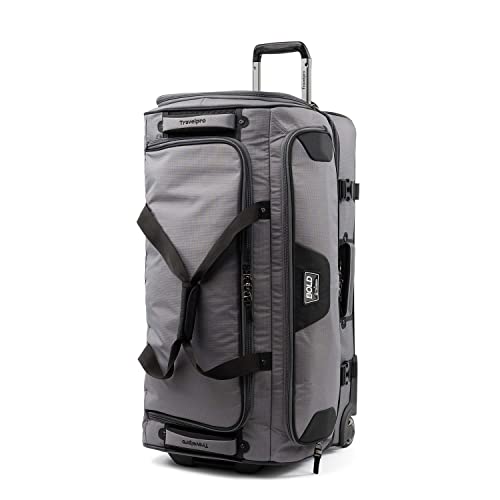
The Bold is the heavy hauler of this comparison, built for checked gear trips where capacity matters more than empty weight. It offers 118 liters with its expansion zipper open, and the drop-bottom compartment can stay separate for boots and bulky gear or zip open into one cavernous space. Ball-bearing inline skate wheels, an aircraft-grade aluminum handle that stops at two heights, and exterior compression straps are all aimed at moving a full, heavy bag without a fight. At 10.9 pounds empty and 30 inches long, it is a checked bag through and through — the pick for family trips, sports equipment, cruises, and relocations rather than light weekends.
Specs
- Capacity: 118 liters (expanded)
- Dimensions: 30 x 15 x 16 in (31 x 16.5 x 17 in overall)
- Weight: 10.9 lb
- Material: High-density polyester with a water-repellent coating
- Wheels: Ball-bearing inline skate wheels
- Handle: Aircraft-grade aluminum telescoping handle, stops at 38 and 42 in
- Design: Drop-bottom compartment with zip-away divider, 2-inch expansion, exterior compression straps
- Warranty: Built For A Lifetime Limited Warranty
- Model: 412153005
The Carry Picks
adidas Defender 4.0 Duffel, Medium — Budget Carry Pick

The Defender 4.0 is a team-sports staple that translates directly to travel: a simple, durable 66-liter holdall with more organization than most basic duffels. Zip end pockets keep shoes or small gear separate from the main compartment, a small front pocket holds the items you reach for in transit, and the water-resistant base shrugs off wet locker-room floors, damp pavement, and baggage belts. The adjustable shoulder strap detaches when you want to carry it by the handles, and the 600D polyester body is made to be thrown in trunks and team buses without ceremony.
Specs
- Capacity: 66 liters (Medium)
- Dimensions: 24.75 x 13 x 12 in
- Material: 600D polyester with a water-resistant base
- Pockets: Zip end pockets and a front zip pocket
- Carry: Adjustable, detachable shoulder strap and grab handles
- Model: 979175
Nike Brasilia 9.5 Training Duffel, Medium — Mid-Range Carry Pick

The Brasilia 9.5 is the gym-to-weekend crossover: 60 liters of space in a bag that weighs just 1.8 pounds. A separate shoe compartment keeps footwear and worn clothes away from clean gear, a coated base protects the contents from bumps, scratches, and moisture, and inner and outer pockets give small items a home. The body is polyester made with at least 65 percent recycled fibers. It is sized and shaped for cars, gyms, and short trips rather than airline cabins, and as a second bag or sports-weekend bag, its combination of capacity and near-zero empty weight is hard to beat.
Specs
- Capacity: 60 liters (Medium)
- Dimensions: 25 x 12 x 12 in
- Weight: 1.8 lb
- Material: Polyester, made with at least 65 percent recycled polyester fibers
- Compartments: Main zip compartment, separate shoe compartment, inner and outer pockets
- Base: Coated base for protection against moisture and scuffs
- Carry: Removable shoulder strap and dual top handles
- Model: DH7710
Herschel Novel Duffle, 43L — Premium Carry Pick

The Novel is the weekender of the group: a 43-liter carry duffel in a cabin-friendly footprint, finished to a standard the sports duffels do not attempt. A separate shoe compartment, an internal mesh pocket, and Herschel’s signature striped liner keep a short trip organized, and the removable padded shoulder strap makes terminal-length carries comfortable. It gives up the sheer volume of the bigger carry picks, but for two-to-four-day trips where the bag will be carried onto the plane and through the city, it is the most polished option here.
Specs
- Capacity: 43 liters
- Dimensions: 20.5 x 11 x 11.75 in
- Material: Polyester with signature striped fabric liner
- Pockets: Internal mesh pocket and a separate shoe compartment
- Carry: Removable padded shoulder strap and reinforced carry handles
- Model: 11505-00001-OS
How to Choose: Verdict by Trip Type
Checked gear hauls and family trips: go rolling. When the bag is heavy and the route is paved, wheels pay for their weight many times over. The Travelpro Bold suits maximum capacity; the Samsonite Andante 2 suits travelers who want wheels without the heaviest frame.
Gym, team sports, and weekend road trips: go carry. The bag moves from house to trunk to room, carrying distance is short, and a light, simple duffel like the Defender 4.0 or Brasilia 9.5 is easier to live with and easier to store.
Carry-on-only flights: go carry, in a cabin-sized model. The Herschel Novel’s 43 liters and flexible shape fit the cabin brief, while the rolling picks here are checked sizes.
Stairs, cobblestones, and mixed terrain: go carry. Wheels lose their advantage the moment the pavement ends, and a shoulder bag never has to be lifted over a curb by its handle.
One bag for everything: ask how heavy your typical load is. Under roughly 20 pounds, a carry duffel covers almost any trip. Above that, or with long airport walks in the picture, a rolling duffel earns its hardware.
FAQ
Is a rolling duffel allowed as a carry-on?
Only the smaller ones. Rolling duffels around 22 inches can meet cabin limits, but both rolling picks in this comparison — at 28 and 30 inches — are checked-bag sizes. Carry duffels in the 40-liter range, like the Herschel Novel above, are the safer cabin choice, and soft carry duffels can compress when underpacked. Always compare the manufacturer’s stated dimensions with your airline’s published limits before you fly.
How much weight do wheels and a handle add?
Several pounds. The rolling picks here weigh 7.1 and 10.9 pounds empty, while the lightest carry pick weighs 1.8 pounds. That gap matters most on airlines with strict cabin weight limits and matters least when the bag is checked and rolled everywhere it goes.
Which type handles stairs and rough ground better?
The carry duffel, by a wide margin. A shoulder bag treats stairs, gravel, snow, and cobblestones as non-events, while a rolling duffel has to be carried by its grab handles in the same places — with all its hardware weight included. If your trips regularly leave the pavement, carry is the honest choice.
Are rolling duffels durable enough for checked baggage?
Well-built ones are. Look for the features the rolling picks here share: ball-bearing or inline skate wheels in reinforced housings, a protected base, compression straps that take strain off the zippers, and tough polyester shells. Wheels and handles remain the most vulnerable parts on any rolling bag, which is one reason the Travelpro’s lifetime limited warranty is worth noting.
Conclusion
Rolling versus carry is really a question about where the weight should ride: on the ground behind you, or on your shoulder. Pick the rolling duffel when loads are heavy, distances are long, and surfaces are smooth — it turns a punishing haul into a walk. Pick the classic carry duffel when you value lightness, flexibility, and simplicity — it stores flat, fits anywhere, and never meets a staircase it cannot handle. Decide by your heaviest typical trip, then choose the tier that matches how often you travel: the picks above cover budget, mid-range, and premium options on both sides.